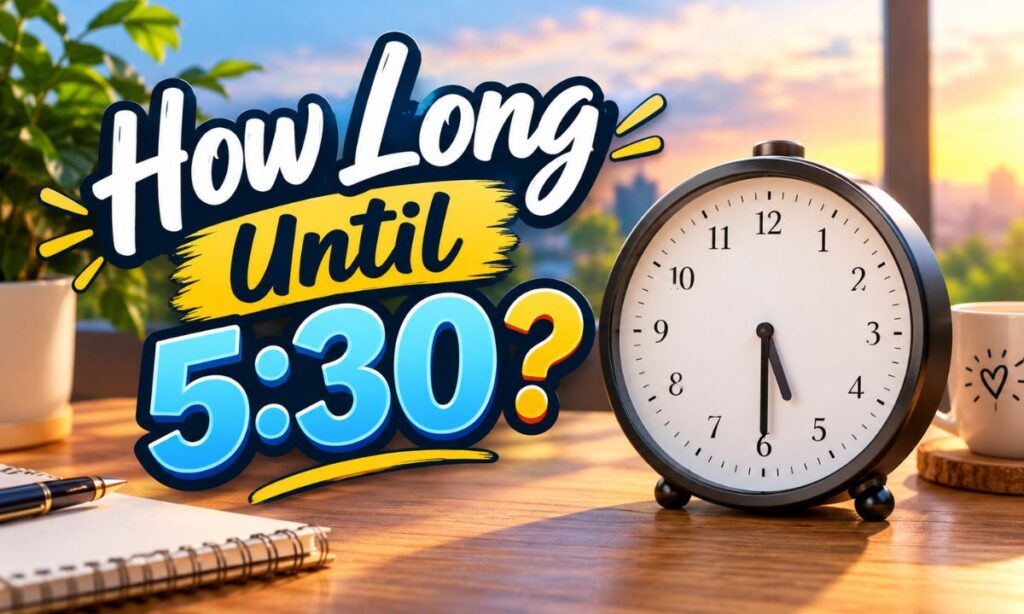
The answer to how long until 5:30 depends on the time it is right now. Subtract your current time from 5:30 and you have the gap. If your clock shows 4:30, you wait exactly one hour.
This guide gives you simple methods, ready made examples, and a few traps to avoid. You will also see how AM, PM, overnight gaps, and daylight saving changes affect the result.
Quick Facts About 5:30
5:30 is half past five, and it appears twice every day, once in the morning and once in the evening.
| Detail | Value |
| Spoken form | Half past five |
| 12 hour clock | 5:30 AM or 5:30 PM |
| 24 hour clock | 05:30 or 17:30 |
| Minutes after midnight | 330 for AM, 1,050 for PM |
| Minutes past 5:00 | 30 |
| Quarter hours from 5:00 | 2 |
How Do You Find the Time Left Until 5:30?
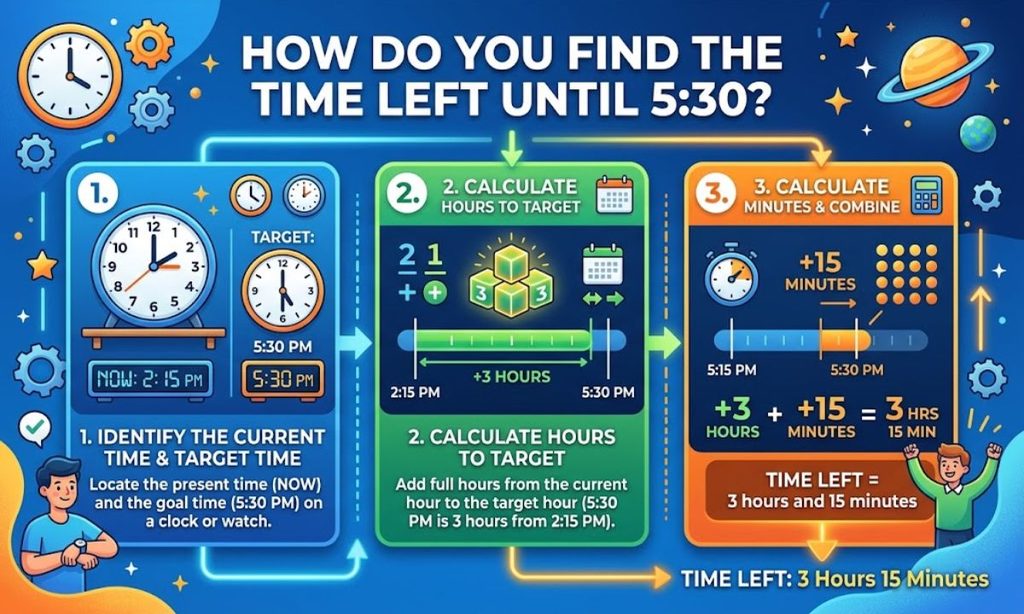
Take 5:30 and subtract the current time, working in hours first and minutes second. The result is your countdown.
Here is the basic routine:
- Read the current time on your clock or phone.
- Decide if you mean 5:30 AM or 5:30 PM.
- Count the full hours between now and 5:30.
- Add or remove minutes until the gap matches.
Say it is 2:10 PM. From 2:10 to 5:10 is three hours, and 5:10 to 5:30 is twenty minutes. The wait is 3 hours and 20 minutes.
Is It 5:30 AM or 5:30 PM?
Choose the next 5:30 that will show up on the clock. If it is morning and before 5:30, the target is likely AM. If it is afternoon, the target is almost always PM.
Context helps. People who say “until 5:30” at noon usually mean the end of the workday. Someone typing the same words at 2 AM probably means an early alarm or a flight.
When two people plan something, say AM or PM out loud. One missing label can cost someone twelve hours.
Method 1: Count to the Next Hour, Then Add 30
This is the fastest mental trick. Count the minutes to the next full hour, count the full hours to 5:00, then add 30.
Try it with 1:45 PM:
- 1:45 to 2:00 is 15 minutes.
- 2:00 to 5:00 is 3 hours.
- 5:00 to 5:30 is 30 minutes.
Total: 3 hours and 45 minutes. You can also join the pieces. Fifteen plus thirty is 45 minutes, so the answer holds.
Method 2: Convert Everything to Minutes
Turn both times into minutes after midnight and subtract. This method is slower but almost impossible to get wrong.
Take 3:20 PM. On a 24 hour clock that is 15:20, which equals 920 minutes. The target 5:30 PM is 17:30, which equals 1,050 minutes.
Now subtract: 1,050 minus 920 is 130 minutes. Divide by 60 and you get 2 hours and 10 minutes. Use this method whenever the numbers feel messy.
Method 3: Borrow an Hour
Borrowing works like subtraction in school. Rewrite 5:30 as 4 hours and 90 minutes, then subtract the current time.
Imagine it is 2:50 PM:
- 5:30 becomes 4 hours and 90 minutes.
- Subtract 2 hours and 50 minutes.
- Hours: 4 minus 2 is 2.
- Minutes: 90 minus 50 is 40.
The countdown is 2 hours and 40 minutes. Borrow only when the current minutes are higher than 30.
Read More: How Long Until 4:30? Simple Ways to Find the Answer
Time Left Until 5:30 PM
This chart covers common starting points. Match your clock to a row and read the wait.
| Current time | Time until 5:30 PM |
| 9:00 AM | 8 hours 30 minutes |
| 10:40 AM | 6 hours 50 minutes |
| 12:00 PM | 5 hours 30 minutes |
| 1:00 PM | 4 hours 30 minutes |
| 2:45 PM | 2 hours 45 minutes |
| 4:00 PM | 1 hour 30 minutes |
| 4:50 PM | 40 minutes |
| 5:15 PM | 15 minutes |
Notice the pattern. Every row ending in :30 gives a clean number of hours, and every row ending in :00 gives a number of hours plus 30 minutes.
Time Left Until 5:30 AM
Overnight gaps work the same way, except the clock crosses midnight. Count to midnight first, then add 5 hours and 30 minutes.
| Current time | Time until 5:30 AM |
| 8:15 PM | 9 hours 15 minutes |
| 10:00 PM | 7 hours 30 minutes |
| 11:45 PM | 5 hours 45 minutes |
| 1:00 AM | 4 hours 30 minutes |
| 3:15 AM | 2 hours 15 minutes |
| 5:00 AM | 30 minutes |
Take 8:15 PM as a worked case. Midnight is 3 hours and 45 minutes away. Add 5 hours and 30 minutes and you reach 9 hours and 15 minutes.
This chart also works as a sleep planner. If you want a full night, count back from your alarm and pick a bedtime that fits.
What If 5:30 Already Passed Today?
When the time is past 5:30, your target moves to the next day. Add 24 hours to 5:30, then subtract the current time.
Suppose it is 6:00 PM and you need the next 5:30 PM. The wait is 23 hours and 30 minutes. If you need the next 5:30 AM instead, the wait is 11 hours and 30 minutes.
Quick check: from 6:00 PM to midnight is 6 hours. From midnight to 5:30 AM is 5 hours and 30 minutes. Together they make 11 hours and 30 minutes.
How Do Daylight Saving and Time Zones Change the Answer?
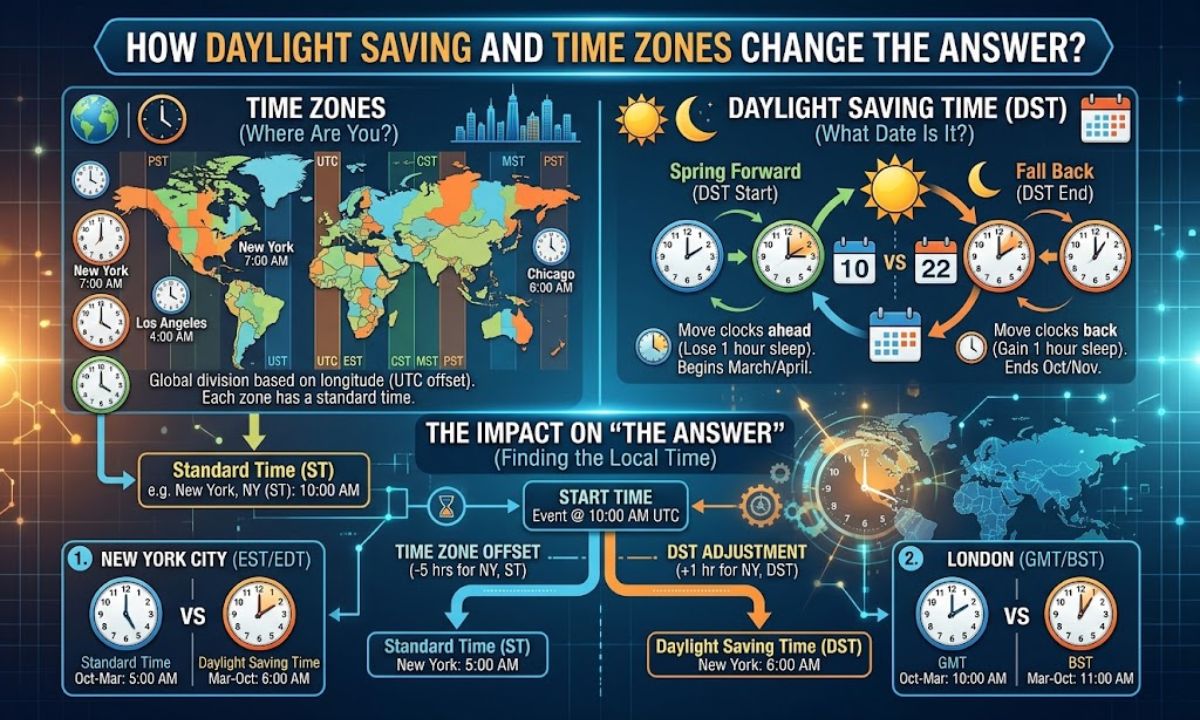
Daylight saving can add or remove one hour from an overnight countdown. Time zones change the answer whenever 5:30 belongs to another place.
On the night clocks move forward, a countdown that crosses the change loses an hour. On the night clocks move back, it gains one. Your phone adjusts itself, but a mental estimate will not.
For calls and travel, confirm whose 5:30 you mean. A meeting at 5:30 in a city three hours ahead of you happens at 2:30 on your clock. Always convert first, then count down.
Why Do People Ask How Long Until 5:30?
The question usually comes from a deadline, a shift end, or a plan with a fixed start. Knowing the gap helps you pace your time.
Common situations include:
- Work shifts: Many offices and shops close around 5:30 PM, so staff track the final stretch.
- School and childcare: Pickup windows often end near that time.
- Early alarms: 5:30 AM suits gym sessions, commutes, and flights.
- Cooking: A dinner planned for 5:30 needs a start time worked backward.
- Events: Doors, webinars, and live streams often begin at half past five.
Each case follows one rule. Find the gap, then split it into smaller blocks you can manage.
Fast Tools for Checking the Countdown
A voice assistant, a timer app, or a simple clock check will give you the answer in seconds. Pick the tool that suits the moment.
- Voice assistant: Ask how long until 5:30 and it replies with the exact gap.
- Timer app: Enter the gap you calculated, then let the phone count it down.
- Alarm clock: Set an alarm for 5:30 so you do not need to watch the clock.
- Calendar reminder: Add an event with a warning 15 minutes early.
Even with tools, the manual method is worth knowing. Batteries die and apps freeze, but the math never does.
Common Mistakes to Avoid
Most errors come from small slips in AM and PM, minutes, or the 60 minute rule. A quick second check catches nearly all of them.
- Mixing up AM and PM: This causes the biggest errors, often by twelve hours.
- Treating 30 minutes as 50: An hour has 60 minutes, so half an hour is 30.
- Forgetting the midnight jump: Overnight gaps need two parts, before and after 12:00.
- Ignoring daylight saving: One lost or gained hour can break a sleep plan.
- Skipping the time zone: Always confirm whose clock the 5:30 belongs to.
A simple habit helps. After you get your answer, add it back to the current time. If you land on 5:30, you are right.
Frequently Asked Questions
How long until 5:30 if it is 4:00 PM?
You wait 1 hour and 30 minutes. Four o’clock to five is one hour, plus 30 minutes.
How many minutes are there until 5:30 from 5:00?
There are exactly 30 minutes. Half an hour separates 5:00 from 5:30.
How do I count the time until 5:30 AM from 10 PM?
You wait 7 hours and 30 minutes. Two hours reach midnight, then 5 hours and 30 minutes more.
What is 5:30 PM in 24 hour time?
It is 17:30. Add 12 to the hour for any PM time after noon.
Can I get an exact countdown without doing math?
Yes. Ask a voice assistant or set a timer and alarm for 5:30 on your phone.
Conclusion
Working out how long until 5:30 takes only a few seconds once you know the steps. Read the current time, pick AM or PM, count to the next hour, and add the remaining minutes.
Keep the charts handy for quick checks and use the minute method for tricky cases. Watch for midnight, daylight saving, and time zones, and your answer will be right every time.