If you’ve ever typed “it’s called” and then second-guessed yourself — or written “it called” and wondered if that’s even correct — you’re not alone. These three phrases look nearly identical, yet they carry different grammatical functions, meanings, and levels of formality. One missing apostrophe can flip a sentence from perfectly clear to completely confusing.
This guide breaks down every variation: what is it called, what’s it called, it’s called, and it called — with real examples, side-by-side comparisons, and a memory trick that makes the rule stick instantly.
What Does “What Is It Called” Mean?
“What is it called?” is a question used to ask for the name of something you don’t know or can’t remember. It follows English’s standard passive-voice structure for naming things.
Structure: What + is + it + called?
Examples:
- “This fruit is orange and sweet — what is it called?”
- “There’s a word for that feeling — what is it called?”
- “I saw a device at the store that folds. What is it called?”
This is the grammatically complete, formal version. The auxiliary verb “is” is essential here. Without it — if you ask “What it called?” — the sentence becomes grammatically broken in standard English.
Quick note for ESL learners: Many languages ask “How is it called?” when asking for a name. In English, this is incorrect. Always use “What is it called?” — never “How is it called?”
What Does “What’s It Called” Mean?
“What’s it called?” is simply the contracted, conversational version of “What is it called?” The apostrophe replaces the letter i in is.
Full form → Contracted form:
What is it called? → What**’s** it called?
Both are grammatically correct. The difference is purely about tone and register:
| Form | Register | When to Use |
| What is it called? | Formal / Neutral | Academic writing, professional emails, interviews |
| What’s it called? | Informal / Conversational | Everyday speech, casual texts, blogs |
Examples:
- “I know you showed me that app before — what’s it called again?”
- “There’s a name for this phenomenon. What’s it called?”
Both forms ask the exact same question. “What’s it called” just flows more naturally in spoken English.
Understanding word order in questions is a key part of English grammar. For example, knowing when to use direct vs indirect question structure — like in When I Can or When Can I – Which Is Correct? — helps you sound more natural in everyday conversation.
What Does “It’s Called” Mean? Full Form vs Contracted Form
This is the phrase you’ll use most often when naming or identifying something.
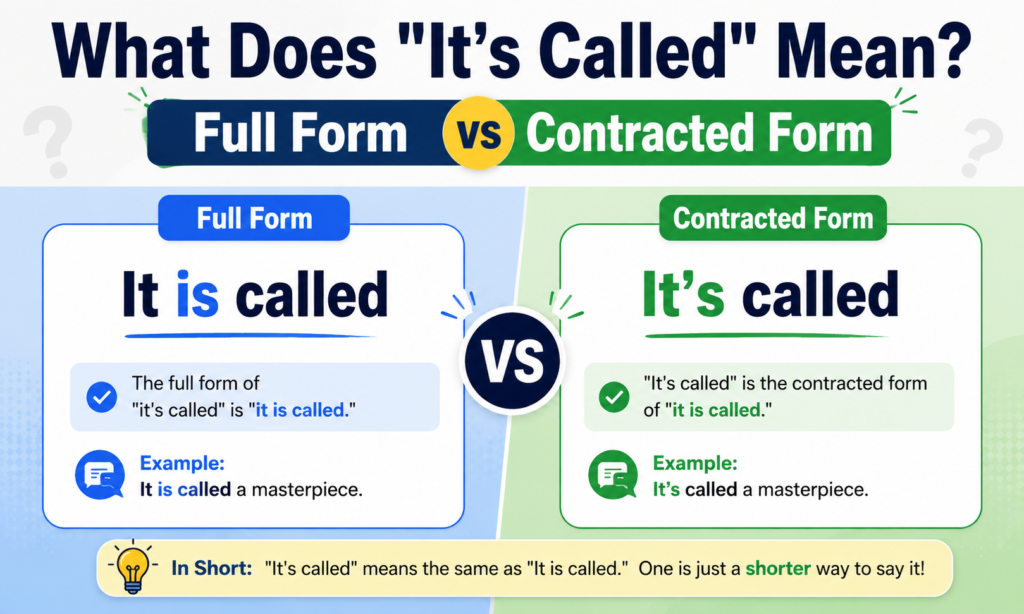
“It’s called” is a contraction of “it is called.” The apostrophe replaces the letter i in is, creating a shortened but grammatically equivalent form.
It’s called = It is called
This phrase uses the passive voice — the subject receives a name rather than performing an action. That’s exactly how English works when identifying or labeling things.
Examples in context:
- “What is that process in plants? It’s called photosynthesis.”
- “That technique you’re describing? It’s called the Pomodoro Method.”
- “This fabric? It’s called cashmere.”
Full Form vs Contracted Form
| Phrase | Meaning | Best For |
| It is called | Full, uncontracted | Academic papers, legal documents, formal reports |
| It’s called | Contracted | Blog posts, emails, conversations, everyday writing |
Both are grammatically correct. According to usage studies of informal English writing, contracted forms like “it’s” appear in over 60% of everyday written communication — making it the dominant form in modern usage.
Pro tip: In formal or academic writing, spell out the full form — “it is called” — to maintain a polished, professional tone. In everything else, “it’s called” sounds completely natural.
What Does “It Called” Mean?
Here’s where most people trip up. “It called” is NOT the same as “it’s called” — and in most situations, it’s simply incorrect when used to name something.
“It called” is the simple past tense of the verb to call. It means that the subject (it) performed the action of calling in the past.
Examples of correct “it called” usage:
- “The alarm went off. It called the emergency line automatically.”
- “The dog heard the whistle. It called to him from across the field.”
- “The notification appeared, then it called the backup server.”
Notice what these examples have in common: the subject “it” is doing the calling. It’s an action, not a label.
When “it called” is WRONG:
| Incorrect | Correct |
| It called photosynthesis. | It’s called photosynthesis. |
| It called a palindrome. | It’s called a palindrome. |
| It called machine learning. | It’s called machine learning. |
Using “it called” to name something strips out the essential verb “is” that makes the sentence grammatically complete. The reader is left wondering — it called what, exactly?
It’s Called vs It Called — Side-by-Side Comparison
| Feature | It’s Called | It Called |
| Full form | It is called | It called (no contraction) |
| Grammatical role | Passive voice (present) | Active voice (past tense) |
| Purpose | Names or identifies something | Describes a past action |
| Frequency in everyday use | Extremely common | Rare in everyday English |
| Example | “It’s called the placebo effect.” | “It called for immediate action.” |
| Without context, is it complete? | Yes — fully clear | Often sounds incomplete |
| Used by ESL learners incorrectly? | Sometimes (missing apostrophe) | Yes — often confused with “it’s called” |
The single apostrophe in it’s makes all the difference. Drop it, and you go from naming something to describing a past action — or worse, producing a grammatically incomplete sentence.
Is It Called / Was It Called — Are These Correct?
Yes — both “is it called” and “was it called” are grammatically correct, but they belong in questions, not statements.
“Is It Called” — Present Tense Question
Used when asking what something is named right now.
- “What is it called when you feel happy for someone else’s success?”
(Answer: It’s called “compersion.”) - “Is it called a theorem or a formula?”
“Was It Called” — Past Tense Question
Used when asking what something was named at a previous point in time.
- “What was it called before they renamed it?”
- “Was it called the same thing in the 19th century?”
| Form | Tense | Purpose |
| Is it called | Present | Asking the current name of something |
| Was it called | Past | Asking the former name of something |
| It’s called | Present | Stating the current name of something |
| It was called | Past | Stating the former name of something |
The Contraction Trap: It’s vs Its
One of the most common errors in English — even among native speakers — is confusing it’s with its. They look nearly identical, but they serve completely different purposes.
It’s = contraction of it is or it has
Its = possessive pronoun showing ownership
| Word | Meaning | Example |
| It’s | It is / It has | It’s called a labyrinth. |
| Its | Belonging to it | The cat licked its paw. |
The quick test: Replace the word with “it is” or “it has.” If the sentence still makes sense, use it’s (with apostrophe). If it doesn’t, use its (no apostrophe).
- “It’s called minimalism.” → “It is called minimalism.” ✅ — Use it’s
- “The dog wagged it’s tail.” → “The dog wagged it is tail.” ❌ — Should be its
Never write “its called” — that’s always wrong. The verb “is” requires the apostrophe in the contraction.
Memory Trick
Struggling to remember which form to use? Try this two-step approach:
Step 1 — The Replacement Test:
Swap “it’s” with “it is.”
If the sentence still makes sense → use it’s called.
If it sounds wrong → you probably need its (possessive) or a different construction.
Step 2 — The Name vs Action Test:
Are you naming something? → Use it’s called (or it is called).
Are you describing something that did the calling in the past? → Use it called.
Visual shortcut:
🏷️ Label/Name something → It’s called
📞 Something made a call in the past → It called
Once you run this check a few times, it becomes automatic.
Frequently Asked Questions
Is “it called” ever correct?
Yes — but only when “it” is actively performing the action of calling in the past tense, such as “The alarm sounded, then it called the fire station.” For naming things, always use “it’s called.”
Is “it’s called” correct in formal writing?
Yes, though many style guides prefer the full form “it is called” in academic papers and legal documents.
Can I use “what’s it called” in professional emails?
Yes — it’s perfectly acceptable in business emails and everyday professional communication.
Is “its called” (without apostrophe) ever correct?
No. “Its called” is always incorrect. The contraction “it is” always requires an apostrophe: “it’s.”
What does “it’s called” mean in grammar?
It is a passive voice construction in the present tense used to identify or name something. The contraction “it’s” stands for “it is.”
How do I remember when to use “it’s” vs “its”?
Replace the word with “it is.” If the sentence still works, use “it’s.” If not, use “its” for possession.
Conclusion
The difference between what is it called, what’s it called, it’s called, and it called may seem small, but it has a real impact on how clearly you communicate.
Here’s the quick summary:
- What is it called? / What’s it called? — Both ask for the name of something. The second is simply more conversational.
- It’s called (= it is called) — The standard, correct way to name or identify something. Use this almost every time.
- It is called — The formal version of the same thing. Best for academic and legal writing.
- It called — A past tense action phrase. Use only when “it” literally performed the act of calling. Not for naming things.
- Its called — Always wrong. Never use this form.
Mastering these small distinctions builds real confidence in English — whether you’re writing a blog post, a business email, or an academic paper.