
You’ve seen it a thousand times in texts, tweets, and Instagram captions: “I’m soo excited!” or “This is soo good!” But is “soo” actually a real word — or just a typo that slipped through autocorrect? And how is it different from the grammatically correct “so”?
This guide breaks down the difference between so vs soo, when each one belongs in your writing, and why getting it right can shape how people perceive your message — professionally and personally.
“So” – Why It’s Always Correct
“So” is one of the oldest, most versatile words in the English language. It traces back to Old English swa, meaning in this way or to such an extent. Over centuries, it evolved into the multi-functional word we rely on today.
Here’s what makes “so” grammatically powerful — it wears many hats:
As a conjunction (cause and effect):
“He missed the bus, so he was late for work.”
As an adverb (intensifier):
“The food was so delicious!”
As a transition or conclusion marker:
“So, what do we do next?”
According to corpus studies, “so” appears in over 0.3% of all written English texts, making it one of the most frequently used words in the entire language. It works in essays, emails, academic papers, casual conversation, business reports, and everything in between.
The bottom line: “so” is always correct. Whether you’re writing a cover letter or a birthday card, it fits perfectly.
Is “Soo” a Real Word or Just Internet Slang?
Here’s the short answer: “soo” is not a standard English word.
Major dictionaries — including Merriam-Webster, Oxford English Dictionary, and Cambridge Dictionary — do not list “soo” as a valid word with any grammatical function. Grammar tools like Grammarly, Microsoft Word, and Google Docs all flag it as a spelling error.
However, calling it just a typo misses the point entirely.
“Soo” is used deliberately — and that’s what makes it interesting. It emerged from early 2000s internet chat culture, where users began stretching vowels to convey tone and emotion that plain text couldn’t carry. The extra “o” became a kind of emotional amplifier, a visual representation of how someone might stretch a word when they speak.
Think of it this way: if “so” is a steady speaking voice, “soo” is the same voice with genuine feeling behind it.
Where “soo” does legitimately exist:
- Geography: “The Soo” is a real nickname for Sault Ste. Marie, a city in Michigan and Ontario, Canada.
- Names: “Soo” appears as a given name in Korean culture (e.g., Soo Jin, Soo Yeon) and as a surname in several East Asian traditions.
But as a substitute for “so”? No reputable English dictionary recognizes that usage.
The Urban Dictionary Definition
Urban Dictionary — the internet’s unofficial archive of slang — defines “soo” as an exaggerated form of “so”, used for dramatic emphasis or to stretch the emotional weight of a statement.
Examples commonly cited:
- “I’m soo tired of this.”
- “That was soo cute, I literally can’t.”
While Urban Dictionary isn’t a grammar authority, it does reflect how language actually moves through digital culture. Words that start here sometimes work their way into mainstream use — think “selfie,” “LOL,” or “emoji,” which all earned spots in formal dictionaries after years of casual adoption.
Could “soo” follow that path? Linguist Gretchen McCulloch, author of Because Internet, notes that elongated spellings are effectively “the punctuation of digital emotion.” They’re not accidents — they’re a communication system of their own. Whether “soo” crosses into formal recognition remains to be seen, but for now, it lives squarely in the world of internet expression.
So vs. Soo – Key Differences
Here’s a clear side-by-side comparison to help you understand when each form belongs:
| Feature | So | Soo |
| Grammar status | Standard English word | Informal, non-standard |
| Dictionary recognition | Yes (all major dictionaries) | No (informal/slang only) |
| Used in formal writing | ✅ Yes | ❌ No |
| Used in casual texts | ✅ Yes | ✅ Yes |
| Conveys emotion/exaggeration | Neutral | Yes, intentionally |
| Spell-check flagged | Never | Always |
| Appropriate for social media | Yes | Yes |
| Appropriate for business emails | Yes | No |
| Origin | Old English (swa) | Early 2000s internet culture |
The key takeaway: “so” connects ideas; “soo” connects emotions.
The Emotional Impact Difference
This is where things get genuinely interesting.
“So” is grammatically clean and tonally neutral. It conveys precision, logic, and professionalism. When you write “I’m so grateful for this opportunity,” it reads as sincere and composed.
“Soo” does something different. It adds warmth, enthusiasm, and a sense of personality that “so” simply doesn’t carry in digital spaces. When someone texts “I’m soo happy for you!!!”, the double “o” acts like a vocal inflection — it mirrors the way someone might actually stretch the word in speech. It’s expressive in a way that text alone often isn’t.
The same logic applies to other internet elongations: “noooo,” “yaaas,” “heyyy.” None of these are grammatically correct, but all of them communicate something specific about tone that standard spelling can’t quite capture.
So if “soo” is more expressive, why not use it everywhere?
Because context is everything. Emotion belongs in casual spaces. Clarity belongs in professional ones. Using “soo” in a business email doesn’t make you seem more enthusiastic — it makes you seem less credible.
When Context Changes Everything — The Difference Between So vs Soo
The same sentence can land very differently depending on which form you choose:
Formal version: “I am so excited to join the team.” Casual version: “I’m soo excited to join the team!!”
The first belongs in an acceptance email. The second belongs in a text to your best friend.
Here are the scenarios that should guide your choice:
Use “so” when you are:
- Writing essays, academic papers, or reports
- Sending professional emails or business communication
- Publishing a blog, article, or official content
- Communicating in any context where tone should feel neutral or authoritative
“Soo” may work when you are:
- Texting friends or family
- Posting casually on social media
- Writing in a conversational, playful brand voice
- Trying to convey genuine excitement, frustration, or sarcasm informally
A quick self-check: Would you feel embarrassed reading this sentence aloud in a meeting? If yes, drop the “soo.”
When to Use “So” (And When to Avoid “Soo”)
The Credibility Factor
Your word choices signal your credibility before your content even lands. A resume, job application, or professional pitch that includes “soo” will likely raise eyebrows — not because the reader doesn’t understand what you meant, but because it suggests a lack of attention to register and context.
Spellcheck tools like Grammarly, Microsoft Word, and Google Docs all flag “soo” as incorrect. If your document passes through any automated check before reaching a reader, “soo” will be marked as a mistake — regardless of your intent.
Style guides — APA, MLA, and the Chicago Manual of Style — make no accommodation for “soo” as a legitimate variant. In academic and professional writing, there is only one correct choice: so.
When “Soo” Actually Works (Social Media & Casual Texts)
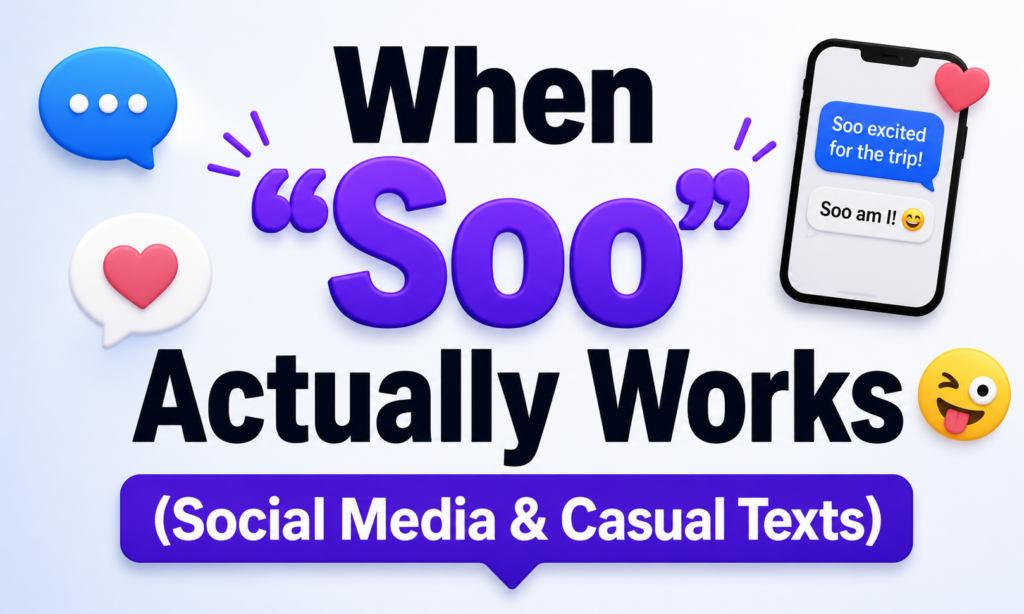
“Soo” genuinely earns its place in informal digital communication. When your audience is friends, followers, or fans — people who expect personality over polish — “soo” adds a human touch that “so” sometimes lacks.
Compare these two captions:
- “I’m so grateful for 10K followers. Thank you all.”
- “I’m soo grateful for 10K followers!! You guys mean everything 🥹”
The second one reads warmer, more personal, and more emotionally alive — which is exactly what social media thrives on. Authenticity beats grammatical perfection when your audience craves connection.
How Brands Use “Soo” Strategically
Some brands have deliberately adopted informal spellings — including “soo” — to create a more relatable, personality-driven voice on social media. Wendy’s Twitter (now X) is a well-known example, often leaning into exaggerated, conversational language to seem witty and approachable.
But there’s a fine line. As one example illustrates: a brand posting “We’re soo grateful for your support!” may read as charming to a young, casual audience — but could feel off to investors, partners, or stakeholders expecting professional communication.
The rule for brands: match the platform, not just the message. Informal language on Instagram Stories is a strategic choice. The same language in a press release is a misstep.
Frequently Asked Questions
Is “soo” a real word?
No. “Soo” is not recognized as a standard English word in any major dictionary — it’s an informal, emotional spelling used in casual digital communication.
Can I use “soo” in an essay or academic paper?
Absolutely not. Always use “so” in any formal, professional, or academic writing.
Why do people write “soo” instead of “so”?
To express exaggerated emotion or enthusiasm — the extra “o” mimics how someone might stretch the word in speech.
Does “soo” change the meaning of a sentence?
It doesn’t change the definition, but it significantly shifts the tone — from neutral to expressive, from formal to casual.
What if autocorrect changes “soo” to “so”?
That’s intentional — spellcheck tools treat “soo” as a typo. If you want “soo” in a casual text, you may need to override autocorrect manually.
Final Thoughts
The debate between so vs. soo comes down to one thing: knowing your audience and respecting the context you’re writing in.
“So” is a grammatical workhorse — versatile, universally accepted, and appropriate everywhere. It has served the English language for centuries, and it will keep doing its job reliably in every piece of formal communication you ever write.
The takeaway is simple:
Use “so” when accuracy and professionalism matter. Use “soo” when personality and emotion matter more.
Master that distinction, and you’ll always know which one fits.