If you’ve ever paused mid-sentence wondering whether to write “by which” or “in which,” you’re not alone. These two phrases are among the most commonly confused prepositional expressions in formal English. They look similar, sound formal, and yet one small preposition separates their meanings entirely.
The good news? Once you understand the logic behind each phrase, you’ll never mix them up again. This guide breaks down the difference between by which and in which, covers the rules with clear examples, lists common expressions, and answers the most frequently asked questions — all in plain English.
“Mastering small but powerful grammar distinctions is a key step in writing better English. If you enjoy learning these kinds of rules, you might also find our guide on When I Can or When Can I – Which Is Correct?“
By Which vs In Which Meaning: What’s the Real Difference?
The core difference comes down to what question each phrase answers.
- “By which” answers How? — It describes a method, means, or process.
- “In which” answers Where? or When? — It describes a location, situation, or context.
Both phrases use the relative pronoun which to introduce a dependent (relative) clause. The preposition — by or in — is what changes the meaning entirely.
A simple way to test which one to use: remove the relative clause and check what preposition fits the main verb naturally.
- “The method ___ we solved it” → “We solved it by a method” → ✅ by which
- “The city ___ the event took place” → “The event took place in the city” → ✅ in which
| Feature | By Which | In Which |
| Answers | How? (method/means) | Where? / When? (location/context) |
| Preposition logic | Verb naturally takes “by” | Verb naturally takes “in” |
| Typical context | Process, mechanism, rule | Place, situation, circumstance |
| Register | Formal/academic | Formal/academic |
| Interchangeable? | ❌ No | ❌ No |
When to Use “By Which” (Rules + Examples)
The Rule
Use “by which” when you are explaining how something is done, achieved, or measured — essentially when you are describing a method, process, mechanism, or means.
The key signal is the verb: if the natural construction uses “by” (e.g., “achieved by,” “measured by,” “caused by,” “judged by”), then the relative clause should use “by which.”
Common Verbs That Pair with “By Which”
- achieve, accomplish
- measure, evaluate, judge
- cause, produce
- operate, function
- identify, determine
- communicate, transfer
Examples of “By Which” in Sentences
- The method by which the scientist extracted the compound was groundbreaking. (How was it extracted? By a method.)
- The standard by which employees are evaluated has been updated. (How are they evaluated? By a standard.)
- No one understood the process by which the new law was passed. (How was it passed? By a process.)
- The mechanism by which the virus spreads is still being studied. (How does it spread? By a mechanism.)
- The principle by which the organization operates is transparency. (How does it operate? By a principle.)
Quick Tip
If you can replace “by which” with “through which” or “how” and the sentence still makes sense, you’ve chosen correctly.
“The method by which she succeeded” = “The method through which she succeeded” ✅
When to Use “In Which” (Rules + Examples)
The Rule
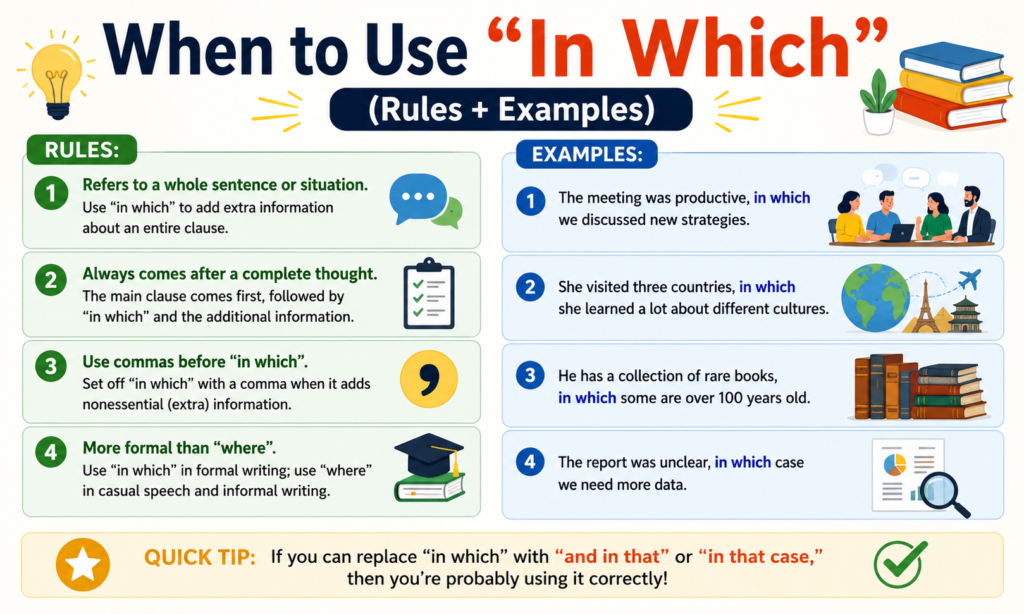
Use “in which” when you are describing a place, situation, time period, or context in which something occurs. It connects a noun to a clause that explains where or when something happens.
The key signal: if the natural verb takes “in” (e.g., “occurred in,” “lived in,” “found in,” “took place in”), the relative clause should use “in which.”
Common Nouns That Pair with “In Which”
- place, location, city, country
- situation, case, circumstance
- period, era, year, decade
- environment, context, setting
- field, area, domain
Examples of “In Which” in Sentences
- The country in which she was born no longer exists. (Where was she born? In the country.)
- That was the era in which modern medicine truly began. (When did it begin? In that era.)
- This is a case in which the exception proves the rule. (Where does the rule apply? In this case.)
- The environment in which children grow up shapes their future. (Where do they grow up? In the environment.)
- The situation in which we found ourselves was completely unexpected. (What was the context? The situation.)
Quick Tip
“In which” can often be replaced by “where” in informal writing without changing the meaning — though “in which” is more precise and appropriate in formal or academic contexts.
“The city in which I grew up” = “The city where I grew up” ✅ (informal)
More Examples: Side-by-Side Comparison
Seeing both phrases together in similar sentences makes the distinction crystal clear.
| Sentence with “By Which” | Sentence with “In Which” |
| The process by which iron rusts involves oxygen. | The container in which the iron was stored had moisture. |
| The formula by which we calculate interest is simple. | The spreadsheet in which we track interest rates is shared. |
| The criteria by which candidates are judged are public. | The panel in which candidates are judged meets on Friday. |
| The strategy by which they won was unexpected. | The region in which they won had historically voted differently. |
| The rule by which we operate is fairness. | The office in which we operate is downtown. |
Common Expressions and Idioms Using “By Which” and “In Which”
Both phrases appear frequently in formal writing, legal documents, academic papers, and professional communication. Here are the most common fixed expressions you’ll encounter.
Expressions with “By Which”
- “The means by which” — refers to the tools or resources used to accomplish something. “The means by which the company gained market share was aggressive pricing.”
- “The method by which” — describes a specific approach or technique. “The method by which data is collected must be transparent.”
- “The way by which” — highlights the manner of doing something (formal). “The way by which disputes are resolved reflects company culture.”
- “The standard by which” — used in evaluation or judgment contexts. “The standard by which all employees are assessed was revised this year.”
- “The process by which” — common in scientific and technical writing. “The process by which cells divide is called mitosis.”
- “The mechanism by which” — describes how something works at a deeper level. “The mechanism by which the drug reduces inflammation is not fully understood.”
Expressions with “In Which”
- “The situation in which” — sets the context or circumstances of an event. “The situation in which she found herself was extraordinarily complex.”
- “The case in which” — common in legal and logical contexts. “This is a case in which a second opinion is strongly advised.”
- “The world in which” — philosophical or literary expression describing a broader context. “The world in which we live demands adaptability.”
- “The way in which” — describes circumstances or style (context-focused, not method). “The way in which he spoke suggested he was deeply troubled.”
- “A society in which” — used in academic and sociological discourse. “We should aim for a society in which equal opportunity exists for all.”
- “The field in which” — common in professional and academic settings. “The field in which she specialized was computational linguistics.”
“Learning grammar one topic at a time makes every study session a day well spent**.”
Common Mistakes to Avoid
Even experienced writers slip up. Here are the most frequent errors — and how to fix them.
❌ Wrong: “The principle in which we operate ensures fairness.” ✅ Correct: “The principle by which we operate ensures fairness.” Why: You operate by a principle, not in a principle.
❌ Wrong: “The book by which I read that story changed my life.” ✅ Correct: “The book in which I read that story changed my life.” Why: A story exists in a book, not by a book.
❌ Wrong: “The regulation in which the government acts.” ✅ Correct: “The regulation by which the government acts.” Why: Actions are governed by regulations, not in them.
Frequently Asked Questions
Can “by which” and “in which” be used interchangeably?
No. They serve different grammatical roles — “by which” indicates method or means, while “in which” indicates location or context.
Can both phrases appear in the same sentence?
Yes, if the sentence has two different clauses requiring different relationships. It’s rare but grammatically valid.
Are these phrases only used in formal writing?
Mostly yes. In casual speech, people prefer simpler constructions like “how” or “where” instead.
Conclusion
Mastering the difference between by which and in which is one of those small grammar wins that makes a big difference in your writing. The rule is straightforward: use “by which” for method and means, use “in which” for location, situation, or context.
The fastest way to decide? Strip back your sentence and ask: “Does my verb naturally take ‘by’ or ‘in’?” That answer tells you everything.Keep this guide bookmarked, practice with the examples above, and your writing will sound more precise, confident, and credible in 2026 and beyond.
Grammarly guide on Where vs. In Which