Do you ever get confused choosing between unregister or deregister? You’re not alone. Most people use them interchangeably — but they’re not the same. The difference is subtle yet important, especially in professional, legal, and technical writing.
Both words involve removing something from a register, but the key distinction lies in formality, context, and who performs the action. Once you understand that, choosing the right word becomes second nature.
What Does Unregister Mean?
Unregister means to remove yourself or something from a list, system, or digital platform — typically through a simple, user-directed action. The prefix un- signals a reversal of something you did yourself, much like “undo” or “unsubscribe.”
Like many confusing word pairs in English — such as Inpatient or Impatient — the words unregister and deregister look nearly identical but serve very different purposes depending on context.
It is most common in technology, software, and everyday digital contexts. When you cancel your spot in a webinar, remove a plugin from a system, or delete your account from an app, you are unregistering.
Key characteristics of unregister:
- Informal and user-driven
- Common in tech, apps, and online platforms
- Usually quick — a click or a settings change
- Reversible in most cases
- No official paperwork required
Example sentences:
- “Click here to unregister your device from this account.”
- “You can unregister from the newsletter at any time.”
- “The developer unregistered the event listener to free up memory.”
What Does Deregister Mean?
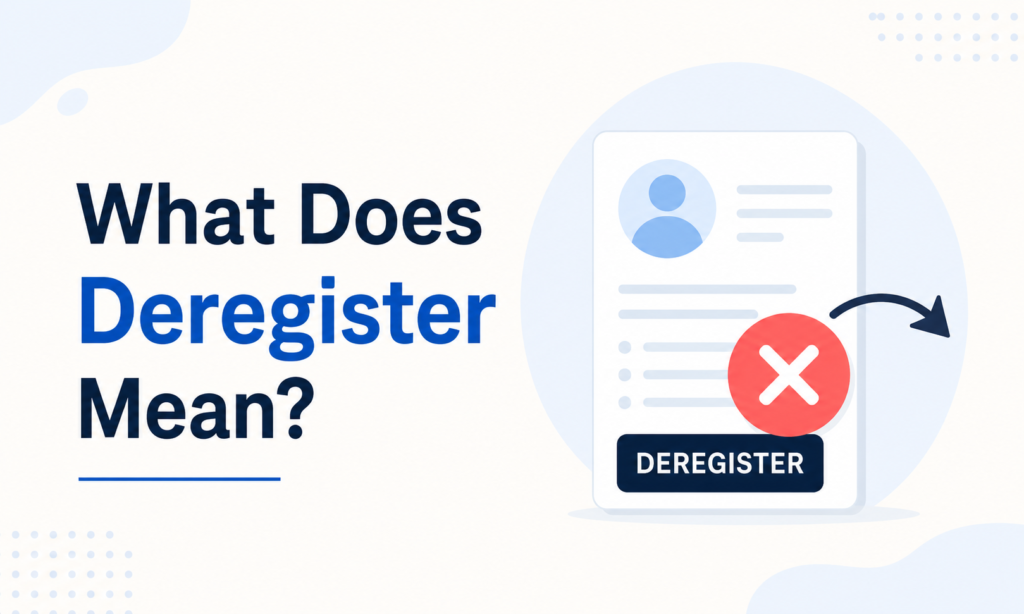
Deregister means to formally remove something from an official registry or record — usually through an authorized, structured process. The prefix de- implies the removal of a previously established state, often with legal or institutional consequences.
This term is more common in British English and appears frequently in legal, governmental, and administrative settings. Deregistering a vehicle, closing a company with tax authorities, or removing a professional license all fall under this category.
Key characteristics of deregister:
- Formal, official, and often legally binding
- Common in law, government, business, and healthcare
- Requires documentation, forms, or official approval
- Often permanent or long-term in effect
- May involve compliance obligations
Example sentences:
- “The business was deregistered after failing to submit annual reports.”
- “You must deregister your vehicle before exporting it.”
- “The doctor deregistered from the medical council upon retirement.”
Unregister vs Deregister – Side-by-Side Comparison
| Feature | Unregister | Deregister |
| Tone | Informal | Formal |
| Common context | Apps, software, digital platforms | Legal, business, government |
| Process required | Simple user action | Official forms or procedures |
| Authority | Self-directed | Often institution-directed |
| Reversibility | Usually reversible | Often permanent |
| British English | Less common | Widely preferred |
| American English | Common in tech/consumer | Used in legal/official docs |
| Example | Unregister from a webinar | Deregister a company with the state |
Unregister or Deregister – Usage Context

The clearest way to choose the right word is to ask yourself one question: Is this a formal, official process or a casual, personal action?
When to Use “Unregister”
Use unregister when the action is personal, digital, and informal:
- Canceling an online account or subscription
- Removing a device from a streaming service
- Dropping out of a webinar or online event
In programming, unregister is practically standard. Developers routinely unregister components, event handlers, and API services as part of system maintenance.
When to Use “Deregister”
Use deregister when the action carries legal weight or requires official approval:
- Closing a business with a government authority (e.g., Companies House in the UK)
- Removing a vehicle from state records at the DMV
- Deregistering firearms or other regulated assets
Using unregister in these formal situations can make your communication seem casual or legally imprecise — and in some contexts, it can actually create confusion about whether a proper official process was followed.
A Quick Decision Rule
Informal action + digital platform = unregister
Formal process + official record = deregister
The Prefix Difference: “Un-” vs “De-“
Understanding the prefixes helps lock in the distinction for good.
- Un- means to reverse a personal action. Think: unlock, undo, unsubscribe. It implies you’re stepping back from something you chose to do.
- De- means to systematically remove or reverse a state. Think: deactivate, decommission, devalue. It implies a more structured, often externally managed process.
That is why deregister feels more authoritative — because the prefix itself carries that weight.
Real-World Examples by Industry
Technology: A user unregisters their old phone from a cloud account before selling it. A developer unregisters a webhook from an API to stop receiving data.
Business & Legal: A sole proprietorship is deregistered with the state after the owner retires. An LLC deregisters from the VAT system after ceasing taxable activities.
Education: A student unregisters from a single elective course mid-semester. A student who drops out entirely is deregistered from the university’s official enrollment records.
Conclusion
Unregister or deregister are not always interchangeable — and the difference matters more than most people realize. Use unregister for informal, everyday digital actions where no official process is involved. Use deregister when the removal is formal, regulated, or tied to legal consequences.
Matching the right word to the right context makes your writing clearer, more professional, and more trustworthy — whether you’re drafting a user interface, writing a compliance policy, or filling out official paperwork.