
If you’ve ever typed “inpatient” when you meant “impatient” — or vice versa — you’re not alone. These two words look nearly identical, sound almost the same, and both trace back to the root word patient. Yet they mean completely different things. One describes a feeling; the other describes a medical status. Mix them up in a document or medical form, and the error can cause real confusion.
This guide breaks down the difference between inpatient or impatient with clear definitions, pronunciation help, real-world examples, and an easy memory trick so you never mix them up again.
Quick Overview
| Feature | Impatient | Inpatient |
| Meaning | Feeling restless or frustrated | A patient staying in a hospital |
| Word type | Adjective | Noun or adjective |
| Context | Everyday emotions | Medical / healthcare |
| Prefix | im- (means “not”) | in- (means “inside”) |
| Opposite | Patient (calm) | Outpatient |
| Example | She grew impatient in traffic. | He was admitted as an inpatient. |
What Does “Impatient” Mean? (Definition, Usage & Examples)
Definition and Pronunciation
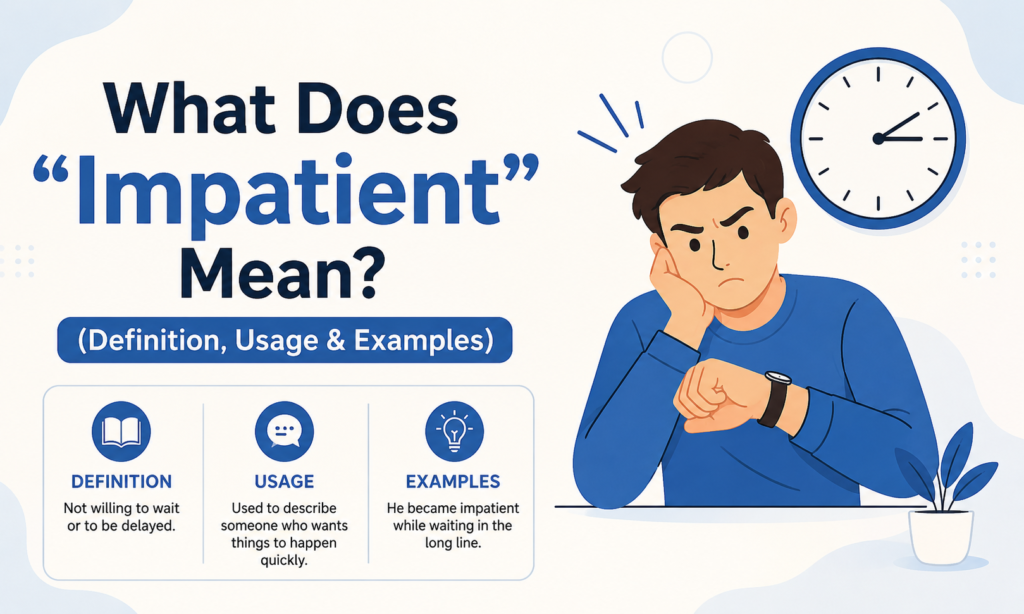
Impatient is an adjective that describes someone who cannot wait calmly, feels frustrated by delays, or becomes easily annoyed when things move too slowly.
- Pronunciation: /ɪmˈpeɪʃənt/ — stress falls on the second syllable: im-PAY-shent
- Root: Latin impatiens — “im” (not) + “pati” (to endure)
- Noun form: impatience
- Adverb form: impatiently
The prefix “im-“ is a standard English negative prefix, the same one you see in impossible, impolite, and imperfect. So impatient literally means “not patient” — unable to endure waiting.
When to Use “Impatient” in Sentences
Use impatient whenever you’re describing a feeling, emotion, behavior, or personality trait — never for anything medical.
Common sentence patterns:
- “She is impatient with slow service.” (dealing with someone)
- “He is impatient for the results.” (waiting for something)
Examples:
- The children grew impatient after waiting an hour for the parade to start.
- She was so impatient that she refreshed the page five times in a minute.
- His impatient tone made the meeting feel tense.
- I get impatient in long checkout lines.
- Don’t be impatient; good things take time.
Golden Rule: If the sentence is about a feeling, a mood, or a personality trait — always use impatient.
What Does “Inpatient” Mean? (Medical Definition & Context)
Definition and Pronunciation
Inpatient is a medical term referring to a person who has been formally admitted to a hospital or healthcare facility and stays there — typically overnight or longer — to receive treatment, monitoring, or surgery.
- Pronunciation: /ˈɪnˌpeɪʃənt/ — stress falls on the first syllable: IN-pay-shent
- Root: “in” (inside/within) + “patient” (a person receiving care)
- Word type: Noun or adjective
- Opposite: Outpatient (someone who receives care without staying overnight)
The prefix “in-“ here does not mean “not.” It means inside — specifically, inside the hospital. This is the number-one source of confusion with this word pair.
According to the American Hospital Association, more than 36 million inpatient admissions occur in U.S. hospitals each year, making this term a critical part of healthcare communication.
When to Use “Inpatient” in Medical Context
Use inpatient care in healthcare, insurance, and medical documentation whenever someone is admitted and stays inside a facility for care.
Examples:
- After her surgery, she stayed as an inpatient for three days.
- The hospital’s inpatient ward has 80 beds.
- Insurance typically covers inpatient psychiatric treatment.
Golden Rule: If the sentence involves a hospital stay, medical admission, or healthcare facility — always use inpatient.
Inpatient or Impatient – Side-by-Side Comparison
Key Differences at a Glance
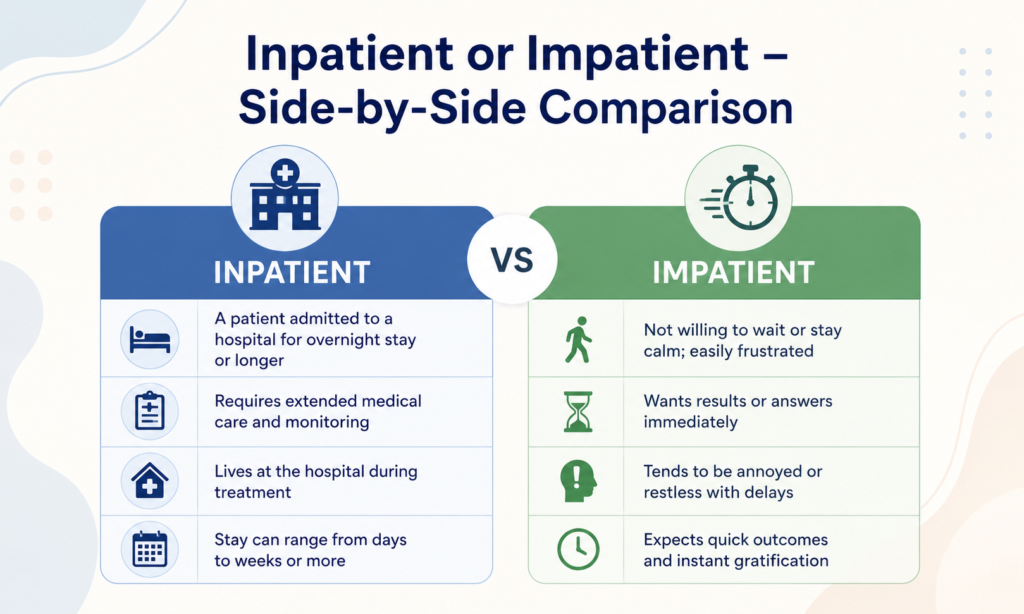
| Category | Impatient | Inpatient |
| Definition | Not able to wait calmly; frustrated | A patient admitted to a hospital for care |
| Prefix meaning | im- = not | in- = inside |
| Part of speech | Adjective only | Noun or adjective |
| Domain | Everyday language | Medical / clinical |
| Pronunciation stress | Second syllable (im-PAY-shent) | First syllable (IN-pay-shent) |
| Antonym | Patient (calm, composed) | Outpatient |
| Common mistake | Using “inpatient” to describe emotion | Using “impatient” in medical records |
Examples of Impatient vs. Inpatient in Sentences
These side-by-side examples show exactly how each word works in real context:
| Situation | Correct Word | Example Sentence |
| Waiting at a doctor’s office | Impatient | She was impatient waiting for her appointment. |
| Admitted after surgery | Inpatient | She was admitted as an inpatient after surgery. |
| Frustrated in traffic | Impatient | He grew impatient stuck on the highway. |
| Staying for rehabilitation | Inpatient | He completed inpatient rehab for two weeks. |
| Child wanting dessert | Impatient | The kids were impatient for dessert. |
| Hospital ward description | Inpatient | The inpatient unit has 24-hour nursing care. |
The fun twist: Both words can appear in the same sentence — and both would be correct.
“The inpatient felt impatient waiting for the nurse to arrive.”
Here, the person is in the hospital (inpatient) and also feeling frustrated (impatient). Both usages are perfectly accurate.
Memory Trick: Never Confuse Them Again
Here’s a simple mnemonic that works every time:
- IMpatient → Think: “I’M annoyed right now.” (It’s about how you feel.)
- INpatient → Think: “IN the hospital.” (It’s about where you are.)
Another quick test: substitute a synonym.
- Can you replace the word with “frustrated” or “restless”? → Use impatient.
- Can you replace the word with “hospitalized”? → Use inpatient.
Common Mistakes to Avoid
- ❌ “The doctor treated the impatient.” → Should be inpatient (medical context)
- ❌ “She felt inpatient during the delay.” → Should be impatient (emotional context)
- ❌ “He was admitted to impatient care.” → Should be inpatient (hospital admission)
- ❌ “The inpatient crowd grew loud.” → Should be impatient (describes a group’s mood)
Note: Spellcheck will not catch these errors. Both words are spelled correctly — the issue is context. Always re-read your sentence to confirm you’ve used the right one.
Conclusion
The difference between inpatient or impatient comes down to one thing: context.
- Feeling frustrated or restless? → Impatient
- Admitted to a hospital for care? → Inpatient
The single-letter swap — m versus n — completely changes the word’s meaning, tone, and domain. In medical writing, using the wrong one can cause genuine confusion. In everyday writing, the error can make you seem careless.
Remember: IM = I’M annoyed. IN = IN the hospital. Apply that rule, and you’ll always pick the right word.