You’ve probably come across the phrase thumb in or thumb out somewhere — maybe in a boxing tutorial, a TikTok video, a Reddit thread, or even a casual conversation about making a fist. It sounds like a simple question, but the answer has real consequences depending on the context. In sports and self-defense, getting it wrong can mean a broken thumb. In body language and social situations, it can affect how confident and open you appear. The phrase carries more weight than most people realize.
This guide covers everything you need to know about thumb in or thumb out: the meaning, the safe fist position, what the trend is about on social media, and what coaches, athletes, and safety experts consistently teach. Whether you’re a beginner stepping into a gym or someone who just stumbled across the debate online, you’ll leave with clear, practical answers.
Thumb In or Thumb Out: Quick Answer
When making a fist — especially for punching, striking, or any combat training — always keep your thumb out. Place it along the outside of your curled fingers, not tucked underneath them. A thumb tucked inside a closed fist is one of the most common causes of hand injuries in boxing and martial arts. The thumb is not designed to absorb impact when compressed under the fingers, and doing so risks sprains, fractures, and joint damage.
What Does Thumb In or Thumb Out Mean?
According to Merriam-Webster, a thumb is the short, thick first digit of the human hand, set apart from the other four fingers. When people say thumb in or thumb out, they’re describing the physical placement of that digit — either tucked inside the hand (thumb in) or resting along the outside (thumb out).
The phrase thumb in or thumb out operates across several contexts:
- Physical/sports context: Where exactly should the thumb sit when forming a closed fist?
- Body language context: Does the visibility of the thumb signal confidence or tension?
- Social media context: A humorous and sometimes suggestive trend on TikTok and Reddit
Understanding which meaning applies depends entirely on the situation, and that context shapes everything.
Thumb In or Thumb Out Meaning on TikTok, Memes, and Social Media
The phrase thumb in or thumb out blew up on TikTok through a wave of street interview videos and comedic challenges. Creators asked people on the street the question — often with deliberately vague wording — and filmed their confused or funny responses. The intentional ambiguity of the question is a big part of the humor.
On TikTok and related meme culture, thumb in or thumb out can carry a few different meanings:
- A playful relationship preference question (used in street interviews about intimacy)
- A bowling technique debate (thumb in the hole or not)
- A dance and body language trend where thumb position signals personality or style
- A broad joke format where the “correct answer” shifts depending on who’s asking
The trend thrives because the phrase sounds innocent in one context and loaded in another. That double meaning keeps it circulating on social media far longer than most one-note trends.
What Does “Thumb In” Mean?
Thumb in means the thumb is positioned inward — tucked inside the palm, hidden under the curled fingers, or pressed close to the body during a physical motion. In casual or figurative speech, it can suggest restraint, caution, or disapproval (the opposite of a thumbs-up).
In dance content on TikTok, thumb in specifically refers to wrapping the fingers around a partner’s thumb, keeping it hidden from view. In body language discussions, a person whose thumbs are hidden or tucked often appears more closed off or uncertain.
What Does “Thumb Out” Mean?
Thumb out means the thumb is extended outward, visible along the side of the fingers or pointing away from the body. In the hitchhiking gesture, the thumb out is a universal signal for requesting a ride. In approval contexts, it resembles a thumbs-up and signals positivity or engagement.
In body language, keeping the thumb visible and extended often reads as confidence, openness, and assertiveness — someone who feels in control of a situation.
Thumb In or Thumb Out When Making a Fist?
This is where the question gets serious. When forming a fist for any physical purpose — punching, sparring, or self-defense — the answer is clear:
Thumb out. Always.
The correct fist formation is:
- Curl all four fingers tightly into the palm
- Rest the thumb along the outside of the index and middle fingers
- Keep the thumb pressed firmly — not dangling, not pointing outward like a hitchhiker
- Align the knuckles so the top row (index and middle) leads contact
This position protects the thumb, stabilizes the wrist, and distributes force correctly through the knuckles.
Thumb Inside Fist Meaning: Why It Can Be Risky
When someone keeps the thumb inside the fist (tucked beneath the fingers), the thumb is directly in the path of any incoming force. On impact, the other fingers drive down onto the trapped thumb, creating compression and torque that the joint was never designed to handle.
This is a well-documented injury pattern. Doctors frequently see thumb fractures and dislocations from exactly this mechanism — mostly in beginner fighters, people who punch walls in frustration, or untrained individuals in altercations. The injury is so common it even has a clinical nickname: “skier’s thumb” or “gamekeeper’s thumb,” which refers to a torn ulnar collateral ligament from hyperextension — a near-inevitable outcome when a tucked thumb meets hard impact.
Thumb In vs Thumb Out: Safety Comparison
| Factor | Thumb In (Inside Fist) | Thumb Out (Outside Fist) |
| Injury Risk | Very high — thumb exposed to compression | Low — thumb protected along the side |
| Wrist Stability | Reduced | Strong and aligned |
| Force Transfer | Inconsistent, poorly directed | Clean through the knuckles |
| Used by Professionals | Never | Always |
| Recommended For Beginners | No | Yes |
| Pain Risk on Impact | High | Low |
Common Thumb Placement Mistakes When Making a Fist
Even people who train regularly can fall into bad habits. Here are the most frequent errors:
Mistake 1: Tucking the Thumb Under the Fingers This is the most dangerous mistake. The thumb becomes a pressure point during any strike and absorbs force it was never meant to handle.
Mistake 2: Letting the Thumb Stick Out Like a Hitchhiker The thumb should rest along the fingers, not point outward at a right angle. A sticking-out thumb still catches impact and can be grabbed or bent backward.
Mistake 3: Forming a Loose Fist A weak, partially closed fist allows the fingers and thumb to shift on contact, increasing the risk of sprains and misalignment.
Mistake 4: Misaligned Knuckles If the knuckles are not flat and forward-facing, force doesn’t transfer cleanly — and the thumb and wrist absorb the misaligned energy.
Proper Thumb Placement for a Safer Closed Fist
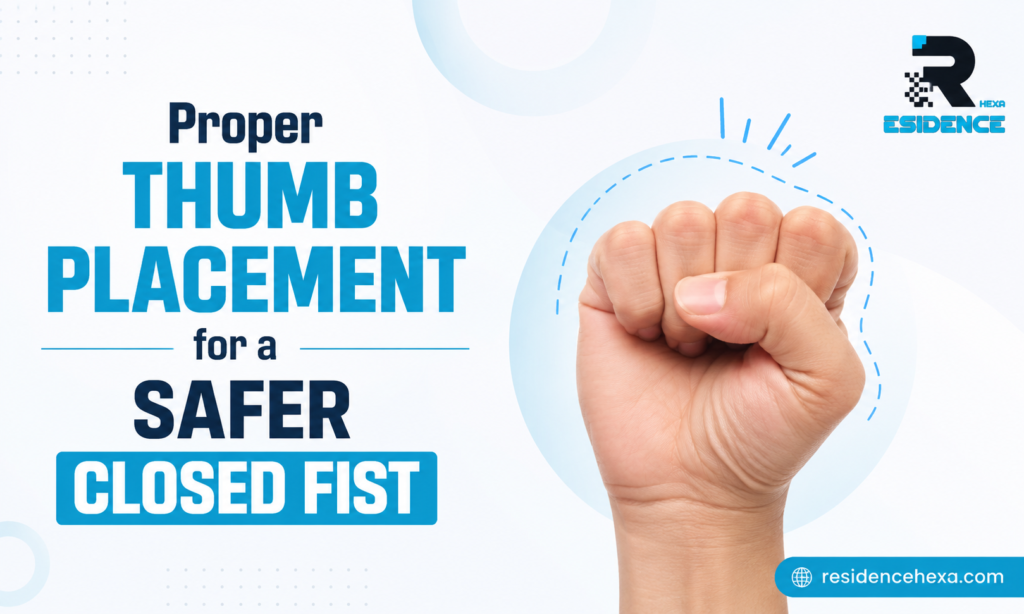
Here’s the step-by-step process coaches teach beginners on day one:
- Open your hand completely, fingers extended and relaxed
- Curl your fingers tightly toward the base of your palm — not the fingertips, the base
- Close firmly so all four fingers press evenly against the palm
- Place your thumb across the front of the index and middle fingers — not underneath, not to the side
- Apply light pressure with the thumb to lock the structure
- Check alignment — knuckles should form a flat, even surface
Practice this slowly in a mirror before ever throwing a punch. Muscle memory is built through repetition, and the correct shape needs to become automatic.
Why Keeping the Thumb Inside the Fist Can Cause Injury
The human thumb contains two bones (phalanges) and one metacarpal bone, connected by a relatively small and mobile joint. It is built for gripping, pinching, and fine motor control — not for absorbing blunt force from the inside of a compressed fist.
When the thumb is trapped inside and impact occurs, several things happen almost simultaneously:
- The flexor tendons of the other four fingers drive downward, directly onto the thumb
- The thumb joint bends in a direction it cannot safely accommodate
- Ligaments on the inner side of the thumb (ulnar collateral) stretch or tear
- In severe cases, the small bones of the thumb fracture
None of this requires a particularly hard hit. Even moderate impact on a poorly formed fist can cause this injury, which is why boxing trainers and self-defense instructors treat thumb placement as a fundamental, non-negotiable teaching point.
Thumb In or Thumb Out in Boxing, MMA, and Martial Arts
Every organized combat sport and martial arts system teaches the same rule: thumb out, wrapped firmly along the outside of the fingers. This isn’t tradition for its own sake — it’s biomechanical necessity.
In boxing, hand wraps reinforce the thumb position, and gloves are designed to encourage proper fist formation. Fighters who tuck their thumb — even with gloves — risk injury on heavy bag work, where repeated impact creates cumulative stress.
In MMA, the open-fingered gloves provide far less protection, making thumb placement even more critical. MMA fighters must also be vigilant because their hands are exposed during clinch work and grappling, where a tucked thumb can be leveraged or accidentally bent.
In traditional martial arts (karate, taekwondo, kung fu), instructors spend significant time on proper fist formation in the earliest stages of training — often before students even throw their first punch.
What Coaches and Safety Experts Commonly Teach
Experienced coaches frame thumb in or thumb out as a safety non-negotiable, not a stylistic preference. The consistent teaching points across disciplines are:
- Thumb out, period. There is no debate at the professional level.
- Check the position before every session until it becomes automatic
- Use hand wraps for additional support during bag and pad work
- Shadow-box slowly to build the correct muscle memory before adding power
- Correct the mistake immediately — bad habits in fist formation compound over time
The phrase that makes the rounds in many gyms captures it simply: “Thumb in, thumb gone.”
Body Mechanics: Why Thumb-Out Placement Is More Stable

From a pure biomechanics standpoint, the thumb-out position creates a closed kinetic chain that stabilizes the entire hand structure. When the thumb wraps along the outside of the curled fingers, it acts as a lateral brace, preventing the fingers from splaying outward on impact and keeping the wrist in alignment.
Think of it like the keystone in an arch — a single structural element that holds everything else in place. Without it correctly positioned, the arch (your fist) collapses under load. This is the same principle that makes proper grip form essential in weightlifting, rock climbing, and any sport requiring hand strength under pressure.
Just as choosing the right phrase matters in everyday communication — similar to understanding the nuances covered in Yea or Nay: Meaning, Differences, Usage, and Examples — choosing the right thumb position is about picking what is structurally correct, not just what feels familiar.
Thumb Position During Workouts and Weightlifting
The thumb in or thumb out question also shows up in gym training — specifically in how you grip a barbell or pull-up bar.
There are two common grip styles in weightlifting:
- Thumbless grip (false grip / thumb in): Thumb rests on the same side as the fingers, not wrapped around the bar. Some powerlifters use this to improve wrist alignment during bench press, but it carries a risk of the bar rolling off the palm.
- Conventional grip (thumb out / wrapped): Thumb wraps fully around the bar. Safer for most exercises, especially overhead lifts and pull-ups where the thumb-out grip prevents the bar from slipping.
For beginners and general fitness, the thumb-wrapped (thumb out) grip is always recommended for safety and control.
Thumb Placement in Self-Defense Situations
In a real self-defense scenario, correct fist formation can mean the difference between an effective response and an immediate self-inflicted hand injury. Anyone who has been taught basic self-defense principles will have heard this: form your fist properly before you do anything else.
Under stress, the hands often tighten instinctively — but that doesn’t mean correctly. People under adrenaline commonly curl their fingers and clench tightly with the thumb inside, because it feels stronger. It isn’t. Practicing the correct form in low-pressure environments is the only way to ensure the right position becomes automatic when it matters most.
Thumb Position in Daily Activities
Beyond sports and fighting, thumb position matters in more everyday contexts than most people notice:
- Carrying bags: A thumb-out grip on handles distributes weight more evenly across the hand
- Opening jars: The thumb needs to be properly anchored outside the palm for torque
- Push-ups: Keeping the thumb in a natural position (neither tightly tucked nor splayed) prevents wrist strain
- Typing and writing: Excessive thumb tension can contribute to repetitive strain injuries over time
Small adjustments in thumb placement during daily activities can meaningfully reduce joint stress over months and years.
Thumb In or Thumb Out: Myths vs Facts
| Myth | Fact |
| Thumb inside creates a stronger fist | It creates a more dangerous fist |
| Real fighters tuck their thumbs | No professional combat system teaches this |
| Thumb position doesn’t matter if your technique is good | Technique and thumb position work together |
| Movies show thumb-in, so it must work | Film choreography isn’t biomechanically accurate |
| Gloves make thumb position irrelevant | Gloves reduce — but don’t eliminate — the risk |
Are There Times When Thumb In Is Acceptable?
Yes — but not for punching or striking. There are specific situations where a thumb-in position is either neutral or appropriate:
- Casual gestures and body language: Keeping thumbs slightly tucked is normal in relaxed, everyday posture
- Certain weightlifting grips: Experienced lifters sometimes use a thumbless grip intentionally for wrist angles in bench press — with the understanding of the added risk
- Dance and performance: Thumb placement in choreography is a stylistic choice, not a safety issue
- Bowling: Some bowlers use a thumb-in-the-hole grip (literal), which is the standard technique for that sport
The key distinction is impact. Any context involving striking force means thumb out is mandatory. Everything else is context-dependent.
Practical Safety Tips for Thumb Placement
- Always practice fist formation before hitting anything, including bags and pads
- Use hand wraps during training to reinforce the correct thumb position
- If your thumb hurts after training, stop — pain is a signal that thumb placement or technique needs correcting
- Ask a qualified coach to check your fist formation early; bad habits are far easier to prevent than to fix
- Build the correct grip into shadowboxing so it transfers automatically to contact work
Thumb In or Thumb Out on Reddit, TikTok, and Online Discussions
On Reddit, the thumb in or thumb out debate shows up most often in martial arts and boxing subreddits, where the consensus is unanimous: thumb out for any striking activity. In r/amateur boxing and r/martialarts threads, experienced practitioners consistently correct beginners who mention thumb-in habits.
On TikTok, the conversation is a mix of genuine technique advice and humorous street interview content. Many creators use the phrase’s deliberate ambiguity to generate reactions, while others — particularly those in fitness and combat sports communities — use it to spread accurate technique guidance.
The phrase’s versatility is what keeps it trending. It works as a safety lesson, a body language discussion, a comedic premise, and a social experiment all at once.
Why Is Thumb In or Thumb Out Funny? Meme Context Explained
The humor in the thumb in or thumb out meme format comes from two things:
- Deliberate ambiguity: The phrase sounds completely innocent when describing fist formation but can carry a very different implication depending on tone and context. Street interviewers exploit this gap perfectly.
- Unexpected reactions: People answering the question confidently, without realizing the question might not be about what they think, creates the comedic moment.
The format is a classic example of how a technical phrase — one with a clear, correct answer in a sports context — becomes viral content simply by being stripped of context and delivered with a straight face.
Thumb In or Thumb Out Videos: What to Look for Safely
If you’re watching technique videos on the thumb in or thumb out question, here’s what to prioritize:
- Look for certified instructors — boxing coaches, martial arts sensei, or certified personal trainers
- Avoid videos that show the thumb tucked under the fingers as a technique — this is always incorrect for striking
- Check for slow-motion fist formation demonstrations, which make the thumb position easy to see
- Cross-reference with multiple sources — the correct position is consistent across all reputable combat sports instruction
Understanding proper form requires more than one video; the best approach is in-person instruction with direct feedback on your own hand position.
Conclusion
The thumb in or thumb out question has a different answer depending on where you encounter it — but in the most important context, the one involving physical safety, the answer is always the same: thumb out. Keeping the thumb along the outside of a closed fist isn’t a preference or a style point. It’s a structural necessity backed by biomechanics, confirmed by every professional combat sports system, and enforced by coaches who have seen what happens when it’s ignored.
Understanding these kinds of nuanced phrase-and-position choices — where the right answer depends on context — is something that comes up in English and communication too. For a similar analysis of two phrases where context determines the correct choice, check out When I Can or When Can I — Which Is Correct? on Residence Hexa for a clear breakdown.
Know your context. Protect your thumb. And if someone asks you thumb in or thumb out out of nowhere, now you know exactly what they might be asking — and what the right answer is in every case.