
If you’ve ever paused mid-sentence and typed “seemless,” only to second-guess yourself, you’re in good company. The confusion between seamless vs seemless shows up in professional emails, blog posts, UX copy, and social media captions every single day. It’s one of those spelling traps where the wrong version feels completely natural because of how the word sounds when spoken aloud.
Here’s the truth you need to hear right now: only one of these spellings is real. In this guide, you’ll get the clear, definitive answer on seamless vs seemless, understand exactly why the mistake happens, and learn practical tools to avoid it in every piece of writing you produce in 2026 and beyond. No fluff — just the facts, examples, and memory tricks that actually stick.
Seamless vs Seemless: Quick Comparison
| Feature | Seamless | Seemless |
| Correct spelling? | ✅ Yes | ❌ No |
| Found in dictionaries? | ✅ Yes (Merriam-Webster, Oxford, Cambridge) | ❌ No |
| Root word | seam (a joining line in fabric) | seem (to appear or give an impression) |
| Part of speech | Adjective | N/A — not a valid word |
| Adverb form | Seamlessly | N/A |
| Used in formal writing? | ✅ Yes | ❌ Never |
| British vs American English | Same in both | N/A |
The verdict is simple: seamless vs seemless has only one winner. “Seamless” is the correct, dictionary-recognized spelling across all major varieties of English.
What Does “Seamless” Mean?
The word seamless is an adjective built from two parts: seam + less. A seam is the line where two pieces of fabric, material, or surfaces are joined together. Add the suffix -less (meaning “without”), and you get seamless — literally, “without seams.”
In practical use, seamless has both a literal and a figurative meaning:
- Literal: A garment or surface with no visible stitching or join lines. Think of seamless sportswear, stockings, or piping in construction.
- Figurative: Any process, transition, experience, or system that operates smoothly and without visible interruption, friction, or gaps.
The figurative meaning is overwhelmingly more common in modern writing. When someone describes a “seamless user experience,” they mean an interaction so smooth and well-integrated that the user never notices any awkward breaks or technical hiccups.
According to Merriam-Webster, seamless means “having no seams” or “having no awkward transitions, interruptions, or indications of disparity.” That dual definition is precisely why this word appears so frequently across technology, marketing, business, and UX writing.
Common Collocations of Seamless
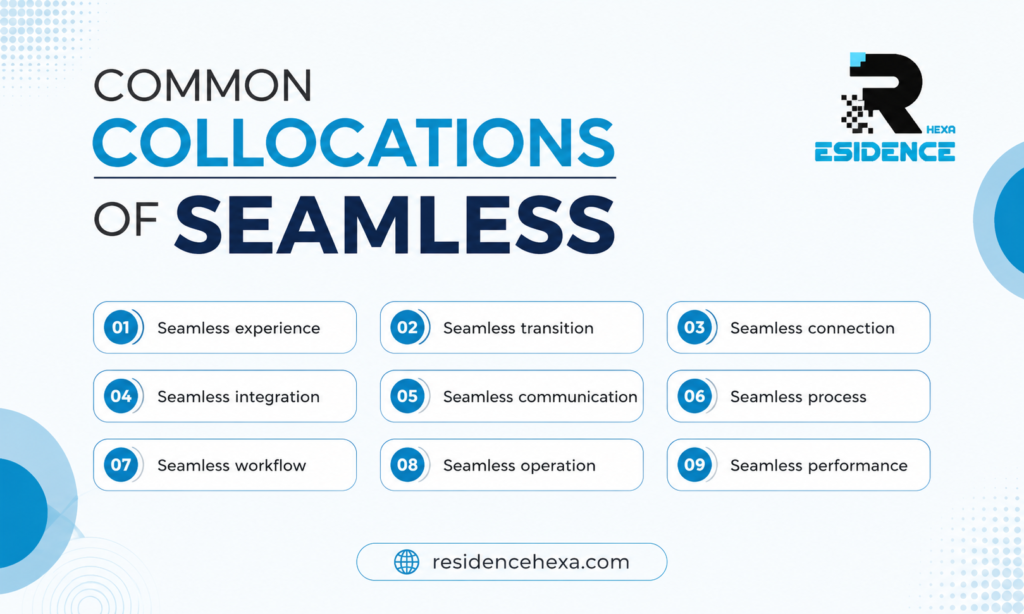
In everyday professional and creative writing, seamless almost always appears alongside certain partner words. These pairings have become standard phrases across industries:
- Seamless integration — used heavily in software, APIs, and business mergers
- Seamless experience — dominant in UX writing, e-commerce, and hospitality
- Seamless transition — common in corporate communication, media, and storytelling
- Seamless communication — appears in HR, project management, and marketing
- Seamless workflow — popular in SaaS product descriptions and B2B writing
- Seamless connectivity — standard in telecom and tech device marketing
Each of these phrases communicates the same core idea: things are working together so smoothly that no friction, gap, or visible join is detectable.
Is “Seemless” a Real Word?
No. Seemless is not a real word in modern standard English. It does not appear in Merriam-Webster, Oxford English Dictionary, Cambridge Dictionary, or any other authoritative reference.
Some historical sources list a very archaic version of “seemless” with the meaning of “unseemly” or “improper,” but that usage disappeared from the English language centuries ago and is entirely irrelevant to modern writing. In 2026, using “seemless” in any context — formal or informal — marks it as a straightforward spelling error.
Why Do So Many People Write “Seemless”?
The confusion in the seamless vs seemless debate stems from a few very human cognitive errors:
- Sound-based spelling: When spoken at a normal conversational pace, “seamless” sounds almost identical to how “seemless” might be pronounced. The brain hears /siːm-lɪs/ and assumes the root must be seem.
- Familiarity with “seem”: The word seem (meaning to appear or give an impression) is extremely common in English. The brain latches onto a word it already knows.
- Autocorrect blind spots: Some word processors don’t always flag “seemless” in casual or informal writing environments, allowing the error to go undetected.
- Typing speed: Fast typists often rely on muscle memory. When the brain fills in “seem-” automatically, the error slips through before proofreading catches it.
The fix is straightforward once you understand the origin: seamless comes from seam, not seem.
Real-World Examples of Seamless in Context
Seeing the correct word in action is the fastest way to cement it in your memory. Below are contextually varied examples across different writing registers:
Technology & UX Writing:
- The latest software update delivers a seamless experience across all connected devices.
- Developers worked for months to achieve seamless integration between the two platforms.
Business Communication:
- The merger created a seamless transition for employees across both companies.
- Our onboarding process ensures seamless communication between new hires and team leads.
Marketing & Copywriting:
- Customers enjoy a seamless checkout experience from browse to buy.
- The brand’s visual identity offers a seamless blend of tradition and modernity.
Academic & Formal Writing:
- The essay moved seamlessly from historical context to contemporary application.
- The research methodology allowed for a seamless flow between qualitative and quantitative phases.
Everyday Conversation:
- The concert setlist flowed seamlessly from ballads to upbeat anthems.
- She handled the handover with seamless efficiency.
In every single one of these examples, substituting “seemless” would be both incorrect and immediately noticeable to any careful reader.
Seamless vs Seemless and Professional Writing
The stakes around the seamless vs seemless error are higher than most writers realize. In professional and digital contexts, a single misspelling carries real consequences:
- Brand credibility: A company whose website reads “We offer seemless integration” instantly loses authority in the eyes of discerning readers and clients.
- SEO performance: Search engines reward content built on accurate, authoritative language. Misspelled keywords disrupt on-page SEO signals and can undermine content quality scores.
- Reader trust: Studies in content marketing consistently show that spelling errors reduce conversion rates and reader trust, even when the reader can’t pinpoint exactly what felt wrong.
- Editing and peer review: In academic and editorial contexts, “seemless” would be flagged immediately as an error, affecting the perceived quality of the entire submission.
If you’re producing content, writing emails, or managing a website, the seamless vs seemless distinction is worth internalizing completely. For related guidance on choosing the right word in formal and professional contexts, the Residence Hexa article on Purposed vs Proposed: Key Differences, Meanings & Examples Explained offers a useful parallel look at how similar-sounding words trip up even experienced writers.
Memory Tricks to Never Misspell Seamless
You only need one trick that actually works — and this is it:
Think of a garment. Visualize a shirt with no visible stitching. No seam = seamless.
Every time you go to type the word, picture that smooth, unstitched fabric. The root is seam — a physical, tangible thing you can see and touch. Because you can picture a seam, you’ll always remember that “seamless” starts with seam, not seem.
A few additional memory anchors:
- Seam + less = seamless. The math is simple. Build it from parts.
- Ask yourself: “Does this word relate to a joining line or a smooth surface?” If yes, it’s seam.
- The “seem” test: Seem means to appear or give an impression. Does “seemless” logically mean “without seeming”? No — that’s not a meaningful concept in English. That absurdity is your red flag.
Common Phrases With “Seamless”
The word appears in standard phrases across industries. Here are the most common ones, organized by context:
Technology: seamless integration, seamless connectivity, seamless sync, seamless data transfer
Business: seamless workflow, seamless onboarding, seamless handoff, seamless collaboration
Customer Experience: seamless checkout, seamless booking, seamless experience, seamless service
Design: seamless pattern, seamless background, seamless blend, seamless layout
Media & Entertainment: seamless transition, seamless edit, seamless flow, seamless narrative
All of these phrases rely on the correct spelling. Writing any of them with “seemless” immediately flags the content as unpolished.
Seamless in Different Writing Contexts
One of the reasons seamless vs seemless confusion persists is that the correct word appears in so many different domains, each with slightly different nuances:
Business Writing: Here, seamless usually describes processes — a seamless workflow, seamless handover, seamless onboarding. The emphasis is on operational efficiency and zero friction between steps.
UX and Product Design: In user experience writing, seamless describes how intuitive and unobtrusive an interface feels. A seamless experience means users accomplish their goals without ever noticing the technology behind them.
Academic Writing: In scholarly contexts, seamless describes logical flow — a seamless argument, seamless progression of ideas, or seamless connection between sections of a paper.
Marketing Copy: Here, seamless is about emotional reassurance. A seamless customer journey means no stress, no confusion, no barriers — just smooth, confident movement toward purchase.
Creative Writing: In fiction and narrative nonfiction, seamless describes transitions between scenes, tones, or timelines. A seamless edit in film or a seamless chapter transition in a novel are both high compliments.
Understanding the right tone for each context helps you use seamless — always the correct spelling — with maximum impact.
Alternative Words to Use
Seamless Synonym
Sometimes the best writing avoids repetition. If you’ve already used “seamless” in a paragraph, these alternatives carry similar meaning with slightly different shades:
| Synonym | Best Used For | Tone |
| Smooth | General transitions, tone | Neutral / Casual |
| Fluid | Motion, communication, design | Elegant |
| Streamlined | Processes, operations, design | Professional |
| Integrated | Tech, systems, workflows | Technical |
| Effortless | Experience, performance | Approachable |
| Cohesive | Structure, narrative, design | Formal |
| Flawless | Quality, execution, delivery | Emphatic |
| Uninterrupted | Flow, service, connection | Descriptive |
| Unified | Team, brand, system | Corporate |
| Continuous | Process, support, coverage | Technical / Formal |
Choose based on context. “Flawless” adds emphasis. “Fluid” sounds elegant. “Streamlined” works well in operational or tech-focused writing. None of them, however, are interchangeable with seamless in every situation — which is why knowing the correct spelling of the original word remains essential.
Common Mistakes and How to Fix Them
Here are the most frequent errors writers make around this word, with direct corrections:
Mistake 1 — Misspelling in headlines:
- ❌ “Our Seemless Integration Platform”
- ✅ “Our Seamless Integration Platform”
Mistake 2 — Misspelling the adverb form:
- ❌ “The teams worked seemlessly together.”
- ✅ “The teams worked seamlessly together.”
Mistake 3 — Trusting autocorrect blindly: Some text editors and email clients don’t flag “seemless” as incorrect. Always run a manual proofread for this specific word, especially in marketing copy, website content, and client-facing documents.
Mistake 4 — Confusing the root words: Remember: seam (a physical join) and seem (to appear) are completely different words with entirely different origins and meanings. The confusion between seamless vs seemless always traces back to mixing up these two roots.
Mistake 5 — Overusing “seamless” itself: Even correct usage can weaken writing. If every feature in your product description is “seamless,” the word loses its impact. Vary your vocabulary using the synonyms above.
Grammar Check: Seamless vs Similar Words
| Word | Correct? | Meaning | Example |
| Seamless | ✅ | Without seams; smooth and continuous | A seamless onboarding process |
| Seemless | ❌ | Not a real word | — |
| Seamlessly | ✅ | Adverb form of seamless | The teams collaborated seamlessly |
| Seamed | ✅ | Having visible seams | A seamed stocking |
| Seamlike | ✅ | Resembling a seam | A seamlike joint in the material |
| Seemly | ✅ | Proper, appropriate (different word entirely) | Her response was perfectly seemly |
| Unseemly | ✅ | Improper, inappropriate | His behavior was unseemly for the occasion |
Note how seemly and unseemly are real words — but they derive from seem and have a completely different meaning (related to propriety and appearance). This distinction underscores why the seamless vs seemless debate matters: the two words come from entirely different lineages.
For anyone looking to sharpen their command of tricky English spelling pairs more broadly, the Residence Hexa guide on Naive or Nieve: Meaning, Spelling, and Correct Usage shows how a similar sound-based confusion plays out with another commonly misspelled word.
Printable Quick Reference Box
SEAMLESS VS SEEMLESS — QUICK GUIDE
✅ CORRECT: SEAMLESS
❌ INCORRECT: SEEMLESS
Root word: SEAM (a joining line in fabric)
Meaning: Smooth, continuous, uninterrupted
Adverb: SEAMLESSLY
Memory trick: Picture a shirt with NO SEAMS.
SEAM + LESS = SEAMLESS. Always.
Common phrases:
• Seamless integration
• Seamless experience
• Seamless transition
• Seamless workflow
Conclusion
The seamless vs seemless debate has a clean, unambiguous answer: seamless is always correct, and seemless is always wrong. The confusion exists purely because of pronunciation — both words sound nearly identical in casual speech. But once you trace the word back to its root, seam, the correct spelling becomes impossible to forget.
Whether you’re writing a product description, a business email, a UX copy document, or an academic paper, using the correct spelling of seamless protects your credibility, strengthens your writing, and signals the kind of attention to detail that professional readers notice and respect. The next time your fingers hover over the keyboard, picture that smooth, stitch-free garment — and spell it with confidence: seamless.