
Typing fast, you land on “persue” and pause. It looks fine, sounds fine, but something feels slightly off. That hesitation is worth trusting — because in standard English, only one of these two spellings has ever been correct.
If you’ve ever wondered whether to write persue or pursue in an email, essay, resume, or blog post, this guide settles the question for good. You’ll learn the correct spelling, the meaning behind the word, its history, common mistakes, and practical ways to remember it so you never second-guess yourself again.
Persuing or Pursuing: What’s the Difference?
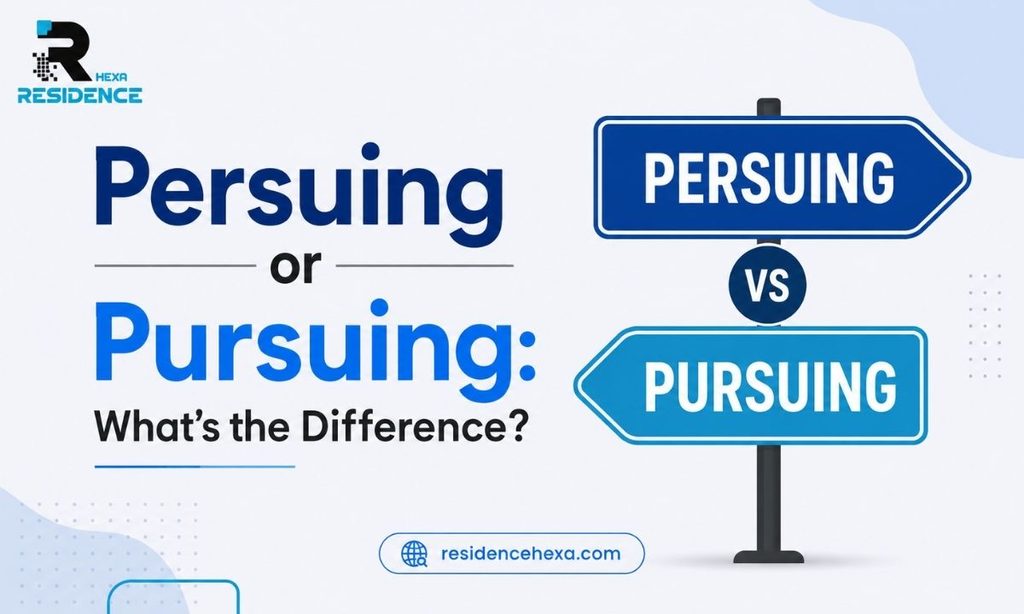
Before locking in the base word, it helps to see how the confusion plays out once “-ing” enters the picture. Many writers get pursue right but stumble the moment they add a suffix.
Pursuing
Pursuing is the correct present-participle form of pursue. When you drop the silent “e” and add “-ing,” you get pursuing — a standard English spelling rule that applies to countless verbs (write → writing, hope → hoping). It means actively following, chasing, or working toward something.
- She is pursuing a degree in computer science.
- They are pursuing new business opportunities.
- He spent years pursuing his dream of becoming a writer.
Persuing
Persuing is not a recognized English word. It’s simply a misspelling that results from writing the word the way it sounds rather than the way it’s actually spelled. No major dictionary lists it as an accepted variant.
Key Difference
| Aspect | Pursuing | Persuing |
| Status | Correct spelling | Common misspelling |
| Dictionary listing | Yes (all major dictionaries) | No |
| Root word | Pursue | None (error of “pursue”) |
| Recommended use | Always | Never |
The Correct Spelling: “Pursue”
The correct spelling is pursue, with two U’s — one in the first syllable, one in the second. According to Merriam-Webster, pursue is a verb meaning to follow in order to overtake, capture, or defeat, or more broadly, to proceed with or continue an activity or course of action. There is no dictionary, style guide, or standard reference that recognizes “persue” as a legitimate alternative spelling.
Examples
- The detective pursued the suspect through the crowded market.
- I plan to pursue a master’s degree next year.
- Our team will pursue every available option before making a final decision.
- She pursued her passion for painting even after retiring from law.
Why “Persue” Is Always Incorrect
“Persue” isn’t a regional variant, an older form, or an informal shortcut — it’s simply wrong in every context. A few reasons this error keeps showing up:
- Phonetic spelling. The word sounds like “per-sue” when spoken quickly, so writers spell it the way it’s heard rather than the way it’s written.
- Prefix confusion. English has many legitimate words that begin with “per-,” such as perform, perfect, and persist. That pattern makes “persue” feel deceptively plausible.
- Auto-correct gaps. Some spell-checkers catch the error, but inconsistent settings or fast typing on mobile devices let it slip through.
- Copied errors. Once a misspelling appears in one document, it’s easy for readers to unconsciously repeat it in their own writing.
No historical manuscript, dictionary edition, or grammar authority has ever listed “persue” as a valid form.
Meaning and Usage of “Pursue” in American English
In American English, pursue carries several related meanings, all built around the idea of continued, purposeful effort:
- To follow in order to catch or overtake — The officer pursued the fleeing vehicle.
- To strive to achieve or obtain — She pursued a career in medicine.
- To continue with an activity or plan — The company decided to pursue the merger.
- To engage in as a course of study or work — He is pursuing a PhD in chemistry.
- To proceed along a path or route — The trail pursues a winding course through the hills.
Because it’s a transitive verb, pursue always needs a direct object — you pursue something (a goal, a person, a strategy), rather than simply “pursuing” in isolation.
Synonyms of “Pursue” and Proper Context
Choosing the right synonym keeps your writing fresh and avoids repetition, which matters for both readability and reader engagement.
| Synonym | Best Used When |
| Chase | Physical or urgent pursuit |
| Seek | Searching for an opportunity or goal |
| Follow | Continuing along a path or plan |
| Strive for | Emphasizing effort toward a goal |
| Continue | Ongoing activity or process |
| Carry on with | Persisting despite obstacles |
| Aim for | Setting a target or ambition |
Use “chase” when describing something urgent or physical, “seek” or “strive for” when describing ambition, and “continue” or “carry on with” when describing an ongoing task or project.
Daily English Example Sentences
- I want to pursue a healthier lifestyle this year.
- The company will pursue legal action if the contract is broken.
- Many students pursue internships to gain real-world experience.
- He decided to pursue his hobby of photography more seriously.
- We should pursue this lead before it goes cold.
Contextual Applications of “Pursue”
Legal Context
In legal writing, pursue describes taking formal action — pursuing a lawsuit, pursuing damages, or pursuing an appeal. Example: “The plaintiff chose to pursue compensation through civil court.”
Academic and Research Context
Academics use pursue for ongoing study or inquiry — pursuing a degree, a line of research, or a thesis topic. Example: “The researcher pursued a new hypothesis after the initial results proved inconclusive.”
Career and Professional Context
This is one of the most common uses of the word. People pursue jobs, promotions, and certifications. Example: “She left her stable job to pursue a career in graphic design.”
Personal Goals and Life Context
Beyond work, pursue applies to hobbies, relationships, and health goals. Example: “He pursued a more balanced lifestyle after years of overworking.”
Literal vs Figurative Use of “Pursue”
Pursue works in two distinct registers:
- Literal use describes physical chasing or following — a police officer pursuing a suspect, a dog pursuing a squirrel across the yard.
- Figurative use describes striving toward an abstract goal — pursuing happiness, pursuing knowledge, pursuing excellence.
Both uses are grammatically identical; the difference lies entirely in whether the object being pursued is tangible or conceptual.
How to Remember the Correct Spelling

A few memory tricks make this word stick permanently:
- Spot the “purse.” The letters of “purse” sit inside pursue — imagine going in search of a purse.
- Count the U’s. Pursue has two U’s; persue has none in the right places. Say it slowly: “pur-sue,” not “per-sue.”
- Break it into parts. Pur- + -sue. Neither half resembles “per.”
- Link it to pursuit. If you know the noun pursuit is spelled correctly, remember that pursue shares the same root.
Mini Quiz
Choose the correct spelling in each sentence:
- She wants to (persue / pursue) a career in law.
- The dog began (persuing / pursuing) the ball.
- He will (persue / pursue) his dream no matter what.
(Answer: All three should use “pursue” or “pursuing.”)
Etymology and Historical Roots of “Pursue”
Pursue traces back to the Latin prosequi, meaning “to follow up” or “to prosecute,” which evolved into the Anglo-Norman French pursuer. Middle English adopted it as pursuen, originally carrying the sense of “to follow with hostility.” Over centuries, the spelling settled into the modern form pursue, while the meaning broadened from hostile chasing to the general sense of striving toward any goal. “Persue” never appeared as a recognized variant at any stage of this evolution.
“Pursue” in Literature and Famous Quotes
Classic Literature References
Writers across centuries have used pursue to capture ambition, longing, and determination — from characters pursuing fortune and love in classic novels to philosophers describing the pursuit of truth and virtue.
Inspirational Quotes
Paraphrased ideas often tied to the word’s spirit of ambition include the notion that boldness carries its own power once you commit to a goal, and that pursuing an original path — rather than a well-worn one — is what leaves a lasting trail. These themes explain why “pursue” appears so often in motivational writing: it captures forward motion toward something meaningful.
Common Mistakes and How to Avoid Them
Frequent Wrong Spellings
- Persue (missing the correct vowel order)
- Pursu (missing the final “e”)
- Puruse (letters transposed)
- Persuing (incorrect “-ing” form)
Quick Fix Tips
- Always double-check words that sound different from how they’re spelled.
- Use a reliable grammar checker, but don’t rely on it exclusively.
- Read your sentence aloud slowly, syllable by syllable: “pur-sue.”
- Compare against a trusted dictionary if you’re ever unsure.
Using “Pursue” in Different Writing Styles
- Formal/academic writing: “The study pursues a quantitative approach to measuring outcomes.”
- Business writing: “Our organization intends to pursue new markets in the coming fiscal year.”
- Creative writing: “She pursued the fading light across the meadow, chasing something she couldn’t quite name.”
- Everyday conversation: “I’m finally going to pursue that cooking class I’ve talked about for years.”
Regardless of tone, the spelling never changes — only the surrounding vocabulary shifts to match the register.
Correction Examples from Real Sentences
| Incorrect | Correct |
| She is persuing a new job. | She is pursuing a new job. |
| We will persue this matter further. | We will pursue this matter further. |
| He has always persued excellence. | He has always pursued excellence. |
| They chose to persu a different strategy. | They chose to pursue a different strategy. |
Case Study: Why Spelling Accuracy Matters Professionally
Consider a job applicant who wrote in a cover letter, “I am eager to persue new opportunities within your organization.” A hiring manager reviewing dozens of applications flagged the error immediately, and since the role emphasized written communication, the mistake created a poor first impression before the interview even began.
After feedback, the applicant revised the line to read, “I am eager to pursue new opportunities that allow for professional growth” — a small change that instantly reads as polished and detail-oriented. This is similar to how getting a word choice slightly wrong, such as confusing purposed vs proposed, can shift a sentence’s meaning without the writer realizing it. Small spelling errors rarely sink an application alone, but consistent mistakes chip away at a reader’s trust.
Self-Assessment Check
Test yourself with these quick prompts:
- Fill in the blank: “He decided to ______ his passion for music.” (persue / pursue)
- True or false: “Persue” is an accepted British English spelling.
- Which is correct: “pursuing a career” or “persuing a career”?
Answer to Self-Assessment
- Pursue
- False — “persue” is not accepted in any English-speaking country
- “Pursuing a career” is correct
Related Grammar Guides
If word pairs like this one trip you up, you’re not alone — English is full of near-identical spellings that quietly shift meaning. For another commonly confused pair that follows a similar pattern of one misplaced letter causing an entirely different (and incorrect) word, see Residence Hexa’s guide on Naive or Nieve: Meaning, Spelling, and Correct Usage.
Final Takeaway
The answer to persue or pursue is simple and permanent: pursue is the only correct spelling, in every dictionary, every style guide, and every English-speaking country. “Persue” is a phonetic misspelling that has never been accepted as standard English, no matter how often it appears online.
Whether you’re writing a resume, an academic paper, a business proposal, or a casual message, using pursue correctly signals attention to detail and strengthens your credibility as a writer. Keep the mnemonic in mind — go in search of a “purse” — and you’ll never misspell this word again.