Have you ever typed a sentence, paused, and wondered whether it should read “the library is quieter than the cafe” or “the library is more quiet than the cafe”? You’re not alone. This tiny grammar decision trips up native speakers and English learners alike, mostly because “quiet” doesn’t play by the usual rules for short adjectives.
The good news is that the answer isn’t complicated once you understand why English treats “quiet” the way it does. In this guide, you’ll learn the grammar rule behind comparatives, when each form is acceptable, how superlatives like “quietest” work, and the small mistakes that make writing look less polished. By the end, choosing between quieter and more quiet will feel automatic.
Definition Quieter Vs More Quiet
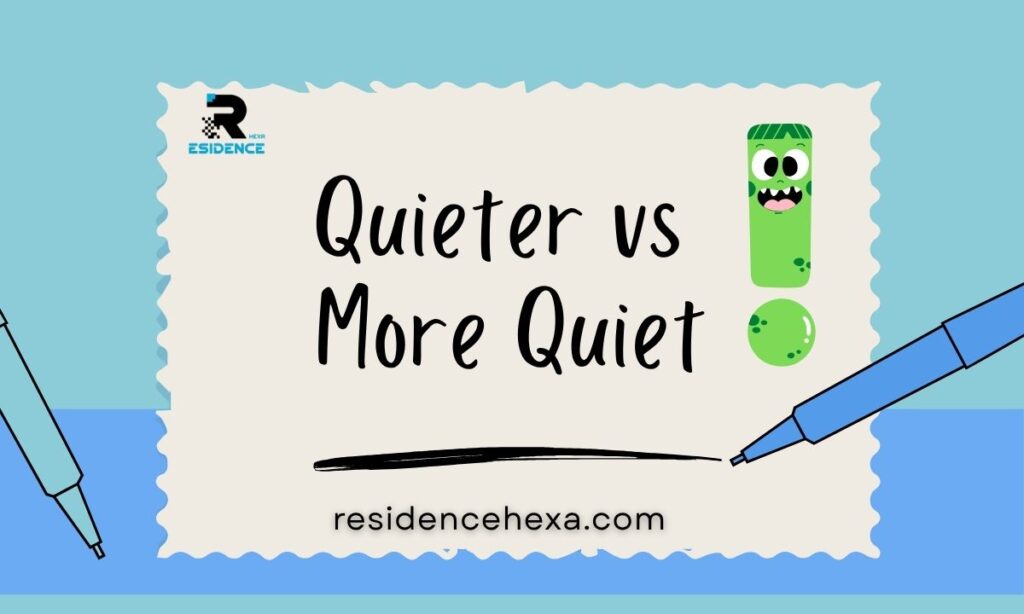
“Quieter” is the standard comparative form of the adjective “quiet,” formed by adding “-er” to the base word. “More quiet” is an alternative comparative form built with the word “more” instead of a suffix. Both describe a lower level of noise or activity when comparing two things, but “quieter” is the form recommended by most grammar authorities, including Merriam-Webster, which lists “quieter” as the primary comparative entry for the word.
In short: quieter and more quiet mean the same thing, but they aren’t used with equal frequency, and understanding the difference helps you write and speak more naturally.
Understanding “Quiet” as an Adjective
Before comparing forms, it helps to know what “quiet” actually describes. As an adjective, “quiet” refers to:
- Low or absent noise (“The street was quiet at midnight.”)
- Calm behavior or temperament (“He has a quiet personality.”)
- Peaceful, undisturbed settings (“They wanted a quiet weekend away.”)
Because “quiet” can describe sound, behavior, and atmosphere, it shows up constantly in everyday writing — which is exactly why its comparative form matters so much for clear communication.
The Grammar Behind Comparatives
Comparative adjectives let us measure one thing against another. English generally builds comparatives in two ways:
- Add “-er” to short adjectives (one syllable, or two syllables ending in a vowel-friendly sound): tall → taller, big → bigger, happy → happier.
- Add “more” before longer adjectives (typically three or more syllables): beautiful → more beautiful, intelligent → more intelligent.
Most two-syllable adjectives are the tricky middle ground, and “quiet” sits right in that gray zone. Technically, “quiet” has two syllables (qui-et), which would normally suggest it could take either form. In practice, though, it behaves like a short, one-syllable word because of how easily it takes the “-er” ending.
“Quieter”: The Standard Comparative Form
“Quieter” is the comparative form native speakers reach for almost automatically. It follows the standard short-adjective pattern and sounds natural in nearly every context — spoken, written, formal, or casual.
Examples:
- This street is quieter than the main road.
- Please try to be quieter during the meeting.
- The new engine runs quieter than the old model.
- Nights are much quieter here than in the city.
Because it’s shorter, smoother, and more familiar to the ear, “quieter” is the form recommended in everyday writing, business communication, and academic English.
When “More Quiet” Can Be Grammatically Acceptable
“More quiet” isn’t incorrect — it’s simply less common. It tends to appear when a writer wants added emphasis, a specific rhythm, or a slightly more formal or literary tone.
You’ll typically see “more quiet” in:
- Poetic or descriptive writing, where rhythm matters more than efficiency
- Emphatic statements, where the speaker wants to slow the sentence down
- Parallel sentence structures, such as “The evening grew more quiet, more still, more distant.”
Example: She felt more quiet after the news settled in, as if the silence itself had weight.
Here, “more quiet” adds a reflective, deliberate tone that “quieter” wouldn’t capture in quite the same way. Still, for everyday communication, “quieter” remains the safer, more natural default.
Quieter vs More Quiet in Real-World Usage
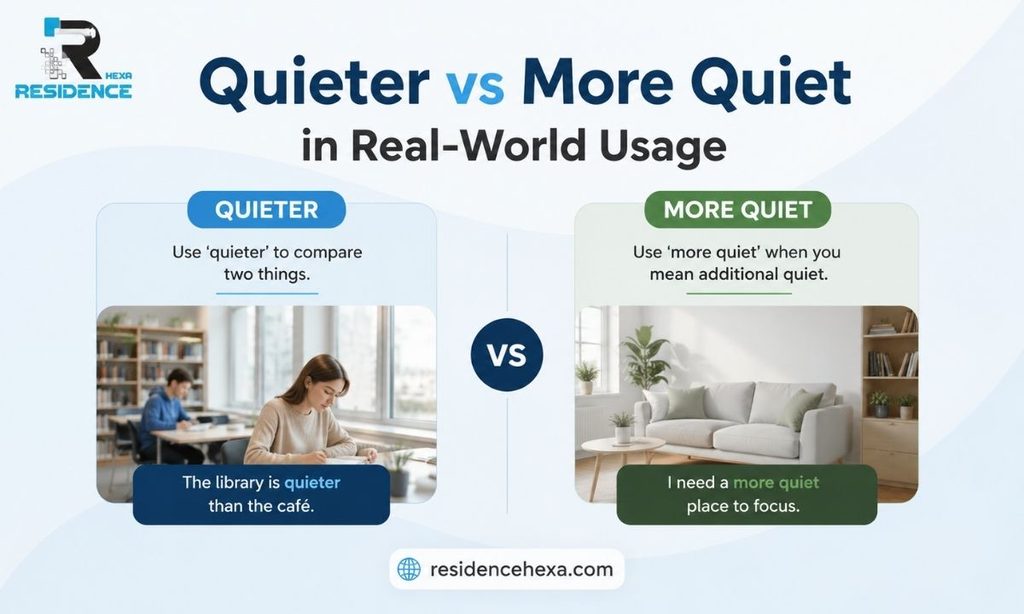
Frequency data and style guides consistently show the same pattern: “quieter” dominates everyday English, appearing far more often in speech, journalism, and casual writing, while “more quiet” surfaces mainly in formal or creative contexts. If you’re writing an email, a report, or a casual message, “quieter” is almost always the better choice. Save “more quiet” for moments where tone and rhythm genuinely call for it.
Comparison Table: Quieter vs More Quiet
| Feature | Quieter | More Quiet |
| Grammar rule | Standard “-er” comparative | Alternative “more + adjective” form |
| Frequency of use | Very common | Rare |
| Tone | Natural, everyday | Formal, emphatic, or literary |
| Best for | Speech, writing, business, exams | Poetry, reflective or descriptive prose |
| Example | The room is quieter now. | The room grew more quiet with each passing minute. |
| Recommended usage | Default choice | Occasional stylistic choice |
“Quietest” vs “Most Quiet” — The Superlative Forms
Superlatives compare three or more things and identify the extreme within a group. Just as “quieter” is the standard comparative, “quietest” is the standard superlative form of “quiet.”
- This is the quietest room in the building.
- She was the quietest student in the class.
- Of all the neighborhoods we visited, this one was the quietest.
“Most quiet” exists but is used even less often than “more quiet,” typically appearing only in formal or stylistic writing. If you’re deciding between the two, “quietest” is the safer and more natural choice in almost every situation — a rule that mirrors how other short adjectives form their superlatives, similar to the reasoning explored in this guide on whether “happiest birthday” is grammatically correct.
Quieter vs Less Noisy — Meaning Comparison
“Quieter” and “less noisy” often get used interchangeably, but they carry subtly different shades of meaning:
- Quieter focuses on the presence of calm or reduced sound overall.
- Less noisy focuses specifically on a reduction in disruptive or unwanted noise.
Examples:
- This fan is quieter than the old one. (general reduction in sound)
- The new engine is less noisy. (specifically less disruptive or grating)
In most everyday contexts, the two are close enough to use interchangeably, but “less noisy” can sound more precise when you’re contrasting an unpleasant sound with a more tolerable one.
Common Usage Constructions
“As Quiet As” — Equal Comparisons
When two things share the same level of quietness, English uses the “as…as” structure instead of a comparative form.
- The house is as quiet as a library.
- She stayed as quiet as possible during the exam.
- The office was as quiet as it had been all week.
This construction shows equality rather than difference, which is why neither “quieter” nor “more quiet” fits here.
Common Idioms and Expressions
“Quiet” also appears in fixed expressions that don’t follow standard comparative rules at all:
- Quiet as a mouse — extremely quiet or unnoticed
- Dead quiet — completely silent
- Keep quiet — stay silent or avoid revealing information
- Quiet down — become calmer or less noisy
These idioms are worth memorizing separately, since their meanings often go beyond the literal definition of “quiet.”
Linguistic Insight & Expert Opinion
Grammar resources including the Cambridge Grammar of the English Language and style guides like Grammarly generally agree: both “quieter” and “more quiet” are grammatically valid, but the choice isn’t about correctness — it’s about rhythm, tone, and audience expectation. English tends to favor efficiency, and shorter comparative forms like “quieter” fit that preference. When two forms are equally correct, native-speaker instinct usually gravitates toward whichever sounds more economical in everyday speech, which is exactly why “quieter” wins out in the vast majority of real-world usage.
Common Mistakes and Misunderstandings
Even confident English speakers slip up occasionally. Watch out for these errors:
- “More quieter” — Combining “more” with “-er” is incorrect. Choose one form only.
- “Most quietest” — Same issue in the superlative form; never double up.
- Using “more quiet” out of habit in casual writing, where “quieter” sounds far more natural.
- Confusing “quiet” with “quite” — a common spelling slip that changes the meaning entirely (“quite” means “very” or “completely”).
- Forgetting “as…as” for equal comparisons and defaulting to a comparative when no real difference exists.
How to Choose Between “Quieter” and “More Quiet”
A simple mental checklist can make this decision instant:
- If you’re writing or speaking casually → use quieter.
- If you want a formal, literary, or emphatic tone → more quiet is acceptable.
- If you’re comparing three or more things → use quietest, not “most quiet.”
- If two things are equal in quietness → use as quiet as, not a comparative at all.
- If in doubt → default to quieter; it’s rarely wrong and always natural.
Quick Summary Rules
- Quiet is a short adjective, so it typically takes “-er,” not “more.”
- Quieter is the standard, most natural comparative form.
- More quiet is grammatically correct but far less common, mostly used for emphasis or style.
- Quietest is the standard superlative; avoid “most quiet” unless writing formally.
- Never combine “more” and “-er” together (no “more quieter”).
- Use “as quiet as” for equal comparisons, not a comparative form.
Real-World Examples in Context
- Everyday speech: “Can you turn the TV down? It needs to be quieter.”
- Business writing: “The updated software runs quieter in the background, reducing system noise.”
- Literary writing: “As the storm passed, the town grew more quiet, as though holding its breath.”
- Travel writing: “This coastal village is quieter than the busy resorts nearby.”
- Academic writing: “Participants rated the second room as quieter than the first, based on decibel readings.”
Self-Assessment Quiz
Test what you’ve learned. Choose the correct word for each sentence.
- This library is much _____ (quieter / more quiet) than the one downtown.
- Of all the rooms in the house, the study is the _____ (quietest / most quiet).
- The garden was _____ (as quiet as / quieter than) a graveyard at midnight.
- Please be _____ (quieter / more quieter) — the baby is sleeping.
- As night fell, the forest grew _____ (more quiet / quieter), almost reflective in its stillness.
Answer Key
- Quieter
- Quietest
- As quiet as
- Quieter
- More quiet (stylistic choice, both technically acceptable)
Final Thoughts
The debate between quieter and more quiet ultimately comes down to natural usage rather than strict correctness. “Quieter” is the standard, efficient comparative form that fits nearly every situation, from casual conversation to professional writing. “More quiet” isn’t wrong — it simply serves a narrower purpose, adding emphasis or a literary touch when the moment calls for it. Once you understand this distinction, along with related structures like “quietest” and “as quiet as,” you’ll never second-guess your word choice again.
For more clear, practical grammar breakdowns like this one, explore related comparisons such as Associated With vs Associated To on Residence Hexa.