Have you ever typed “I send the email yesterday” and then paused, wondering if that sounds off? It should — because it’s one of the most common verb-tense slip-ups in English. With billions of emails, texts, and messages exchanged every day, getting send and sent mixed up is an easy mistake, even for confident writers.
The good news is that the rule behind these two words is refreshingly simple once you see it clearly. This guide walks through exactly what send and sent mean, when to use each one, and how to avoid the mistakes that trip up learners and native speakers alike.
Send or Sent: Quick Answer
- Send is the base (present tense) form of the verb, used for actions happening now or in the future.
- Sent is the past tense and past participle form, used for actions that already happened.
Quick rule: if the action is done, use sent. If it’s happening now or will happen later, use send.
What Does “Send” Mean?
Send means to cause something — a letter, a message, a package — to go from one place or person to another. As Merriam-Webster explains, “send” means to cause something to go or be carried from one place or person to another, and it functions as the base form of this irregular verb.
Send (Present Tense) Explained
Send is used with subjects like I, you, we, and they for present or habitual actions, and it also appears after modal verbs like “will,” “can,” and “should” to describe future actions.
- Present simple: “I send invoices every Friday.”
- Future: “I will send the file tomorrow.”
- Imperative: “Please send the report now.”
- With “does/do”: “Does she send updates weekly?”
Examples of “Send” in Sentences
- Please send me the meeting agenda.
- The system will send a confirmation email automatically.
- We send birthday cards to every client each year.
- Can you send the invoice by Friday?
What Does “Sent” Mean?

Sent is the past tense and past participle of “send.” It’s an irregular verb, meaning it doesn’t follow the standard “-ed” pattern (like “walked” or “played”). Instead of becoming “sended,” it changes form entirely to “sent.”
Sent (Past Tense & Past Participle) Explained
Sent has two jobs:
- Simple past tense — describing a completed action: “I sent the package yesterday.”
- Past participle — used with helping verbs “have,” “has,” or “had” to form perfect tenses: “She has sent the report.”
Unlike many verbs, sent doesn’t change based on who’s performing the action — it stays the same whether the subject is I, you, he, she, or they.
Examples of “Sent” in Sentences
- I sent the documents last week.
- He has sent three reminders already.
- They had sent the invitation before the venue changed.
- The message was sent but never delivered.
Send vs Sent: Key Differences
| Feature | Send | Sent |
| Part of speech | Base form / present tense verb | Past tense & past participle |
| Used for | Present or future actions | Completed (past) actions |
| Works with | will, can, do/does, please | have, has, had |
| Example | I will send the email. | I sent the email. |
| Changes by subject? | No (same for all subjects) | No (same for all subjects) |
Send or Sent: Which One Is Correct?
Both are correct — but only in the right context. Use send for anything happening now or in the future, and sent for anything already completed. A quick test: if you can replace it with “will send” or “am sending,” use send. If you can replace it with “already sent” or pair it with have/has/had, use sent.
Will It Be Send or Sent?
This phrasing trips up a lot of writers. The correct form is always “will be sent,” never “will be send.” Passive future constructions use “will be” + past participle, and the past participle of send is sent.
Will Be Sent or Send: Which Is Grammatically Correct?
- ✅ “The package will be sent tomorrow.”
- ❌ “The package will be send tomorrow.”
The rule: after “will be,” always use the past participle form — sent, not send.
I Will Send or Sent: What’s the Correct Grammar?
- ✅ “I will send the file tomorrow.” (future action, base form)
- ❌ “I will sent the file tomorrow.”
After the modal verb “will,” English always requires the base form of the verb, so it’s “will send,” never “will sent.”
Will Send or Will Sent: Common Grammar Mistake
“Will sent” is always incorrect. Modal verbs like will, can, and should are followed only by the base form of a verb — never the past tense. Stick with “will send.”
Common Mistakes People Make with Send and Sent
- ❌ “I send the email yesterday.” → ✅ “I sent the email yesterday.”
- ❌ “She has send the invoice.” → ✅ “She has sent the invoice.”
- ❌ “I will sent the report.” → ✅ “I will send the report.”
- ❌ “The parcel will be send today.” → ✅ “The parcel will be sent today.”
- ❌ “I didn’t sended the message.” → ✅ “I didn’t send the message.” (after “did,” always use the base form)
Correct Usage in Sentences
US English Examples
- I sent the package via FedEx yesterday.
- We will send your order confirmation shortly.
- She has sent the contract for review.
UK English Examples
- I sent the letter by post this morning.
- They will send the documents through the courier.
- He has sent his CV to three companies.
There’s no spelling or grammar difference between American and British English here — both regions use send and sent identically. The only regional variation is vocabulary, such as British speakers occasionally preferring “posted” over “sent” for physical mail.
Everyday Examples and Practical Tips
- Texting: “I’ll send you the photos in a sec” (present/future) vs. “I already sent them” (past).
- Email: “Please send the attachment” vs. “The attachment was sent an hour ago.”
- Work chat: “Send me the link” vs. “I sent you the link twice.”
Tips to Remember the Difference Between Send and Sent
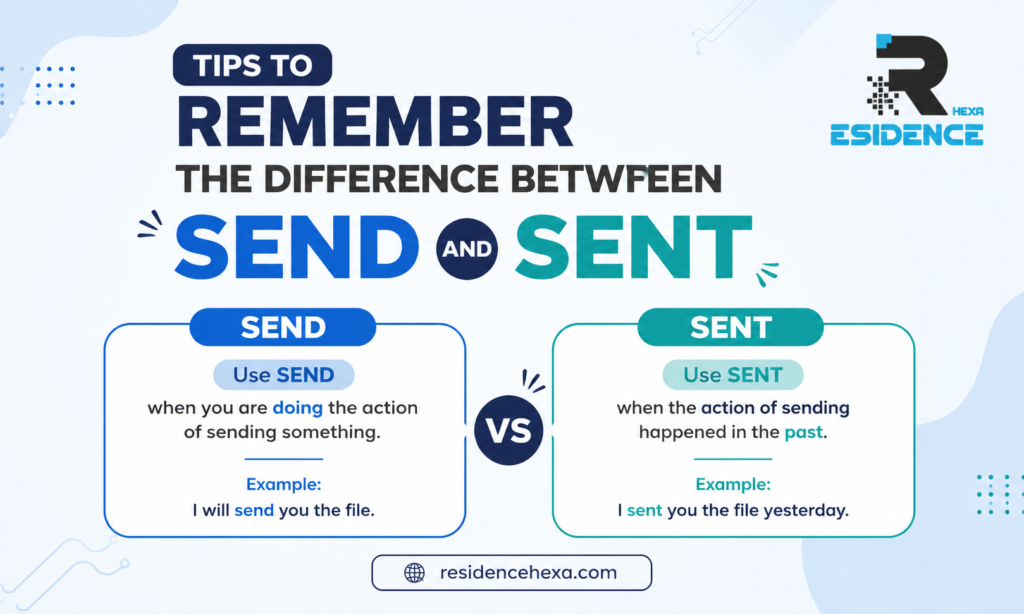
- Letter trick: “Send” starts and continues in the present; “Sent” ends in “t,” just like a task that’s already finished.
- Helping verb rule: Have, has, and had always paired with sent — never with send.
- Modal verb rule: Will, can, should, and would always pair with send — never with sent.
- Replacement test: Swap in “already” — if it fits naturally, you need sent.
Word-form confusion like this is common across English. If you found this helpful, you may also want to check out purposed vs. proposed for another verb-form mix-up, or read about what is it called, what’s it called, and it’s called for more grammar clarity on commonly confused phrases.
Conclusion
The difference between send and sent ultimately comes down to timing: send belongs to the present and future, while sent belongs to the past. Once you internalize that one rule — along with the fact that verbs like have/has/had always pair with sent, while modals like will always pair with send — you’ll never second-guess this pair again. Keep these tips handy, and your emails, messages, and reports will be read cleanly and correctly every time.