Every year, as the festive season rolls around, millions of people pause over the same small question: should I write happy holiday or happy holidays? It seems like a minor detail — just one extra letter — but getting it wrong can make your greeting sound awkward, unprofessional, or even grammatically off. Whether you are writing a holiday email to your entire office, signing a card for a friend, or crafting social media content for a broad audience, this single word choice actually carries real meaning.
The good news is that both phrases exist for a reason, and once you understand the difference, you will never second-guess yourself again. This guide breaks down the grammar, the context, the common mistakes, and the cultural background behind happy holiday or happy holidays — so you can greet people with total confidence this season and every season to come.
Quick Answer: Is It “Happy Holiday” or “Happy Holidays”?
“Happy Holidays” is the most common and widely accepted greeting in modern English. It works as an inclusive, seasonal greeting that covers multiple celebrations at once — Christmas, Hanukkah, Kwanzaa, New Year’s, and more.
“Happy Holiday” is also grammatically correct but is used in a narrower context: when you are referring to one specific celebration that both you and the recipient already have in mind.
In short — when in doubt, use Happy Holidays. It is the safer, more natural choice in almost every situation.
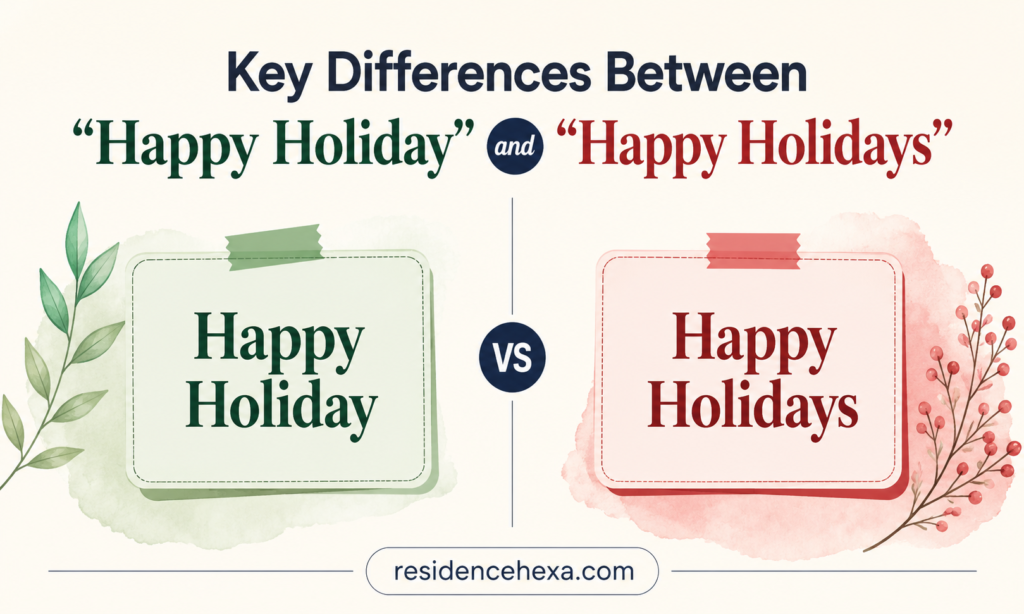
Key Differences Between “Happy Holiday” and “Happy Holidays”
Happy Holiday
“Happy Holiday” is the singular form. It refers to a single, specific occasion — one particular day or event. This phrase is less common and tends to appear in personal conversations or informal contexts where the holiday in question is already obvious.
Happy Holidays
“Happy Holidays” is the plural form and the dominant greeting in both American and British English. It covers a season or group of celebrations rather than a single event. It became the standard expression in North American culture from the mid-20th century onward, partly due to its inclusive tone and partly because the holiday season itself spans multiple events.
Side-by-Side Comparison Table
| Feature | Happy Holiday | Happy Holidays |
| Number | Singular | Plural |
| Refers to | One specific holiday | Multiple holidays / a season |
| Common usage | Rare; situational | Everyday; standard |
| Tone | Specific, personal | Inclusive, broad |
| Appropriate for work? | Only if context is clear | Yes, always |
| Grammatically correct? | Yes | Yes |
What Does “Happy Holiday” Mean?
Simple Meaning
“Happy Holiday” simply means wishing someone a happy time during one particular holiday. The word holiday here is a singular noun, referring to one specific day or occasion — like Christmas Day, Thanksgiving, or Eid.
Examples of “Happy Holiday”
- “Happy Holiday! Enjoy your time with family this Christmas.”
- “Have a happy holiday — you’ve earned this break.”
- “Wishing you a happy holiday this Thanksgiving.”
Notice how each example has a clear, single occasion in mind. The phrase works because both speaker and listener already know which holiday is being discussed.
What Does “Happy Holidays” Mean?
Simple Meaning
“Happy Holidays” is a warm, broad seasonal greeting. According to Merriam-Webster, a holiday is “a day on which one is exempt from work,” and when pluralized, it naturally refers to a run of such days — the entire festive period. The phrase acknowledges that the holiday season includes many celebrations and is used to wish good cheer across all of them at once.
Examples of “Happy Holidays”
- “Happy Holidays from our whole team to yours!”
- “Wishing you and your loved ones happy holidays this season.”
- “Happy Holidays — enjoy every moment of the festive period.”
Is “Happy Holiday” Grammatically Correct?
Yes, happy holiday is grammatically correct. It follows a simple adjective-noun structure: happy modifies the noun holiday. The sentence is complete and clear. However, its correctness depends on context — it only sounds natural when referring to one specific occasion. Outside that context, it can feel incomplete or unusual to native speakers.
Is “Happy Holidays” Grammatically Correct?
Absolutely. Happy Holidays is grammatically correct and is the widely preferred standard in modern English. The plural noun holidays is correctly modified by the adjective happy, and the phrase has been in common use for over a century. It is accepted across all registers — casual conversation, professional emails, greeting cards, and formal announcements.
“Have a Happy Holidays” — Is This Phrase Correct?
Why “Have a Happy Holidays” Sounds Off
No — “Have a happy holidays” is grammatically incorrect, even though you will hear it occasionally. The problem is the article a. In English, you use a before a singular noun, not a plural one. “Holidays” is plural, so pairing it with a creates a grammatical mismatch.
It would be like saying “Have a great weekends” — the number does not agree.
Better Alternatives
Instead of “Have a happy holidays,” use one of these:
- “Have a happy holiday!” (if referring to one specific occasion)
- “Have happy holidays!” (removing the article solves the problem)
- “Enjoy the holidays!”
- “Wishing you a wonderful holiday season!”
The last option is a popular choice in professional writing because it uses the singular holiday season correctly with the article a.
“Happy Holiday or Happy Holiday’s” — Is the Apostrophe Ever Correct?
Why “Happy Holiday’s” Is Incorrect
No — “Happy Holiday’s” is always incorrect in this context. The apostrophe signals possession or a contraction, neither of which applies here. “Holiday’s” would mean belonging to the holiday or would be short for holiday is — neither of which makes sense as a greeting.
This is one of the most common grammar mistakes seen on seasonal cards and marketing materials. Apostrophe errors like this are so frequent that grammar writers have singled them out as a signature seasonal blunder. The simple rule: Happy Holidays is a plural noun. It needs only an s, never an apostrophe.
❌ Happy Holiday’s from the team! ✅ Happy Holidays from the team!
When to Use “Happy Holiday”
Common Situations
Use happy holiday when:
- You are speaking directly to someone about a specific celebration
- The holiday in question is already known and understood by both parties
- You are writing a personal, one-on-one message (not a mass greeting)
- You want to specify one day, such as Thanksgiving or Christmas
Examples
- “Happy Holiday — enjoy every minute of Christmas with your family.”
- “I hope you have a happy holiday this Eid.”
- “Happy Holiday to you and your partner this New Year’s Eve.”
When to Use “Happy Holidays”
Common Situations
Use happy holidays when:
- You are sending a mass message or group email
- You are addressing people of different backgrounds or faiths
- You are writing a seasonal greeting card or social media post
- The festive period — not a single day — is the focus
- You are writing in a professional or corporate context
Examples
- “Happy Holidays to all our customers and partners!”
- “Wishing everyone happy holidays and a prosperous New Year.”
- “Happy Holidays from our family to yours.”
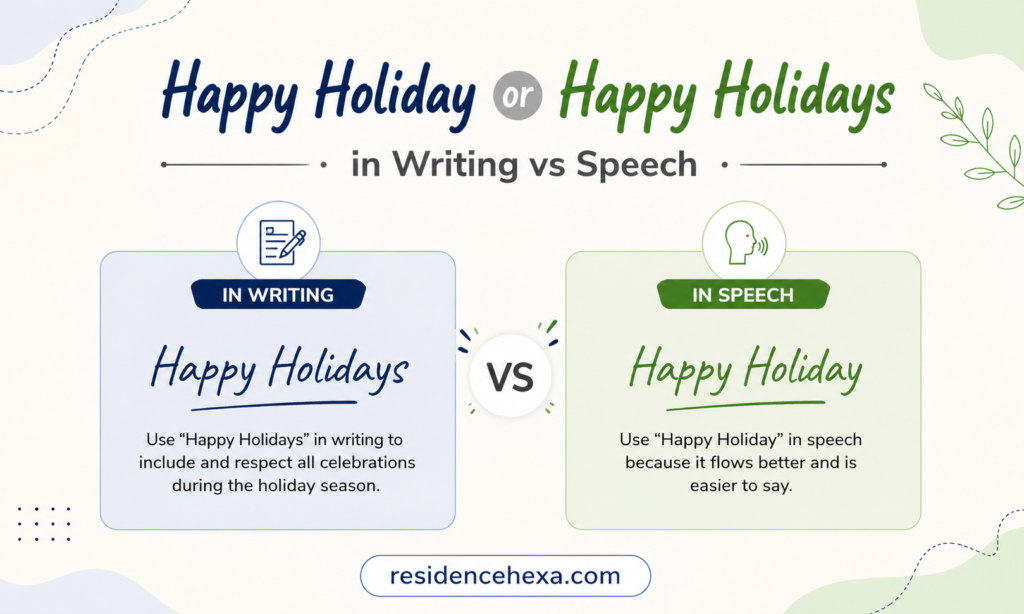
Happy Holiday or Happy Holidays in Writing vs Speech
Informal Writing
In texts, social media captions, or casual cards, both forms appear frequently. People tend to default to Happy Holidays for general posts and Happy Holiday only in personal, direct messages where the occasion is already implied.
Professional Writing & Emails
In professional writing, Happy Holidays is almost always the right choice. It signals awareness of your audience’s diversity and avoids making assumptions about which celebration any individual observes. Starting a company-wide email with Happy Holidays is safe, warm, and widely accepted.
If you are unsure how to phrase seasonal greetings in formal contexts, our guide on Whole Day or All Day — Which Is Correct? explores similar questions about choosing the right form for different writing registers.
Spoken Greetings
In conversation, both phrases are used. You will hear Happy Holidays far more often as a general greeting between acquaintances or colleagues. Happy Holiday tends to appear in more personal spoken exchanges, such as saying goodbye to a family member before a specific celebration.
American vs British English Usage
Key Points
In American English, Happy Holidays is deeply embedded in culture. It has been used by major retailers, greeting card companies like Hallmark, and media outlets since the mid-20th century as an inclusive alternative to holiday-specific greetings.
In British English, the phrase is understood but less dominant. British speakers are more likely to say Happy Christmas or Merry Christmas for the December holidays, and they tend to use holiday in the singular when referring to a vacation or break. The plural seasonal greeting is far more of an American convention.
Examples
- American: “Happy Holidays from all of us here at the store!”
- British: “Have a lovely Christmas and a Happy New Year!”
- Universal: “Wishing you a wonderful holiday season.”
Common Mistakes with “Happy Holiday or Happy Holidays”
Thinking One Is Wrong
Many people assume that happy holiday must be incorrect because happy holidays is so much more common. This is not true. Both are grammatically correct — the difference is purely one of number and context. For more on how singular vs plural choices can affect everyday phrases, see our article on Any Problem or Any Problems — Which Is Correct?, which examines a very similar grammar question.
Using the Wrong Number
The most practical mistake is using the singular when you mean the plural — or vice versa. If you are writing a general seasonal greeting, happy holiday will sound oddly specific and slightly off. If you are wishing a single person well for one named occasion, happy holidays might feel unnecessarily broad.
Adding an Unnecessary Apostrophe
Writing Happy Holiday’s is a clear grammatical error. Apostrophes signal possession or contraction, not plurality. Holidays is simply a regular plural noun — no apostrophe needed, ever.
Which Phrase Is More Polite?
Both phrases are polite. However, Happy Holidays is generally considered more considerate in multicultural or mixed-faith settings because it does not assume which celebration the recipient observes. When addressing a diverse audience — a large team, a customer base, or an online community — Happy Holidays is the more respectful and inclusive choice.
That said, if you know someone celebrates a specific holiday, wishing them Happy Holiday (or better yet, a specific greeting like “Merry Christmas” or “Happy Hanukkah”) is equally polite and often more personal.
Which Phrase Is More Common?
Happy Holidays is significantly more common. In the United States especially, it dominates in advertising, greeting cards, email campaigns, and everyday conversation from late November through early January. Surveys and cultural data consistently show that most Americans hear and use Happy Holidays far more than Happy Holiday during the winter festive period. Globally, Happy Holidays is also the more recognizable form, making it the safer default for international communication.
Practical Tips to Remember the Difference
Think About Number
Ask yourself: am I referring to one holiday or many? One = Happy Holiday. Many = Happy Holidays. This single question resolves the choice in almost every situation.
Think About Season
If you are writing during a period that spans multiple celebrations — say, late November through January — the plural is almost always correct. The season itself is plural by nature.
Follow the Context
General greeting to a group? Use Happy Holidays. Personal note to someone celebrating a specific day you both know? Happy Holiday works. Professional email to hundreds of recipients? Happy Holidays, always.
Conclusion
The debate over happy holiday or happy holidays comes down to one simple rule: singular vs plural. Happy Holiday refers to one specific occasion and is correct in personal, contextually clear situations. Happy Holidays covers multiple celebrations, suits a wider audience, and is the standard choice for professional or general use.
When you are writing seasonal messages this year, remember — happy holiday or happy holidays are both valid tools. The right one depends on how many celebrations you mean, who you are talking to, and how personal or broad you want your message to feel. In most cases, Happy Holidays is your safest, most natural, and most inclusive choice. Use it with confidence and have a wonderful holiday season.