Have you ever stopped mid-sentence wondering whether to write “nighttime” as one word or two? You are not alone. The debate around nighttime or night time trips up students, bloggers, professional writers, and even native English speakers every day. A tiny spelling choice like this can quietly affect how polished your writing looks — especially in formal documents, academic papers, or published content.
The good news is there is a clear answer. Modern English has settled on a preferred form, and understanding the difference between nighttime or night time will sharpen your writing instantly. This guide covers everything — from dictionary authority and historical evolution to real-world examples across education, travel, and everyday life — so you can write with total confidence every single time.
Quick Answer: Is It “Nighttime” or “Night Time”?
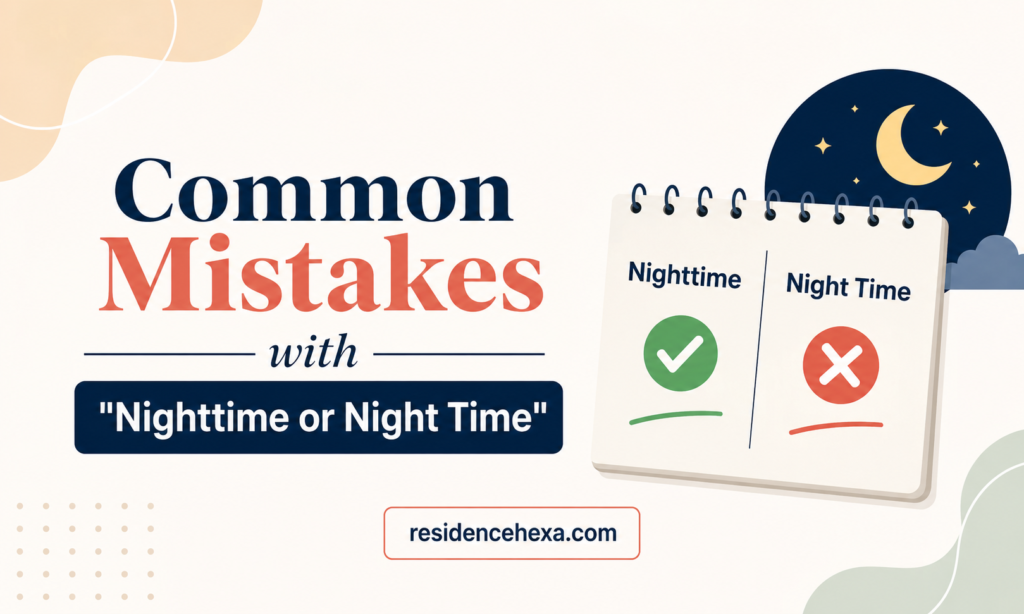
Nighttime (one word, no hyphen) is the correct and preferred spelling in modern English, particularly in American English. It is a closed compound noun formed from “night” and “time,” following the same pattern as daytime, bedtime, and lunchtime.
The two-word form “night time” is considered informal, archaic, or stylistic in most contexts. The hyphenated form “night-time” is still accepted in British English but is gradually being replaced by the single-word version even there.
In short: Use nighttime unless you are writing for a British audience that specifically follows a style guide preferring night-time.
Is “Nighttime” One Word?
Yes. Nighttime is written as one word in standard modern English. It is a compound noun, which means two smaller words have merged into a single unit with a unified meaning. This is a natural process in English — words that are used together frequently tend to fuse over time.
Think of similar compounds: sunrise, sunset, bedtime, daytime. None of these are written as two words in contemporary writing, and the same rule applies to nighttime. According to Merriam-Webster, nighttime is defined as “the time from dusk to dawn” and is listed as a single unhyphenated word.
Is “Night Time” One Word or Two?
“Night time” written as two separate words is not the standard form in modern American English. It was common in older texts, particularly from the 1800s and early 1900s, but usage data from major English corpora shows it has steadily declined as the one-word form took hold.
Writing nighttime or night time as two words is not technically catastrophic, but it signals outdated usage. In professional or formal contexts — reports, journalism, academic writing, or digital content — the two-word version can make your text feel careless or old-fashioned.
What Time Is Considered “Night Time”?
General Time Range for Night
Most people think of nighttime as the hours of darkness, but the exact window varies depending on the context. In broad terms, nighttime begins at sunset and ends at sunrise. In many parts of the world, this means roughly 6:00 PM to 6:00 AM, though this shifts with the seasons and latitude.
Astronomically, nighttime is the period when the sun is below the horizon. Civil twilight — the period just after sunset when ambient light still lingers — is sometimes excluded from the strict definition of night.
How Context Changes the Definition (Sunset, Curfews, Schedules)
The definition of nighttime or night time is not fixed — it shifts depending on who is defining it:
- Legal definitions: Many laws define nighttime hours as 10:00 PM to 7:00 AM for purposes such as noise ordinances, curfews, and construction restrictions.
- Traffic law: Some vehicle codes define nighttime as “one-half hour after sunset to one-half hour before sunrise.”
- Workplace law: EU regulations define night work as covering at least seven hours of the period between midnight and 5:00 AM.
- Everyday use: In casual conversation, most people treat nighttime as beginning when it gets dark and ending when the sun rises.
- Aviation: Pilots use a definition tied to civil twilight — typically 30 minutes after sunset to 30 minutes before sunrise.
The word nighttime holds up in all these contexts as a noun or modifier, regardless of the precise hours involved.
What Does “Nighttime” vs “Night-Time” Mean?
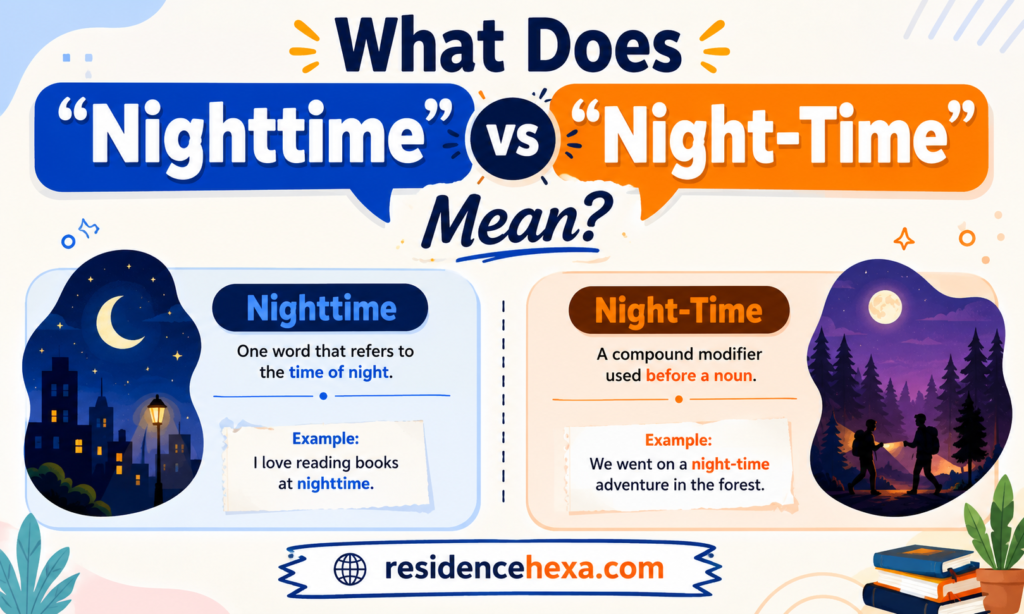
Both nighttime and night-time carry the same meaning: the period of darkness between sunset and sunrise. The difference is purely orthographic — that is, it is a spelling variation, not a difference in definition.
| Form | Region | Status |
| nighttime | American English | Standard, preferred |
| night-time | British English | Accepted, still in use |
| night time | General / Historical | Archaic, informal |
Both forms function as a noun (“She loves the nighttime”) and as an adjectival modifier (“a nighttime routine”). The hyphenated form night-time follows a broader British tendency to retain hyphens in compound modifiers longer than American English does.
Spelling History and Development
English did not always have standardized spelling, and the story of nighttime or night time reflects centuries of organic language change.
- Old English: “Niht” (night) and “tīma” (time) existed as separate words.
- Middle English (1200s–1500s): Writers used “nyght tyme” as a two-word phrase in poetry and religious texts.
- 1700s–1800s: The hyphenated form “night-time” gained popularity, especially in British literature.
- Early 1900s: American English began dropping hyphens across many compound words.
- Mid-to-late 1900s: “Nighttime” became dominant in American dictionaries, journalism, and academic writing.
- Today: The one-word closed compound is the global standard, with “night-time” persisting primarily in British publications.
This mirrors the evolution of daytime, which moved through the same stages and now exists only as a single unhyphenated word in virtually all English-speaking countries.
American vs British English
The regional split on nighttime or night time is one of the clearest in modern English spelling:
American English strongly favors nighttime as the only standard form. Major US publications — The New York Times, The Washington Post, academic journals — consistently use the closed compound.
British English still prefers night-time with a hyphen, though the unhyphenated nighttime is increasingly appearing in British media and is widely understood. The two-word “night time” is considered outdated even in the UK.
If you are writing for a global audience with no particular regional focus, default to nighttime. It is the form most widely recognized across digital platforms, spell-checkers, and international publications.
When to Use “Nighttime”
Use nighttime (one word) in the following situations:
- Writing for an American audience
- Academic or formal documents
- Journalism and digital content
- When using it as an adjective to modify a noun (nighttime sky, nighttime curfew, nighttime feeding)
- General everyday writing where a clean, modern style is preferred
Examples:
- The city skyline is breathtaking at nighttime.
- Many animals are most active during nighttime hours.
- She developed a nighttime skincare routine that transformed her skin.
- Nighttime temperatures can drop sharply in desert regions.
When to Use “Night Time” or “Night-Time”
Use night-time (hyphenated) when:
- Writing for a British audience that follows UK style guides
- Working with a publication that specifically requires hyphenated compound modifiers
- Quoting British sources directly
Use night time (two words) only in:
- Historical or literary references to older texts
- Stylistic or poetic writing where rhythm matters more than conformity
- Informal writing where absolute precision is not expected
Contextual Examples of Correct Usage
Education
School schedules and academic writing almost universally use the one-word form. “Nighttime reading programs have been shown to improve literacy in young children.” Sleep studies referenced in textbooks describe nighttime sleep patterns, circadian rhythms, and nocturnal behavior using the compound form consistently.
Just as you might explore the difference between artefact vs artifact — where spelling shifts with geography and context — nighttime vs night-time follows the same geographic logic in academic settings.
Weather and Climate
Meteorologists and climate reports rely on nighttime to describe temperature patterns, humidity, and atmospheric conditions. “Nighttime lows will fall to near freezing across the region this weekend.” The compound form reads cleanly in weather bulletins and forecasting apps without any ambiguity.
Travel and Transport
Transport schedules, aviation regulations, and travel guides consistently use nighttime when discussing hours of operation, visibility rules, or curfew periods for flights and vehicle movement. “Nighttime driving on mountain roads requires extra caution.” Airlines reference nighttime flying hours when calculating pilot rest requirements.
Everyday Life
From parenting blogs to fitness guides to sleep science articles, nighttime appears as the go-to word for all things related to the hours of darkness. “A consistent nighttime routine helps children fall asleep faster.” “Nighttime anxiety is a common experience that affects millions of adults.”
Common Mistakes with “Nighttime or Night Time”
Believing One Spelling Is Wrong
One of the most common misconceptions is that either nighttime or night-time is flat-out incorrect. Neither is wrong in the right context. Nighttime is correct in American English; night-time is correct in British English. The two-word night time is outdated but not a grammatical error.
Mixing Spellings in the Same Text
Consistency is critical in professional writing. Alternating between nighttime and night-time within the same document looks like a proofreading oversight. Choose one form based on your audience and stick with it from the first sentence to the last.
Confusing “Nighttime” with “Night Time” (Word vs Time Period)
Some writers use “night time” (two words) to specifically emphasize the time-of-day aspect, as in “it happened at night time.” While this reasoning has some logic, it is not recognized as a grammatical distinction in standard usage. The compound nighttime covers both meanings — the noun and the modifier — without needing to be split.
Ignoring the Audience (US vs UK)
Writers producing content for international platforms sometimes overlook regional preferences. If your audience is primarily American, British-style night-time can feel jarring. Conversely, a UK-focused publication may flag nighttime as non-standard. Always know your audience before you commit to a form.
This regional awareness applies across many spelling debates — much like understanding behaviour or behavior, where the correct choice depends entirely on your reader’s location and expectations.
Practical Tips to Remember the Correct Form
Follow these quick rules to never second-guess nighttime or night time again:
- Think of daytime. You would never write “day time” as two words in modern English. The same logic applies to nighttime.
- American = no hyphen, no space. If your audience is in the US, always use nighttime as a single closed compound.
- British = hyphen optional. UK writing accepts night-time, but nighttime is increasingly standard even there.
- Check your spell-checker. Most modern spell-checkers flag “night time” (two words) as non-standard and suggest nighttime.
- Be consistent. Whatever form you choose, use it throughout your entire document.
- Use it as a modifier freely. Nighttime works smoothly as both a noun and a noun modifier — no hyphen needed even when modifying another noun (nighttime routine, nighttime flight).
Conclusion
The debate over nighttime or night time comes down to one simple principle: language evolves, and compound words tend to merge over time. Just as daytime, bedtime, and lunchtime are all written as single words today, nighttime has completed that same journey in modern English.
For most writers — especially those writing for American audiences, academic purposes, or digital platforms — nighttime (one word, no hyphen) is the correct choice. British English still uses night-time with a hyphen, and that form is perfectly valid in its regional context. The two-word night time, however, is largely a relic of older usage and should be avoided in formal writing.
Knowing when to use nighttime or night time is a small but meaningful detail that reflects the care you put into your writing. Stick with nighttime, stay consistent, and your text will always read as polished, professional, and up to date.