Have you ever typed a sentence, paused, and thought, “Wait, is it drier or dryer?” You’re not alone. These two words sound exactly the same when spoken aloud, but on paper, they belong to completely different grammatical families — and mixing them up is one of the quickest ways to make polished writing look sloppy.
The good news is that once you understand the simple rule behind them, you’ll never second-guess this pair again. This guide breaks down the meaning, grammar, and real-world usage of drier and dryer, with examples, common mistakes, and a memory trick you’ll actually remember.
Drier or Dryer: Quick Answer
Here’s the short version before we go deeper:
- Drier is a comparative adjective meaning “more dry.” Use it when comparing two things.
- Dryer is a noun referring to a machine or appliance that removes moisture.
If you’re comparing dryness, choose drier. If you’re talking about a device, choose dryer.
Understanding the Difference Between Drier or Dryer
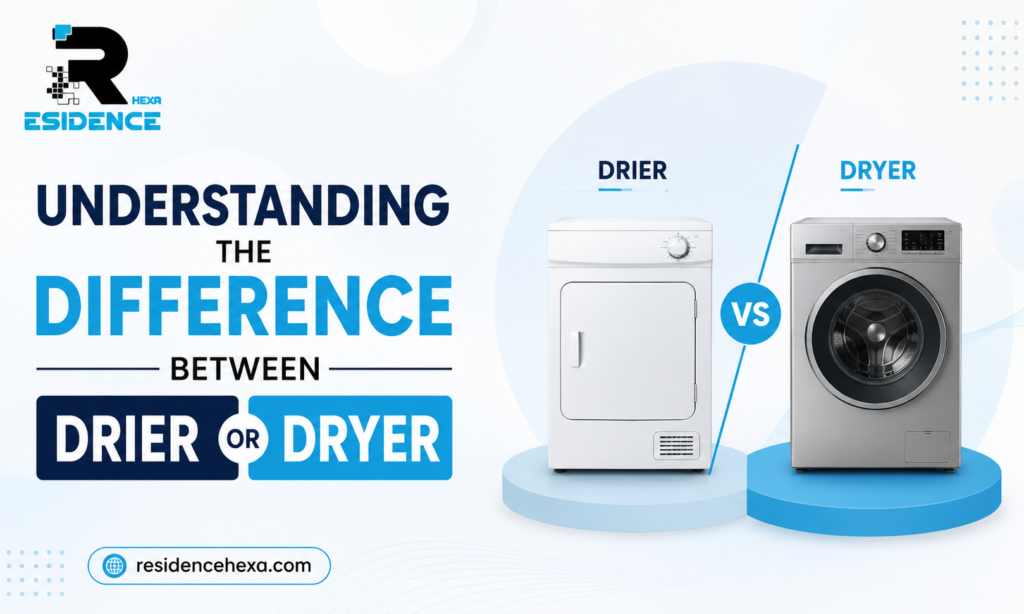
Drier and dryer are homophones — words that sound identical but differ in spelling, meaning, and part of speech. Both come from the root word “dry,” which is why they’re so easy to confuse. The distinction isn’t about pronunciation at all; it’s purely about grammar and context.
What Does “Drier” Mean? Definition, Grammar, and Usage
Drier is the comparative form of the adjective “dry.” It describes something with less moisture than something else, following the standard English rule of adding “-er” to short adjectives (fast → faster, dry → drier). According to Merriam-Webster, drier is recognized as the comparative form of dry, meaning less wet or more free of moisture than something else.
A drier can also describe a subtler kind of “dryness” — like humor or tone — that has nothing to do with moisture at all.
Examples of “Drier” in Sentences
- This towel is drier than the one on the rack.
- Arizona has a drier climate than Florida.
- My skin feels drier in winter.
- His sense of humor is even drier than his brother’s.
What Does “Dryer” Mean? Definition and Correct Usage
Dryer is a noun. It names a machine or device designed to remove moisture from something — clothes, hair, or other materials. It follows a common English pattern where “-er” turns a verb into “a thing that performs the action” (bake → baker, dry → dryer).
Types of Dryers: Clothes Dryer, Hair Dryer, and More
- Clothes dryer – tumbles and heats laundry to remove water
- Hair dryer – blows warm air to dry hair quickly
- Tumble dryer – the British English term for a clothes dryer
- Industrial dryer – used in manufacturing and food processing
- Hand dryer – found in public restrooms
Examples of “Dryer” in Sentences
- Put the wet towels in the dryer.
- She used a hair dryer to style her hair before the interview.
- The laundromat has ten washers and eight dryers.
Drier vs Dryer: Key Differences at a Glance
| Feature | Drier | Dryer |
| Part of speech | Comparative adjective | Noun |
| Meaning | More dry / less wet | A machine that removes moisture |
| Example | The desert is drier than the coast. | I dried my clothes in the dryer. |
| Common use | Weather, texture, tone, mood | Appliances, laundry, hair care |
Drier or Dryer: Which Word Should You Use?
A simple test: try substituting “more dry” into the sentence. If it still makes sense, use a drier. If the sentence is referring to an object or appliance, use a dryer.
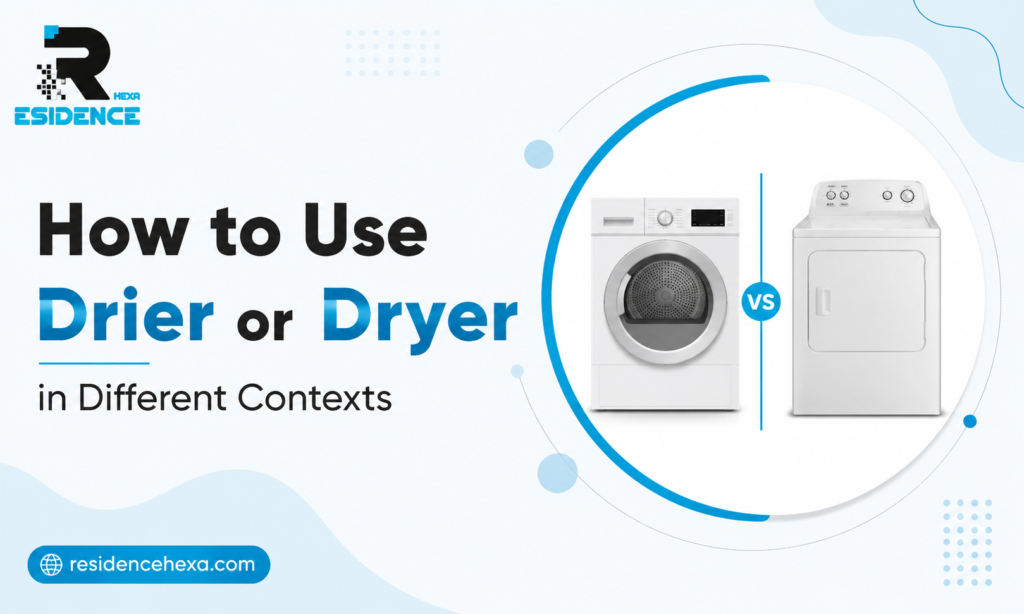
How to Use Drier or Dryer in Different Contexts
Drier or Dryer in Everyday Conversation
In casual speech, people usually get this right instinctively because context does the heavy lifting — “put it in the dryer” versus “it’s drier today.”
Drier or Dryer in Academic Writing
Academic and formal writing demands precision. Use drier only as a comparative adjective, and reserve dryer strictly for appliances or literal devices.
Drier or Dryer in Business and Marketing
Product descriptions, especially for appliances, should always use “dryer” (e.g., “energy-efficient dryer”). Weather or performance comparisons in marketing copy should use “drier” (e.g., “a drier, more comfortable fit”).
Common Mistakes with Drier or Dryer
Using “Dryer” Instead of “Drier”
Writing “the weather is dryer this week” is incorrect — it should be “drier.”
Using “Drier” for an Appliance
Writing “put your hair in the drier” is incorrect — it should be “dryer.”
Confusing Comparative Adjectives with Nouns
Remember: adjectives compare, nouns name things. Drier compares; dryer names a machine.
American vs. British English: Does Drier or Dryer Change by Region?
No — the spelling rule stays the same across American and British English. The only regional difference is vocabulary, not spelling: Americans typically say “clothes dryer,” while the British often say “tumble dryer.” The word “dryer” itself never changes.
How Major Style Guides Use Drier and Dryer
Style guides like the AP Stylebook and Chicago Manual of Style follow the same distinction: drier as the comparative adjective, dryer as the noun for appliances. Most 21st-century publications keep the two strictly separate, even though some older dictionaries once listed them as interchangeable variants.
Common Phrases: Dryer or Drier?
Dryer or Drier for a Washing Machine
Always “dryer” — it’s an appliance.
Drier or Dryer Weather
Always “drier” — it’s a comparison.
Tumble Dryer or Tumble Drier
Always “tumble dryer” — again, an appliance.
Drier Than or Dryer Than
Always “drier than” — it’s comparing two things.
Dryer or Drier Wine
Always “drier wine” — you’re comparing sweetness levels, so it’s an adjective.
Dryer Machine: Is It Correct?
Yes. “Dryer machine” is grammatically fine, though simply saying “dryer” is usually sufficient since the noun already implies a machine.
Is “Drier” a Real Word?
Yes, absolutely. Drier is a standard, dictionary-recognized comparative adjective, not a typo or informal variant of dryer.
Drier vs. Dryer Comparison Table
| Context | Correct Word | Example |
| Weather | Drier | “The forecast calls for drier air tomorrow.” |
| Laundry appliance | Dryer | “The dryer buzzed when the cycle finished.” |
| Hair care | Dryer | “She packed a travel hair dryer.” |
| Wine tasting | Drier | “This red is drier than the last one.” |
| Humor/personality | Drier | “His wit is drier than the Sahara.” |
Quick Quiz: Test Your Understanding of Drier vs. Dryer
- My boots are much _____ after sitting by the heater.
- Don’t forget to grab the towels from the _____.
- Autumn air tends to be _____ than summer air.
- The salon has a professional hair _____.
Quiz Answers
- drier
- dryer
- drier
- dryer
Easy Memory Trick to Remember Drier vs. Dryer
Notice that drier and adjective both contain the letter “i.” If you’re describing or comparing something, think “i” for adjective. If you’re naming a machine, think “y” — as in “y not just call it what it does?”
Real-Life Examples: How One Letter Changes the Meaning
- “The drier climate helped the crops.” (comparison — adjective)
- “The dryer helped dry the crops faster.” (machine — noun)
Swapping just one letter completely changes what the sentence means, which is exactly why this distinction matters in professional and everyday writing.
If you enjoy untangling tricky word pairs like this one, you might also want to read about purposed vs. proposed or explore the difference between what is it called, what’s it called, and it’s called for more grammar clarity.
Conclusion
The difference between drier and dryer comes down to one simple rule: drier compares dryness, while dryer names a machine that creates it. Once that distinction clicks, you’ll never hesitate over this word pair again. Keep the “i for adjective” trick in mind, double-check your context, and your writing will stay clean, accurate, and professional every time.