Have you ever typed a sentence like “he trys his best” and then stopped, unsure if that spelling looks right? You’re not alone. This is one of the most common spelling mix-ups in English, and it trips up native speakers and learners alike. The confusion usually comes from a simple habit: adding an “s” to a verb without thinking about the letter that comes before it.
The good news is that this rule is easy to learn once you see it clearly. In this guide, we’ll settle the trys or tries debate for good, walk through the grammar rule behind it, and cover real examples — including how “tries” is used in everyday writing and even on the rugby field.
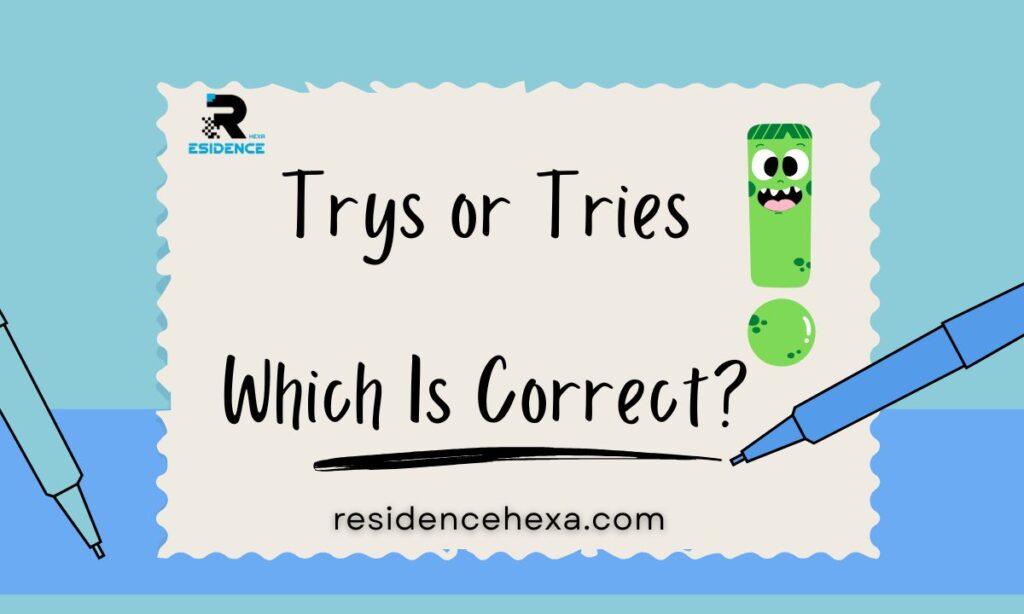
Quick Answer: Trys or Tries?
Tries is the only correct spelling. “Trys” is a common misspelling and is never considered standard English, whether you’re writing a text message, an email, or a formal report.
Is “Trys” or “Tries” the Correct Spelling?
The confusion usually happens because people add “-s” directly to a verb ending in “y” without changing anything, the way they might with “plays” or “says.” But “try” doesn’t follow that pattern. When a verb ends in a consonant followed by “y,” the “y” changes to “i” before adding “es.” That’s why we get tries, not “trys.”
What Does “Tries” Mean?
“Tries” is the third-person singular present tense form of the verb “try.” According to Merriam-Webster, the verb “try” means to make an attempt or effort to do something. It’s used whenever the subject is he, she, it, or a singular noun.
Examples:
- She tries to wake up early every morning.
- The company tries to improve its customer service.
“Tries” can also work as a plural noun, meaning multiple attempts, such as “It took him three tries to open the jar.”
Why “Trys” Is Incorrect
“Trys” breaks a basic English spelling rule. Verbs that end in a consonant plus “y” must change the “y” to “i” before adding “es” in the third-person singular form. “Trys” simply ignores that rule, which is why dictionaries, style guides, and grammar checkers all flag it as an error. You won’t find “trys” listed as an acceptable variant anywhere in standard English.
Trys vs Tries: Key Differences
| Feature | Trys | Tries |
| Correct spelling | ❌ No | ✅ Yes |
| Found in dictionaries | No | Yes |
| Grammar rule followed | No | Yes (consonant + y → ies) |
| Acceptable in formal writing | Never | Always |
| Common usage | Typo/misspelling | Standard verb & noun form |
Grammar Rule: Why “Try” Changes to “Tries”
English has a straightforward spelling rule for verbs ending in a consonant + “y”:
- Identify the letter before the final “y.” If it’s a consonant, change the “y” to “i.”
- Add “-es” instead of just “-s.”
- This creates the correct third-person singular or plural form.
So “try” becomes “tries,” just like:
- Cry → Cries
- Fry → Fries
- Carry → Carries
This rule doesn’t apply when the letter before the “y” is a vowel. For example, “play” becomes “plays,” not “plaies,” because “a” is a vowel.
He Trys or He Tries? (Common Grammar Rule)
The correct phrase is always “he tries,” never “he trys.” Third-person singular subjects (he, she, it) require the verb to take the “-es” ending, following the consonant + y rule described above.
- Correct: He tries to finish his homework before dinner.
- Incorrect: He trys to finish his homework before dinner.
Tries vs Trys Examples in Sentences
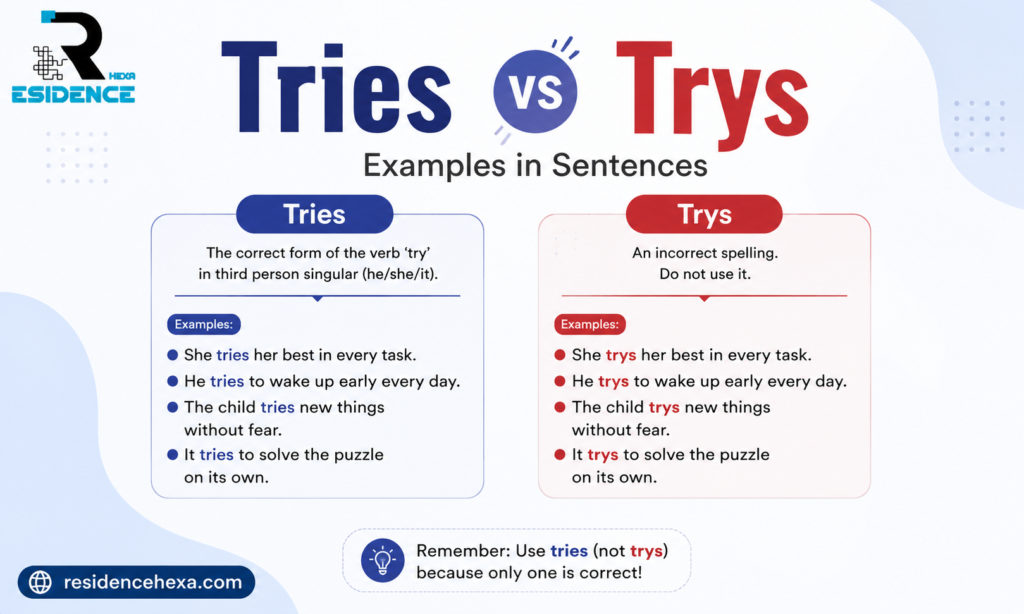
- Correct: My sister tries a new recipe every weekend.
- Incorrect: My sister trys a new recipe every weekend.
- Correct: The team scored three tries in the second half.
- Incorrect: The team scored three trys in the second half.
- Correct: He always tries his hardest, even when things get difficult.
Correct Usage in Everyday Sentences
“Tries” fits naturally into many everyday contexts:
- Work: She tries to meet every deadline on time.
- School: The student tries hard to understand new concepts.
- Health: He tries to eat healthier meals each week.
- Relationships: My friend always tries to stay in touch, even when life gets busy.
Because “try” is such a common verb, learning the correct form of “tries” makes a noticeable difference in how polished your writing looks. If you’re also unsure about other verb-tense mix-ups, this guide on the difference between send and sent breaks down a similar everyday grammar confusion with clear rules and examples.
Common Mistakes People Make with Trys or Tries
- Adding “-s” directly to “try” without changing the “y,” resulting in “trys.”
- Assuming the rule works the same for all “y”-ending verbs, without checking whether a vowel or consonant comes before the “y.”
- Autocorrect and fast typing, which often let “trys” slip through unnoticed.
- Confusing “tries” with other irregular verb forms while writing quickly.
- Forgetting that “tries” also works as a plural noun, not just a verb.
Tips to Remember the Correct Spelling
- Remember the pattern: consonant + y → change y to i, then add “es.”
- Compare “try” to similar words like “cry/cries” and “fly/flies” — they all follow the same rule.
- Read your sentence aloud; “trys” often sounds and looks off once you know the rule.
- Use a spelling or grammar checker when writing something formal, like a resume or report.
- Practice with flashcards pairing base verbs (try, cry, fry) with their correct “-ies” forms.
If spelling patterns like this one interest you, you may also want to review how to correctly spell summarise or summarize, which covers another frequently confused word pair rooted in spelling conventions.
Trys or Tries Rugby: What Does “Tries” Mean in Rugby?
In rugby, a “try” is a scoring play where a player grounds the ball in the opponent’s in-goal area. When talking about more than one of these scoring plays, the correct plural is tries, not “trys.”
- Correct: The winger scored two tries in the first half.
- Incorrect: The winger scored two trys in the first half.
This rule applies whether you’re discussing a school match or a professional championship — “tries” is the standard term used by commentators, sports journalists, and official rugby bodies alike.
3 Tries or Trys? Which Is Correct?
When counting multiple attempts or rugby scores, always use “3 tries,” never “3 trys.” The plural form follows the same consonant + y rule as the verb form, so there’s no separate spelling for counting purposes.
- Correct: He made 3 tries before finally solving the puzzle.
- Incorrect: He made 3 trys before finally solving the puzzle.
Practice Exercises: Trys or Tries
Choose the correct word for each sentence:
- She always ______ to help her classmates. (tries/trys)
- The rugby player scored two ______ in the match. (tries/trys)
- He ______ his best every single day. (tries/trys)
- After three ______, she finally passed the driving test. (tries/trys)
- The dog ______ to catch the ball every time. (tries/trys)
Answers: 1. tries 2. tries 3. tries 4. tries 5. tries
Conclusion
The debate between trys or tries has a simple, permanent answer: tries is correct, and “trys” is always a spelling mistake. This comes down to one dependable English rule — when a verb ends in a consonant plus “y,” you change the “y” to “i” and add “es.” Whether you’re writing about someone’s daily effort, counting rugby scores, or drafting a professional email, sticking to “tries” keeps your writing accurate and credible. Once this rule clicks, you’ll never second-guess “he tries” or “3 tries” again.