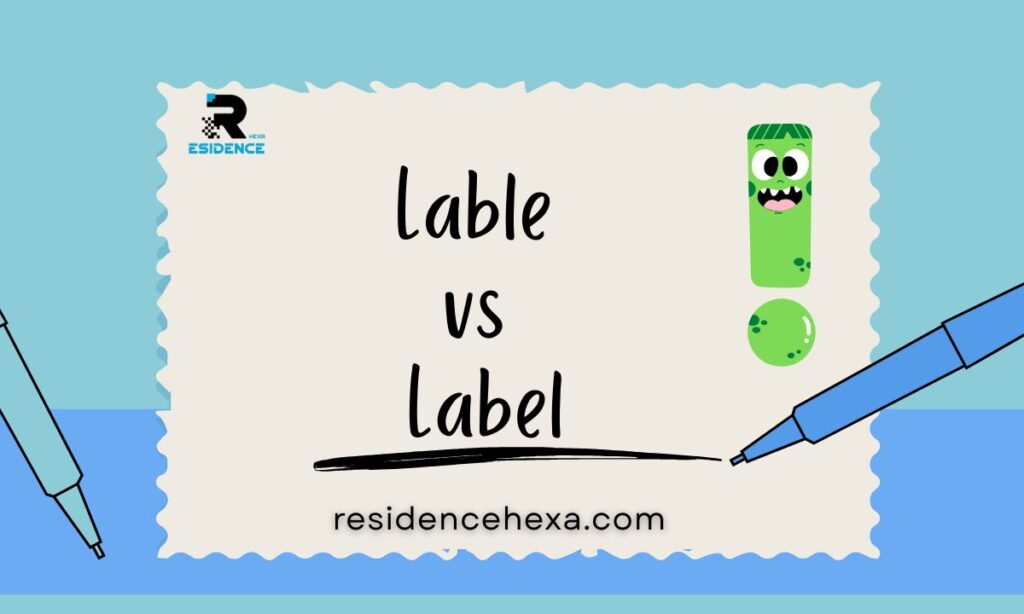
If you’ve ever paused mid-sentence wondering whether it’s “lable” vs “label,” you’re not alone. This is one of the most common spelling mix-ups in English, and it trips up native speakers and learners alike. The confusion usually comes down to how the word sounds when spoken quickly, combined with the pull of similar-looking words like “table” and “cable.”
The good news is that the rule here is simple, with no exceptions to memorize. In this guide, you’ll learn the correct spelling, what the word means as both a noun and a verb, why the mistake happens so often, and practical tricks to lock the right spelling into memory for good.
Quick Answer
Label is the only correct spelling. Lable is a common misspelling and is not a recognized word in English, whether you’re writing for a UK or US audience. If you remember one thing from this article, remember this: label rhymes with table, and both end in “-le” turned around — think l-a-b-e-l.
Meaning of Label (Correct Form)
As a Noun
As a noun, a label is a piece of paper, fabric, plastic, or other material attached to an object to identify or describe it. Think of the nutrition facts on a cereal box or the size tag inside a jacket. According to Merriam-Webster, a label can also refer to a descriptive word or phrase applied to a person, group, or idea — for example, calling someone a “genius” is a kind of label.
As a Verb
As a verb, to label means to attach an identifying tag to something, or to categorize someone or something, sometimes in a reductive or unfair way. For example:
- She labeled every box before the move.
- Try not to label people based on first impressions.
British vs American Spelling
Here’s where a real (and different) spelling distinction exists — but it’s not between “label” and “lable.” It’s in how the word changes when suffixes are added:
| Form | American English | British English |
| Base word | label | label |
| Past tense | labeled | labelled |
| Present participle | labeling | labelling |
| Person who labels | labeler | labeller |
Notice that the base spelling “label” never changes. Only the verb forms double the “l” in British English.
Meaning of Lable (Incorrect Form)
“Lable” carries no meaning at all. It isn’t a word in any dictionary, isn’t a regional spelling, and isn’t an older or alternate form of “label.” It’s simply an error — one that happens to be extremely common.
Why Do People Write “Lable”?
A few patterns explain why this mistake keeps showing up:
- Pronunciation confusion: The second syllable of “label” sounds a bit like “bul,” which can nudge people toward “lable.”
- Pattern matching with other words: Words like “table,” “cable,” and “fable” end in “-ble,” so writers sometimes assume “label” follows the same pattern.
- Fast typing: Swapping two adjacent letters (the classic “e” and “l” transposition) is one of the most frequent typos in English.
- Muscle memory from mobile keyboards: Autocorrect doesn’t always catch it, especially when typing quickly on a phone.
Lable vs Label: Key Differences
| Feature | Label | Lable |
| Correct spelling | ✅ Yes | ❌ No |
| Found in dictionaries | Yes (Merriam-Webster, Oxford, etc.) | No |
| Part of speech | Noun and verb | None — not a word |
| Used in formal writing | Yes | Never |
| Common in British English | Yes | No |
| Common in American English | Yes | No |
Key Takeaway
There is no legitimate context — academic, professional, casual, British, or American — where “lable” is correct. If you’re unsure while writing, default to “label” every time.
Lable vs Label Examples
- ❌ Please lable the shipping box. → ✅ Please label the shipping box.
- ❌ The lable on the jar was torn. → ✅ The label on the jar was torn.
- ❌ Don’t lable people you barely know. → ✅ Don’t label people you barely know.
- ❌ The teacher asked us to lable the diagram. → ✅ The teacher asked us to label the diagram.
- ❌ His new album is out on a small lable. → ✅ His new album is out on a small label.
Common Mistakes People Make
Mixing Letter Order
The most frequent error is transposing the “e” and the “l,” turning label into lable. Slowing down while proofreading catches most of these.
Assuming British vs American Difference
Some writers assume “lable” might be a British or American variant, similar to “color” versus “colour.” It isn’t. Both dialects agree: it’s label.
Typing Errors
Autocorrect tools don’t always flag “lable” since it can resemble a plausible word shape. Manual proofreading still matters.
Confusion with Similar Words
Writers occasionally blur the line between label, tag, and sticker. While related, they aren’t interchangeable — a tag is often a small attached card, while a sticker is specifically adhesive.
Correct Usage of Label in Sentences
Everyday Use
- Always check the label before taking medication.
- The jar’s label had faded in the sun.
Workplace Examples
- Please label each file with today’s date.
- The manager asked the team to label the inventory boxes clearly.
Educational Context
- Students were asked to label the parts of the cell.
- Label your homework with your full name and class section.
Social Context
- It’s unfair to label someone after one bad day.
- People often resist being labeled by a single mistake.
Shopping & Products
- Check the nutritional label before buying packaged snacks.
- The clothing label listed the fabric as 100% cotton.
Tips to Remember the Correct Spelling
Break the Word
Split it into two clear chunks: la + bel. Neither piece resembles “lable.”
Compare with the “Table” Trick
Label rhymes with table, cable, and fable — all of which end in “-le” reversed as “-el” only in the label’s specific pattern (l-a-b-e-l). Picture a label sitting on a table; both end the same way.
Say It Clearly
Sound out each syllable slowly: LAY-bul. This slower pronunciation makes the correct letter order easier to recall while writing.
Use Spell Check Tools
Built-in spell checkers in Word, Google Docs, and Grammarly will flag “lable” instantly, but don’t rely on this alone for handwritten or fast-typed content.
Practice Writing
Write the correct spelling a few times in context: “label,” “labeled,” “labeling.” Repetition builds long-term memory faster than reading alone.
Remember This Rule
If you can spell “table,” you can spell “label” — just swap the first letter and remember the ending stays “-el,” not “-le.”
Conclusion
The takeaway is straightforward: label is correct, and lable is always a mistake, regardless of context, dialect, or formality level. Whether you’re writing a product description, an academic paper, or a quick text message, sticking to “label” keeps your writing accurate and professional. If you found this breakdown useful, you might also enjoy sorting out other tricky word pairs like purposed vs proposed or getting the correct plural form in passersby, passerbys, or passerbyers.