If you’ve ever typed a sentence about a tall bird or a construction machine and paused to wonder whether it’s spelled “crain” or “crane,” you’re in good company. This is one of those small spelling mix-ups that trips up native speakers, students, and even professional writers, usually because the word sounds so simple but looks slightly tricky once you start typing fast.
The good news is that the answer is straightforward. Only one of these spellings is a standard English word, and the other one is either a surname or a common typo. In this guide, you’ll learn exactly which spelling to use, why the confusion happens, and how to remember the difference for good.
Quick Answer
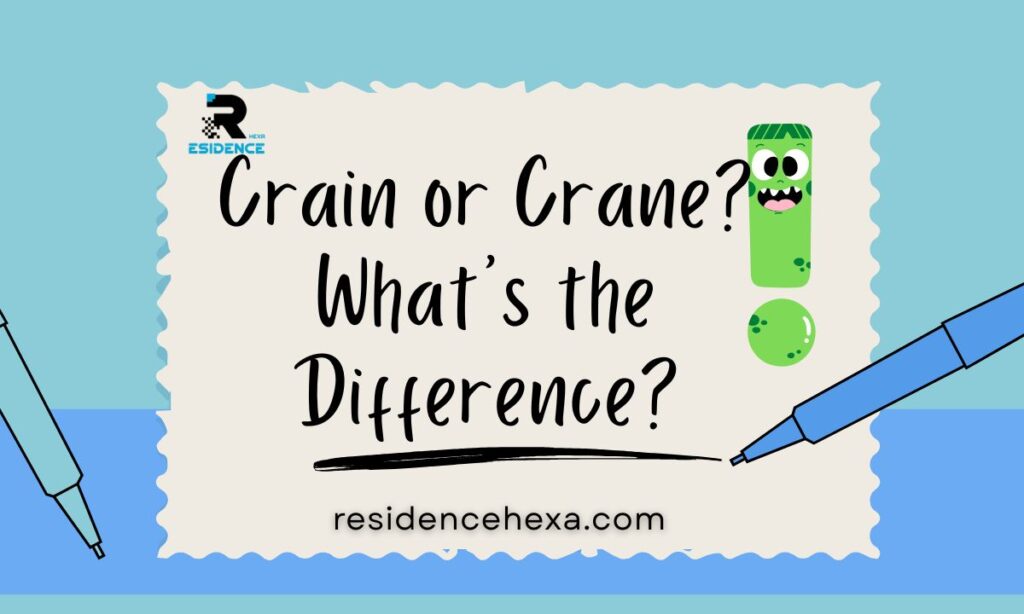
“Crane” is the correct spelling. It refers to a long-necked bird and to a machine used for lifting heavy objects. “Crain,” on the other hand, is not a recognized English word — it mostly shows up as a surname or as a simple misspelling of “crane.”
Meaning of the Correct Form – “Crane”

The word “crane” carries two main meanings in everyday English, and both are completely correct.
1. Crane as a Bird
A crane is a large wading bird known for its long neck, long legs, and graceful movements. Cranes belong to the Gruidae family and are often spotted near wetlands, rivers, and open fields. Species like the sandhill crane and the whooping crane are well known among birdwatchers for their striking migration patterns.
2. Crane as a Machine
The second common meaning refers to a tall piece of construction equipment used to lift and move heavy materials. Tower cranes are a familiar sight on skylines around the world, helping build everything from apartment complexes to bridges. According to Merriam-Webster, “crane” also functions as a verb, meaning to stretch one’s neck to see something better — a usage that ties both meanings together, since the bird itself stretches its long neck in a similar way.
Meaning of the Incorrect Form – “Crain”
“Crain” is not listed as a standard noun or verb in any major English dictionary. It carries no independent meaning of its own in everyday grammar and should not be used as a substitute for “crane” in writing.
Crain Definition
There is no dictionary definition for “crain” as a common word. It exists almost exclusively as:
- A surname (for example, people named John Crain or Emily Crain)
- A place name in a handful of regional contexts
- A typing error made when someone means to write “crane”
Crain Meaning
Because “crain” isn’t a recognized English word, it has no fixed meaning outside of being a proper noun. If you see it used as a common noun in a sentence, it’s almost always a spelling mistake that should be corrected to “crane.”
Keyword Comparison / Key Differences
| Feature | Crane ✅ | Crain ❌ |
| Word type | Standard English noun/verb | Mostly a surname |
| Meaning | Bird or lifting machine | No standard meaning |
| Dictionary status | Listed in all major dictionaries | Not listed as a common word |
| Common use | Everyday writing, construction, nature topics | Names, typos |
| UK vs US spelling | Same in both | Not applicable |
Crain or Crane
Quick Explanation
“Crane” wins every time when you’re describing the bird or the machine. “Crain” only belongs in writing when referring to someone’s actual surname.
Crane or Crain
Quick Explanation
If you’re stuck choosing between the two while writing, default to “crane.” It’s the version accepted in dictionaries, style guides, and professional writing across every English-speaking region.
Crane vs Crain
Quick Explanation
Think of it this way: cranes fly and lift things; “crain” doesn’t do anything, because it isn’t a functioning word in the language.
Spell Crane
Quick Explanation
The correct spelling is c-r-a-n-e. A simple way to lock it in is remembering that the bird’s long neck “extends,” and so does the word — it ends in a silent “e,” just like other lengthening words such as “plane” and “lane.”
Common Mistakes People Make
Common Mistakes:
- Typing “crain” instead of “crane” due to fast typing or autocorrect slips
- Assuming “crain” is a valid alternate spelling because it sounds identical when spoken
- Confusing “crane” with the similarly spelled but unrelated word “craine”
- Using “crain” in formal writing after seeing it as someone’s last name
UK vs US Note
Unlike many words that change spelling between British and American English (such as “colour” vs. “color”), “crane” is spelled the same way in both varieties. There is no regional exception here, so writers in the UK, US, Canada, Australia, and elsewhere should always use “crane.”
Correct Usage in Sentences
For Birds
- The sandhill crane migrated south as winter approached.
- A crane stood motionless at the edge of the marsh, watching the water.
For Machines
- The construction crew used a tower crane to lift the steel beams.
- That crane can hoist several tons of material in a single lift.
In Idioms / Figurative Language
- She had to crane her neck to see over the crowd.
- He craned forward, straining to catch every word of the announcement.
Extra Examples
- Emily Crain (a person’s surname) presented her research at the conference.
- The paper crane is a popular origami design in Japanese culture.
Tips to Remember the Correct Usage

- Picture the bird’s long neck stretching out — that visual matches the long “a” sound in “crane.”
- Remember that “crain” only appears correctly as someone’s name, never as a common noun.
- If spell-check flags “crain,” trust it — the correct fix is almost always “crane.”
- Compare it to other similar spelling pairs, like this guide on Drier or Dryer, where one spelling is standard and the other is a common mix-up.
- When in doubt, read the sentence aloud — if you’re talking about a bird or machine, “crane” is your answer.
Conclusion
The takeaway is simple: “crane” is the correct and only standard spelling for both the long-necked bird and the heavy-lifting construction machine, while “crain” is limited to use as a surname or is simply a spelling error.
Keeping this distinction in mind will help you write with more confidence, whether you’re describing wildlife, discussing construction equipment, or double-checking a name. For more guidance on commonly confused words, take a look at this breakdown of Winner or Winer, another pair that trips up even careful writers.