Ask ten people to spell the plural of “goose,” and at least a couple will hesitate. It’s one of those English words that refuses to play by the normal rules, and that’s exactly why so many writers, students, and even native speakers pause before typing it. If you’ve ever typed “gooses” and then stared at it wondering if that’s actually a word, you’re not alone.
This guide breaks down exactly when to use “goose” and when to use “geese,” why English treats this word so differently from regular nouns, and how to avoid the small mistakes that trip people up in emails, essays, and everyday conversation. By the end, you’ll never second-guess this word again.
Quick Answer
Goose is singular — it means one bird. Geese is plural — it means two or more birds. There is no “gooses” in standard English. This is an irregular plural, similar to “foot” becoming “feet” or “tooth” becoming “teeth.”
| Form | Meaning | Example |
| Goose | One bird | A goose swam across the pond. |
| Geese | Two or more birds | The geese swam across the pond. |
| Gooses | Not a real word | ❌ Incorrect in all contexts |
Meaning of the Correct Form
What Does “Goose” Mean?
“Goose” is a noun referring to a large water bird in the Anatidae family, related to ducks and swans. It’s always singular — one goose, not a group. Merriam-Webster’s dictionary entry describes the goose as a large web-footed bird, typically bigger than a duck with a longer neck. You’ll also hear “goose” used as a verb, meaning to poke someone playfully, or in idioms like “cook someone’s goose.”
What Does “Geese” Mean?
“Geese” is the plural form of “goose,” used whenever you’re talking about two or more of these birds. It doesn’t follow the standard “-s” plural pattern that most English nouns use. Instead, it comes from an ancient vowel-change pattern in Old English, meaning the entire word shifts rather than just gaining a letter at the end.
Meaning of the Incorrect Form (If Any)
Is “Gooses” Correct?
No. “Gooses” is not a standard English word. Many learners assume every noun becomes plural by adding “-s,” but “goose” belongs to a small group of irregular nouns that change internally instead. The only correct plural is “geese.” If you catch yourself writing “gooses,” swap it for “geese” immediately.
Geese vs Goose Meaning
Both words describe the exact same species of bird — the difference is purely about number, not meaning. Goose refers to a single bird; geese refers to a flock or group of two or more. Neither word changes based on gender, region, or formality — American English and British English use them identically.
Keyword Comparison / Key Differences
Goose vs Geese
| Feature | Goose | Geese |
| Grammar role | Singular noun | Plural noun |
| Number of birds | One | Two or more |
| Verb agreement | Goes with singular verbs (is, walks) | Goes with plural verbs (are, walk) |
| Plural rule type | N/A | Irregular (vowel change, not “-s”) |
| Similar word patterns | Foot, tooth, mouse | Feet, teeth, mice |
Key Points to Remember
- Goose = one bird; geese = many birds.
- Never add “-s” to make “goose” plural.
- Geese pairs with plural verbs: “The geese are flying.”
- Goose pairs with singular verbs: “The goose is swimming.”
- Possessive forms differ too: “the goose’s nest” (singular) vs. “the geese’s nest” (plural).
Geese or Goose Band
If you’ve searched this topic recently, you may have landed here because of the buzz around Geese, the Brooklyn-formed rock band that’s gained major attention for its album “Getting Killed.” It’s worth noting there’s also an unrelated American jam band simply called Goose, based in Connecticut. The two acts are entirely separate groups, and the naming overlap is a coincidence — but it’s a common source of confusion when people search “geese or goose” online.
Geese or Goose White
“White geese” is a real ornithological term referring to species like the Snow Goose, Ross’s Goose, and Emperor Goose — birds known for their mostly white plumage with black wingtips. When referring to more than one white-feathered goose, “white geese” is correct; a single bird is a “white goose.” The same singular-plural rule applies here as it does everywhere else with this word.
Geese vs Goose Pronunciation
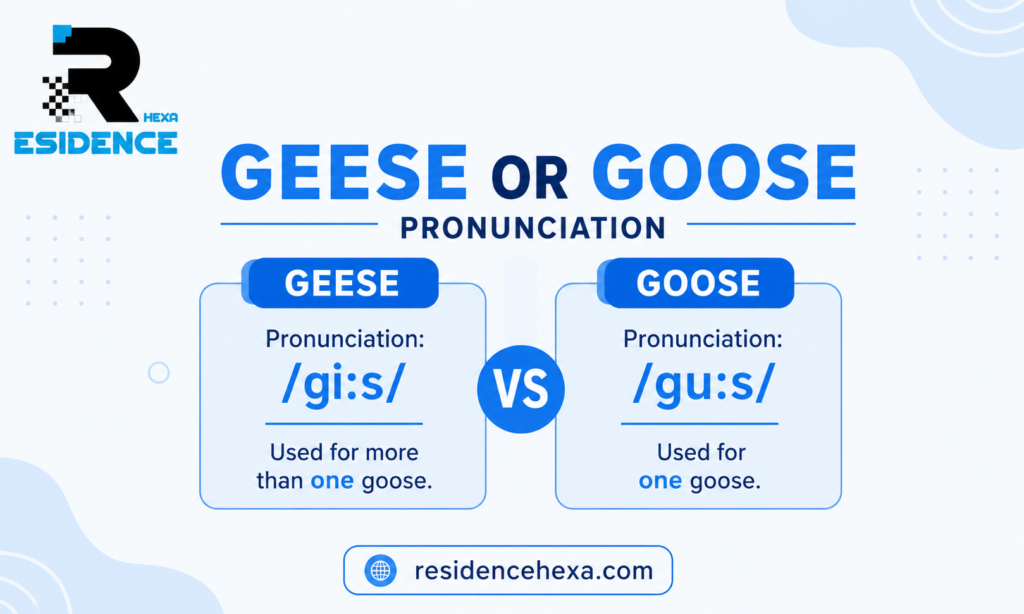
- Goose is pronounced /guːs/ — rhyming with “loose” or “moose.”
- Geese is pronounced /giːs/ — rhyming with “peace” or “fleece.”
The vowel sound shifts from a long “oo” sound in “goose” to a long “ee” sound in “geese,” which mirrors the spelling change and makes the words easy to distinguish out loud.
Common Mistakes People Make
1. Adding “-s” to Form the Plural
Writing “gooses” instead of “geese” is the single most common error, especially among English learners applying the standard plural rule to an irregular noun.
2. Mixing Singular and Plural
Sentences like “The geese is loud” mismatch a plural subject with a singular verb. It should read “The geese are loud.”
3. Using the Wrong Form in Writing
Some writers use “geese” when referring to just one bird, likely because it “sounds” more natural in a sentence. Always double-check the actual count before choosing the word.
4. Confusion in Idioms
Idioms like “cook someone’s goose” or “wild goose chase” always use the singular “goose,” even though the phrase might describe a group activity. These are fixed expressions, not literal counts.
Correct Usage in Sentences
Using “Goose” (Singular)
- A goose waddled across the farmyard.
- The goose hissed at the dog.
- I saw a goose near the lake this morning.
Using “Geese” (Plural)
- The geese flew south for the winter.
- A flock of geese landed on the pond.
- Geese are known for mating for life.
Mixed Examples
- One goose stayed behind while the rest of the geese migrated.
- The farmer keeps a single goose, but his neighbor raises dozens of geese.
Tips to Remember the Correct Usage

1. Remember the Pattern
Think of “foot → feet” and “tooth → teeth.” “Goose → geese” follows the exact same internal vowel-change pattern.
2. Use a Simple Trick
If you can count more than one bird, use “geese.” If you’re talking about just one, use “goose.” Never insert an “-s.”
3. Practice with Sentences
Write a few practice sentences using both forms until the switch feels automatic rather than something you have to think about.
4. Visual Memory Trick
Picture a single goose standing alone (goose = one) versus a large flock honking overhead (geese = many). The mental image reinforces the grammar.
5. Avoid Overthinking
This is a short, well-established rule with no exceptions. Once you’ve memorized “one goose, many geese,” there’s nothing more to second-guess.
Conclusion
The rule behind goose and geese is short, but it’s one of those grammar points that quietly builds your credibility as a writer. Goose is singular, geese is plural, and “gooses” simply isn’t part of standard English. Once you connect this word to other irregular plurals like foot/feet and tooth/teeth, the pattern sticks for good. For more quick, practical grammar breakdowns like this one, take a look at Residence Hexa’s guide on when to use “trys” versus “tries” or their explainer on forming plurals correctly with “babies” versus “baby’s” — both tackle the same kind of everyday mix-ups that trip up confident writers.