
You’re scrolling through a group photo, a meme, or a personality quiz result, and you want to ask a friend to point themselves out. Your fingers hover over the keyboard, and suddenly a tiny grammar question stops you cold: is it “which one are you” or “which one is you”? It looks like a simple two-word swap, but it trips up native speakers and English learners alike, especially in fast-moving text chats and social media captions where nobody stops to think twice.
The good news is that this mix-up has a clean, memorable answer rooted in one of the most basic rules in English grammar: subject-verb agreement. Once you understand why one version wins, you’ll never second-guess yourself again — and you’ll start noticing the same rule pop up in dozens of similar phrases. This guide breaks down the correct form, explains the logic in plain English, and gives you real examples so the rule sticks for good.
Quick answer: Which one is correct and why
“Which one are you?” is the grammatically correct phrase. The subject of the sentence is the pronoun “you,” and “you” always pairs with “are” — never “is” — no matter how many people you’re talking about or how the sentence is phrased.
“Which one is you?” shows up constantly in casual speech, texting, and social media, but it doesn’t follow standard subject-verb agreement rules. It’s a common, understandable slip, not an accepted grammatical alternative.
Why this question confuses so many people
Two things collide here, and both pull speakers in the wrong direction.
- “One” looks singular. Since “which one” sounds like it’s asking about a single item, people instinctively reach for the singular verb “is.”
- “You” doesn’t feel plural. Even though “you” behaves grammatically like a plural pronoun, it refers to a single person in most everyday conversations, so the “are” pairing feels counterintuitive.
Add fast typing, regional speech habits, and the influence of phrases like “that is you” or “this is you” — which really are correct — and it’s easy to see why “which one is you” spreads so easily, even though it breaks the rule.
The core rule you actually need
English verbs agree with their subject, not with the noun sitting closest to the verb. In “Which one are you?” The true subject is “you,” not “one.” The word “one” is simply part of the question phrase — it identifies what kind of choice is being made, but it doesn’t control the verb.
Plain rule to memorize
If the subject of the sentence is “you,” always use “are.” No exceptions.
This holds true whether you’re addressing one person or a group, and it holds true in every tense-appropriate variation: “Who are you?”, “Where are you?”, “How are you?”, and “Which one are you?” all follow the exact same pattern.
“Which One Are You?” vs. “Which One Is You?” at a glance
| Feature | Which One Are You? | Which One Is You? |
| Standard grammar | ✅ Correct | ❌ Incorrect |
| Subject-verb agreement | Matches “you” with “are” | Mismatches “you” with “is” |
| Used in formal writing | Yes | No |
| Used in school or academic essays | Yes | No |
| Used in business communication | Yes | No |
| Heard in casual conversation | Very common | Occasionally, informally |
| Recommended for learners | Yes | No |
Breaking down sentence structure: What’s really being asked
When you ask “Which one are you?” you’re really asking someone to identify themselves out of a group of options — people in a photo, characters in a quiz, or items in a lineup. Structurally, the sentence works like this:
- “Which one” — the question phrase, pointing to a group of choices.
- “are” — the verb, which must agree with the actual subject.
- “you” — the subject, the person being asked to respond.
Because English typically inverts word order in questions, it’s easy to misread “one” as the subject simply because it appears right before the verb. But moving the sentence into statement form makes it obvious: “You are the one in the red shirt” — not “you is.” That confirms “you” is driving the verb choice, not “one.”
Subject-verb agreement table: Which one uses is or are?
| Subject | Correct Verb | Example |
| I | am | I am the one in the middle. |
| You | are | Which one are you? |
| He / She / It | is | Which one is he? |
| We | are | Which ones are we? |
| They | are | Which ones are they? |
| One (as a formal pronoun) | is | Which one is correct? |
Notice that “one” only takes “is” when “one” itself is the subject of the sentence — for example, “Which one is correct?” That’s a completely different sentence structure from “Which one are you?” where “you” is doing the grammatical work.
Is “Which One Is You?” ever acceptable?
In strict, standard English, no — “which one is you” doesn’t meet the rules of subject-verb agreement. That said, language in the real world is flexible, and you’ll still hear it in a few contexts:
- Casual or regional speech, especially in fast conversation where speakers aren’t focused on formal grammar.
- Social media captions and comments, where informal tone is the norm.
- Song lyrics or dialogue, where writers sometimes prioritize rhythm or a character’s voice over textbook correctness.
None of these contexts make the phrase “correct” in an academic or professional sense — they simply show that spoken English often bends written rules. If you’re writing an email, an essay, a resume, or anything formal, stick with “which one are you.”
Why “Which One Are You?” is grammatically correct
The explanation comes down to one dependable fact: “you” is grammatically treated as plural in English, even when it refers to a single person. This is different from many other languages, which distinguish between a singular “you” and a plural “you.” English collapsed that distinction centuries ago, and as a result, “you” always takes the same verb forms as “we” and “they” — never the singular forms used with “he,” “she,” or “it.”
That’s why constructions like “You are late,” “You are wonderful,” and “Which one are you?” all use “are,” regardless of context. According to Merriam-Webster, standard subject-verb agreement requires the verb to match the true grammatical subject in number and person — and with “you,” that subject always calls for a plural-style verb form. This single, consistent rule is what keeps “which one are you” grammatically sound in every situation.
Why “Which One Are You?” sounds natural to Americans
For most American English speakers, “which one are you” isn’t something they consciously calculate — it simply sounds right, the same way “how are you” or “who are you” sounds right. That instinct comes from repetition: children hear and absorb pronoun-verb pairings like “you are” from an early age, long before they learn formal grammar rules in school.
This is also why “which one is you” can sound jarring to native ears, even to speakers who couldn’t explain the rule if asked. The mismatch between “you” and “is” clashes with thousands of hours of accumulated language exposure, which is part of why the correct version dominates in books, news writing, and professional communication across the United States.
What is “Which One Are You?” mean?
At its core, “Which one are you?” is a request for identification. The speaker is looking at a set of options — people, characters, objects, or choices — and asking the listener to point out which specific one represents them. It’s commonly used to:
- Identify a person in a photo or video
- Match someone to a category, result, or label
- Distinguish one person from a group of similar-looking options
- Clarify a choice among multiple listed items
The phrase assumes there’s a defined set to choose from, which is why it so often appears alongside images, lists, or quizzes.
Real-life examples you’ll actually hear
“Which One Are You?” in pictures
- “This is our whole team at the retreat — which one are you?”
- “I found an old class photo. Which one are you in the back row?”
“Which One Are You?” in quizzes
- “The quiz sorted everyone into four personality types — which one are you?”
- “Out of the five Hogwarts-style houses, which one are you?”
“Which One Are You?” when choosing between people or things
- “We have two candidates named Alex on the list — which one are you?”
- “There are three package options on the screen. Which one are you choosing?”
Common mistakes and why they happen
Frequent mistakes
- Saying or writing “which one is you” in formal contexts like emails or reports
- Assuming “one” is always the grammatical subject in “which one” questions
- Mixing up “which one is yours” (a different, correct structure) with “which one is you”
- Over-correcting and using “are” in places where “is” is actually needed, such as “Which one is correct?”
Why mistakes occur
These errors usually stem from three sources: fast, unedited speech; direct translation habits among ESL speakers whose native language treats “you” as strictly singular; and simple proximity bias, where the brain matches the verb to whichever word sits closest, rather than the true subject.
“Which You” vs. “Which One Are You”: What’s the Difference?
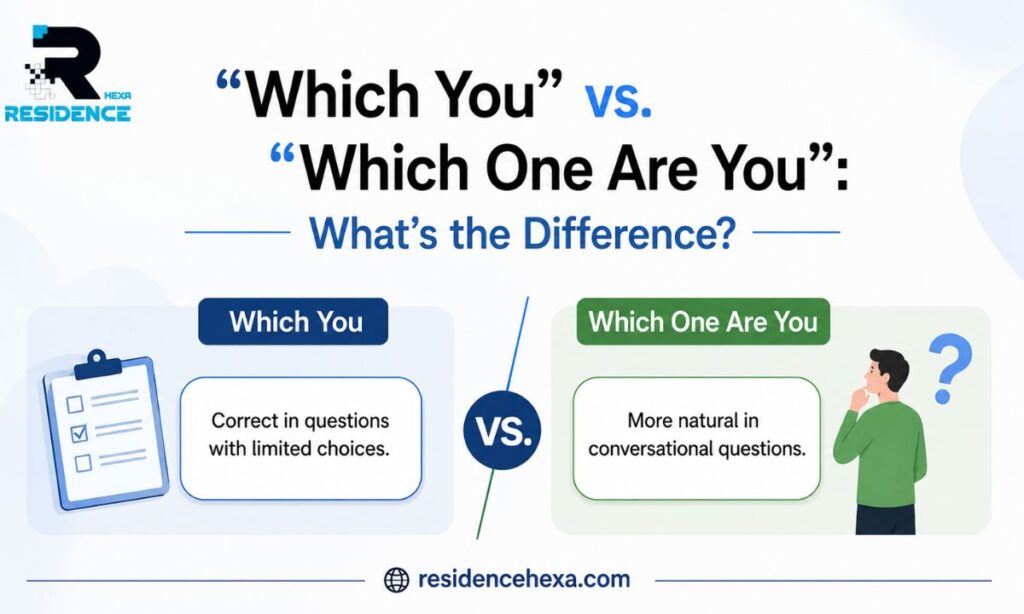
“Which you” isn’t a natural standalone phrase — it needs more context, as in “Which of you.” “Which one are you” is a complete, self-contained question that asks someone to identify themselves within a defined group. If you’re asking about identity or selection among people, “which one are you” is almost always the phrase you want.
Quick decision chart: Choose “is” or “are” in two seconds
Ask yourself: What is the true subject of my sentence?
- Subject is “you” → use are (“Which one are you?”)
- Subject is “one” → use is (“Which one is correct?”)
- Subject is “he/she/it” → use is (“Which one is hers?”)
- Subject is “we/they” → use are (“Which ones are theirs?”)
If you’re ever unsure, rewrite the question as a statement. “You ___ the one” only ever fits with “are,” which confirms your answer instantly.
How Americans actually use these phrases in daily speech
Teenagers and young adults
Younger speakers frequently use “which one are you” in texting, gaming chats, and meme culture — sometimes shortened to “which one r u” — but the underlying grammar stays consistent with the standard rule, even when spelling gets casual.
Professionals and formal settings
In workplace emails, presentations, and written reports, “which one are you” is the only version considered acceptable. Editors and style guides consistently favor it, and using “which one is you” in a professional document can come across as a careless error.
Regional differences
Certain regional and informal dialects loosen subject-verb agreement rules across many phrases, not just this one. That’s why you might occasionally hear “which one is you” in casual regional speech or television dialogue written to reflect a character’s voice — none of which reflect standard written English.
Editing and proofreading: Spotting and fixing errors
How to spot the error instantly
Read the sentence aloud and isolate the pronoun and verb pair. If you hear “is you” anywhere in your draft, pause and check whether “you” is functioning as the subject. If it is, that’s your signal to switch to “are.”
How to fix it without rewriting
You rarely need to restructure the whole sentence — swapping the verb is usually enough:
- ❌ Which one is you in this picture?
- ✅ Which one are you in this picture?
Before-and-after examples
| Before (Incorrect) | After (Correct) |
| Which one is you at the party? | Which one are you at the party? |
| I can’t tell which one is you. | I can’t tell which one are you. * |
| Which one is you on the team roster? | Which one are you on the team roster? |
*Note: In embedded or indirect questions like “I can’t tell which one you are,” native speakers typically reorder the sentence entirely rather than keep the question format — this is covered further in the advanced notes section below.
Practical alternatives that avoid the issue
If you want to sidestep the is/are debate entirely, a few alternative phrasings work just as well:
- “Which one is yours?” (asking about possession, not identity)
- “Can you point yourself out?”
- “Where are you in this photo?”
These alternatives work fine for variety in casual writing, but “which one are you” remains the clearest, most direct, and most grammatically solid choice.
When native speakers break the rules
Even fluent speakers bend grammar rules constantly in relaxed conversation — dropping helping verbs, mismatching subjects and verbs, or trailing off mid-sentence. Native speakers might say “which one is you” while joking around, texting quickly, or imitating a meme format, fully aware it’s not textbook-correct. This is normal and doesn’t indicate poor language skills; spoken English simply prioritizes speed and personality over strict formality. Written English, especially in professional or academic settings, holds a higher bar.
Case study: Classroom confusion and teacher fix
A middle school English teacher once noticed nearly a third of her class writing “which one is you” in peer-review comments on classmates’ yearbook photos. Instead of marking it wrong outright, she had students rewrite each sentence as a statement first — “You ___ the one wearing glasses” — before turning it back into a question. Within one lesson, most students caught the pattern themselves: statements never sound right with “you is,” so the question form shouldn’t either. This statement-first trick remains one of the fastest ways to self-correct the mistake.
“Which One Are You?” in American English vs. Indian English
Standard grammar rules don’t change between American and Indian English — both varieties follow the same subject-verb agreement principle taught in formal schooling. The difference shows up mainly in casual spoken registers, where verb agreement with “you” can loosen in informal conversation, much like regional dialects do across the United States and the UK. In formal writing, business communication, and academic contexts in both regions, “which one are you” remains the standard, expected form.
Quotes about usage and clarity
Grammar resources consistently stress that clarity and consistency matter more than sounding fancy in writing. Subject-verb agreement is one of the foundational rules that keeps sentences clear and professional, since mismatched subjects and verbs distract readers from the actual message. That principle applies directly here: readers instinctively notice when “you” and “is” are paired incorrectly, even if they can’t explain why it sounds off.
Common pitfalls and how to correct them fast
- Pitfall: Defaulting to “is” because “one” sits next to the verb. Fix: Trace the sentence back to its true subject before choosing a verb.
- Pitfall: Assuming spoken habits reflect written correctness. Fix: Treat casual speech and formal writing as separate standards.
- Pitfall: Overcorrecting and using “are” with true singular subjects like “he” or “she.” Fix: Remember the rule is specific to “you,” not every “which one” question.
Quick reference: You and verb agreement
| Tense | Correct Form | Example |
| Present | are | Which one are you? |
| Past | were | Which one were you at the reunion? |
| Present perfect | have been | Which one have you been all along? |
| Future | will be | Which one will you be in the next round? |
Examples showing the hidden subject in similar constructions
- “Who are you rooting for?” — subject is “you,” not “who.”
- “Where are you headed?” — subject is “you,” not “where.”
- “Which one are you bringing?” — subject is “you,” not “one.”
In every case, the question word sets up the topic, but “you” remains the true grammatical subject controlling the verb.
More advanced notes: When “one” can control the verb
“One” does take a singular verb when it genuinely functions as the subject of its own sentence, separate from “you” — for example, “Which one is correct?” or “Which one is missing?” There’s no “you” in either sentence, so “one” stands alone as the subject and “is” is right. The confusion only happens when “one” and “you” appear together, and writers forget that “you” wins control of the verb.
How to use “which one” correctly in other sentences
Pair “which one” with “is” for singular third-person subjects (“Which one is broken?”), with “are” for plural subjects (“Which ones are missing?”), and always with “are” when “you” is the subject, regardless of meaning (“Which one are you?”). In past tense, that becomes “was” for singular subjects but “were” for “you.”
Practice drills you can use right now
Try converting each incorrect sentence below into its correct form:
- Which one is you in the lineup? → _______________________
- Which one is you on the leaderboard? → _______________________
- Which one is you in the group chat screenshot? → _______________________
- Which one is you at graduation? → _______________________
(Answer key: All four should read “which one are you,” following the exact same pattern each time.)
Common classroom error and solution table
| Error Pattern | Why It Happens | Fix |
| “Which one is you?” | Proximity bias | Rewrite as a statement first |
| “Which ones is you?” | Mixing plural “ones” with singular “is” | Match “ones” and “you” with “are” |
| “Which one you are?” | Word order, often from direct translation | Keep the verb before the subject |
Editing tips for writers and editors
- Read questions aloud during proofreading — mismatched pronoun-verb pairs are easier to hear than to see.
- Search your draft for “is you” and review every instance.
- When editing dialogue in creative writing, decide intentionally whether a character would use casual or grammatically strict speech, rather than defaulting to an error by accident.
For more on related mix-ups involving verb tense and subject agreement, this guide on “I Sent” vs. “I Have Sent” vs. “I Had Sent” walks through how choosing the right verb form changes the meaning and clarity of a sentence. If you’re also unsure about other commonly confused word pairs, this breakdown of any day vs. anyday covers a similar one-word-versus-two-word grammar decision that trips up writers just as often.
Conclusion
“Which one are you?” is the version to trust, in writing and in any setting where clarity matters. The rule behind it is refreshingly simple once it clicks: “you” always takes “are,” no matter how the rest of the sentence is arranged or how many options are on the table. “Which one is you” will keep showing up in casual chats, captions, and everyday speech, and that’s fine for relaxed conversation — but when you’re writing an email, an essay, or anything meant to look polished, “which one are you” is the grammatically sound, professional choice.
Keep the core rule in mind — match the verb to the true subject, not the nearest word — and you’ll navigate this question, and dozens of similar ones, with total confidence.