You’re about to hit send on a follow-up email, and suddenly you freeze. Should it be “I sent the invoice,” “I have sent the invoice,” or “I had sent the invoice”? All three look correct, all three use the same verb, yet only one fits the message you actually want to send. That split-second hesitation is more common than you’d think, and getting it wrong can make a professional email sound vague, awkward, or even confusing to your reader.
The good news is that this isn’t as complicated as it feels. Once you understand what each tense actually communicates — a finished past action, a past action with present relevance, or one past action that happened before another — the choice becomes almost automatic. This guide breaks down “I sent,” “I have sent,” and “I had sent” with clear meanings, real email examples, comparison tables, and the common mistakes people make so you never second-guess yourself again.
“I Sent” vs “I Have Sent” vs “I Had Sent” in Email Writing
Email writing relies heavily on tense because your reader needs to know exactly when something happened and whether it still matters. “I sent” tells them an action is finished and belongs to a specific past moment. “I have sent” tells them the action is done and still relevant right now. “I had sent” tells a short story — it places one past action before another. Choosing correctly makes your emails sound clear, confident, and professional instead of clumsy.
“I Sent” Meaning and Usage
What Does “I Sent” Mean?
“I sent” is the simple past tense of “send.” According to Merriam-Webster, “send” means to cause something to go from one place to another, and “sent” is its past tense and past participle form. It describes a completed action tied to a specific point in time, with no direct connection stated to the present moment.
When to Use “I Sent” in an Email
Use “I sent” when you mention a specific time reference, such as yesterday, last week, or this morning.
- I sent the report yesterday.
- I sent you the contract on Monday.
- I sent the invoice this morning.
“I Sent” vs “I Have Sent”
“I sent” pairs with a stated time and simply reports that something happened. “I have sent” leaves the time unstated and emphasizes that the action still matters now. If you name a specific past moment, “I sent” is the correct choice.
Common Mistakes with “I Sent”
- Using “I sent” without any time reference when the present result matters more (“I sent the file” instead of “I have sent the file”).
- Pairing “I sent” with “already” in formal emails, which can sound blunt or impatient.
- Confusing “sent” with the incorrect form “sended.”
“I Have Sent” Meaning and Correct Usage
What Does “I Have Sent” Mean?
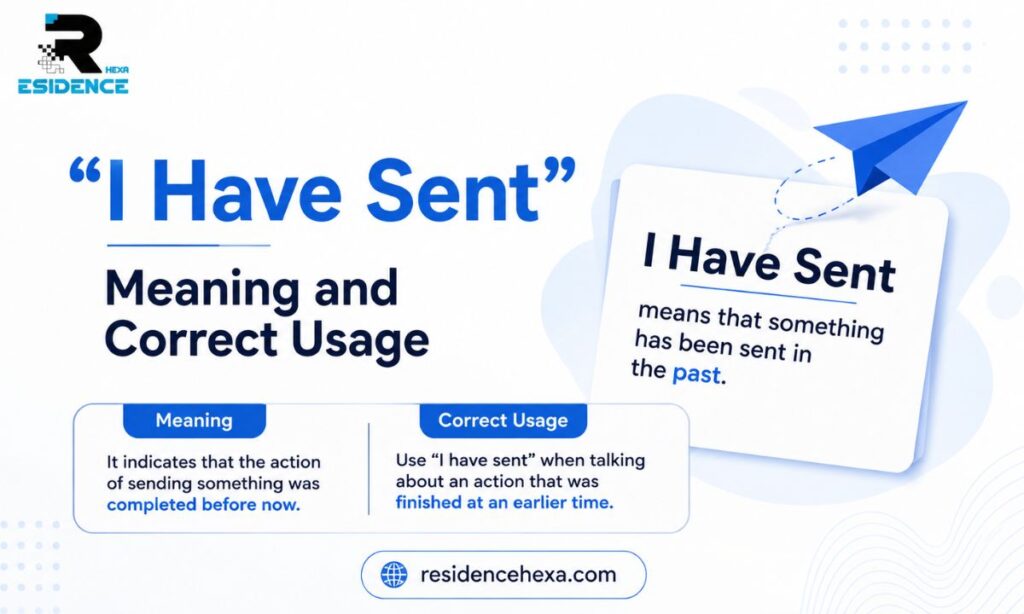
“I have sent” is the present perfect tense. It shows a completed action that connects to the present — the sending is finished, but its effect (waiting for a reply, expecting action) is still active now.
“I Have Sent” or “I Have Send”: Which Is Correct?
“I have sent” is correct. “I have send” is a grammar error — the auxiliary verb “have” must always be followed by a past participle, and “sent” is the correct participle form of “send,” not “send” itself.
“I Have Sent” or “Send”: Which Is Correct?
“I have sent” is correct when describing a completed action. Plain “send” is a base-form verb used for instructions or future requests, such as “Please send the file,” not for reporting something already done.
When to Use “I Have Sent” in an Email
Use “I have sent” when no specific time is mentioned and the outcome still matters:
- I have sent the proposal for your review.
- I have sent the updated invoice.
- I have sent the files you requested.
Is “I Have Sent the Mail” Correct?
Yes, “I have sent the mail” is grammatically correct, though “email” is the more precise and modern word choice in business writing, since “mail” traditionally refers to postal mail in many contexts.
“I Have Sent” vs “I Sent” in Professional Emails
In professional emails, “I have sent” often sounds more polished because it keeps the action relevant and implies you’re expecting a response. “I sent” feels more neutral and factual, useful when narrating events or referencing a clear timeline.
“I Had Sent” Meaning and Correct Usage
What Does “I Had Sent” Mean?
“I had sent” is the past perfect tense. It describes an action completed before another past action or past point in time, helping readers understand the correct sequence of events.
“I Had Sent” or “I Have Sent”: What Is the Difference?
“I have sent” connects a past action to the present moment. “I had sent” connects one past action to another earlier past action. The two are not interchangeable — using “had sent” without a second past event confuses the reader.
When to Use “I Had Sent” in an Email
Use “I had sent” only when comparing two past events:
- I had sent the email before you called.
- I had sent the files when the deadline passed.
- I had sent the invitation earlier that day.
Common Mistakes with “I Had Sent”
- Using “I had sent” with no second past event for comparison.
- Replacing “I have sent” with “I had sent” out of habit, which can make a current update sound outdated or irrelevant.
- Overusing the past perfect tense in casual, everyday email updates where simple past works better.
“I Sent” vs “I Have Sent” vs “I Had Sent”: Key Differences
| Phrase | Tense | Meaning | Example |
| I sent | Simple past | Completed action at a specific past time | I sent the report yesterday. |
| I have sent | Present perfect | Completed action, relevant now | I have sent the report; please check. |
| I had sent | Past perfect | Action completed before another past action | I had sent the report before the meeting started. |
When to Use “I Sent,” “I Have Sent,” or “I Had Sent” in Emails
Following Up on an Email or Proposal
“I have sent the proposal and wanted to follow up” works best here, since the action still matters and you’re expecting a response.
Confirming That an Email Was Sent
“I have sent the confirmation email” or “I sent the confirmation this morning” both work, depending on whether you include a time.
Explaining a Missed Attachment
“I sent the email without the attachment” clearly states a completed, time-bound mistake you’re now correcting.
Reporting Completed Work
“I have sent the finished draft for approval” signals that the task is done and awaiting the next step.
Referring to Two Past Actions
“I had sent the invoice before the client asked for it” shows one action clearly happened first, which is the core job of the past perfect tense.
Common Grammar Mistakes with “Sent” in Emails

“I Have Send” vs “I Have Sent”
“Have” always requires a past participle, so “I have sent” is correct and “I have send” is not.
“I Have Sent” With a Specific Past Time
“I have sent it yesterday” is incorrect; specific time markers require the simple past: “I sent it yesterday.”
Using “I Had Sent” Without a Past Reference
“I had sent the email” on its own, with no second event mentioned, weakens your message and can make it sound irrelevant to the current situation.
Confusing “I Sent” and “I Have Sent”
Mixing these up doesn’t break grammar rules outright, but it can make your timeline unclear — always ask whether the reader needs a specific time (use “sent”) or a present connection (use “have sent”).
“I Have Sent the Mail” — Meaning and Better Alternatives
Is “I Have Sent the Mail” Grammatically Correct?
Yes, it’s grammatically correct. It simply may sound slightly old-fashioned in modern digital communication.
“I Have Sent the Email” vs “I Have Sent the Mail”
“Email” is the standard, precise term in workplace communication today. “Mail” is broader and, in American English especially, often implies physical postal mail.
Better Ways to Say “I Have Sent the Email”
- I’ve just emailed you the file.
- The email is on its way to your inbox.
- I’ve sent this over for your review.
“I Had Sent” vs “I Have Sent” — Simple Examples
| Sentence | Tense Used | Why |
| I have sent the report; let me know your thoughts. | Present perfect | Action still relevant now |
| I had sent the report before you asked for it. | Past perfect | Shows sequence of two past events |
| I have sent three reminders this week. | Present perfect | Ongoing relevance to present |
| I had sent the reminder, but the client had already left. | Past perfect | One action clearly precedes another |
Quick Decision Guide: Which Tense Should You Use?
Did You Mention a Specific Past Time?
If yes, use “I sent.” Time markers like “yesterday” or “last week” always pair with the simple past.
Is the Result Important Now?
If yes, use “I have sent.” This tense keeps the action connected to the present and signals that a response or action is expected.
Are You Talking About Two Past Events?
If yes, use “I had sent” to clearly show which action happened first, similar to how you’d frame when to use a tense-specific phrase like “it called” instead of “it’s called” correctly based on context.
“I Sent” vs “I Have Sent” vs “I Had Sent” Examples
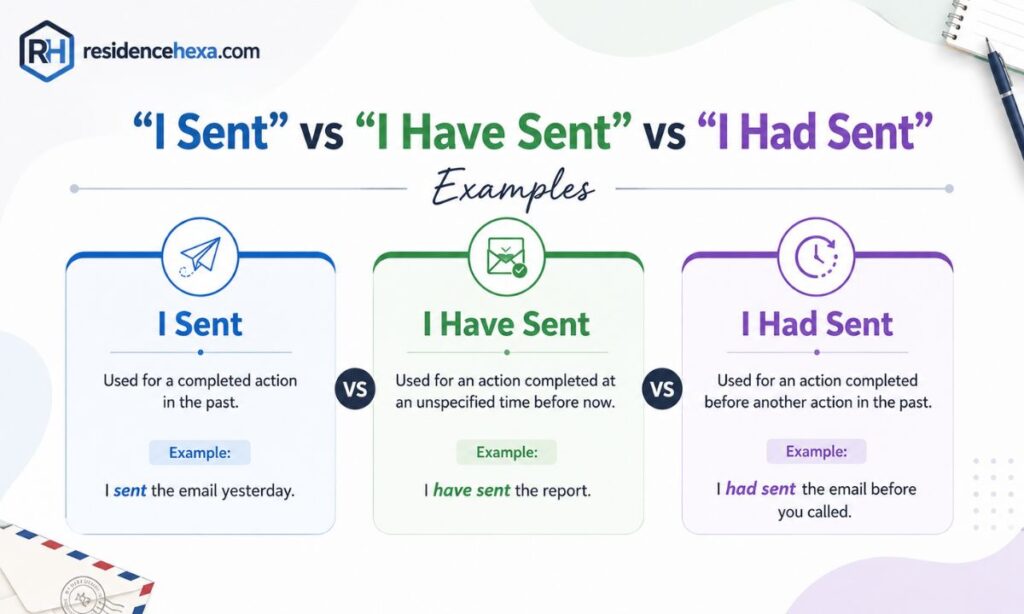
- I sent the email at 3 PM yesterday.
- I have sent the email; please confirm receipt.
- I had sent the email before the server went down.
- I sent the invoice last Friday.
- I have sent the invoice for your approval.
- I had sent the invoice twice before the payment cleared.
Conclusion
“I sent,” “I have sent,” and “I had sent” all describe the same basic action, but timing changes everything. Use “I sent” with a specific past time, “I have sent” when the result still matters now, and “I had sent” when comparing two past events.
Keep this simple framework in mind — similar to knowing exactly when can I use certain phrasing versus when I can flip it around — and your emails will read clearer, sound more professional, and leave no room for confusion.