You’re writing a report, a news story, or a social media caption. Someone walking by helped at the scene. Now you need the passerby plural — and suddenly everything feels uncertain. Is it passersby? Passerbys? Maybe passerbyers?
You’re not alone. This small word trips up native English speakers, ESL learners, journalists, and professional writers alike. The good news? There’s a clear, definitive answer — and once you understand the logic behind it, you’ll never second-guess it again.
What Is the Correct Passerby Plural?
The only correct plural of passerby is passersby.
- ✅ Passersby — correct
- ❌ Passerbys — incorrect
- ❌ Passerbyers — incorrect, not a recognized English word
Every major dictionary — Merriam-Webster, Oxford English Dictionary, Cambridge Dictionary — lists passersby as the standard plural. Neither passerbys nor passerbyers appears in any reputable language reference as an accepted form.
What Does “Passerby” Mean?
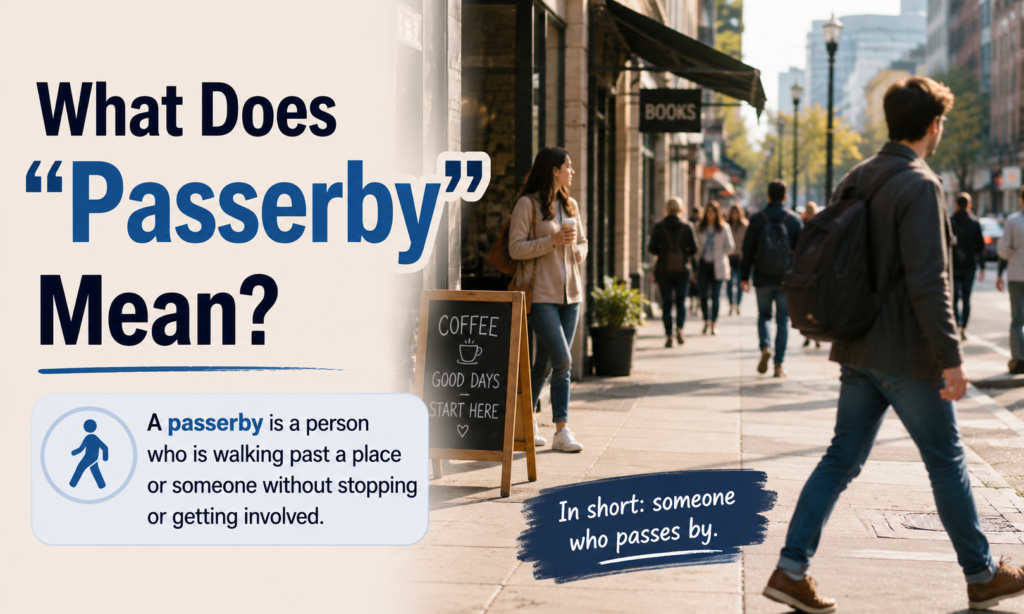
A passerby is a person who happens to be passing a particular place, usually by chance and without direct involvement in what’s happening there. Think of someone walking past a storefront, strolling by an accident scene, or moving through a busy street corner.
The word traces its roots to the 18th century, when it first appeared in written English as the hyphenated form passer-by. Over time — especially in American English — the hyphen disappeared, and the closed compound passerby became the standard. British publications like The Guardian and BBC News still occasionally use passers-by, and that form remains acceptable in British English.
| Form | Status | Usage |
| passerby | ✅ Correct (singular) | One person walking past |
| passersby | ✅ Correct (plural) | More than one person walking past |
| passers-by | ✅ Acceptable (British English) | Traditional hyphenated plural |
| passerbys | ❌ Incorrect | Common misspelling — avoid |
| passerbyers | ❌ Incorrect | Not a recognized English word |
The Grammar Rule Behind the Confusion
This is where most people go wrong — and where the logic finally clicks.
Passerby is a compound noun, meaning it’s built from two parts:
- Passer — the main noun (a person who passes)
- By — a preposition or adverb indicating movement past something
In English, when you pluralize a compound noun, you pluralize the main noun, not the modifier or preposition at the end. Because passer carries the meaning — it’s the actual noun describing a person — it’s the part that takes the plural marker.
So the formula looks like this:
passers (plural noun) + by (unchanged preposition) = passersby
This is called internal pluralization, and it’s a consistent pattern across English. You’ve likely seen it with other compound nouns:
| Singular | Correct Plural | Incorrect Plural |
| passerby | passersby | passerbys / passerbyers |
| mother-in-law | mothers-in-law | mother-in-laws |
| attorney general | attorneys general | attorney generals |
| runner-up | runners-up | runner-ups |
| court-martial | courts-martial | court-martials |
The pattern is clear: the head noun pluralizes, the modifier stays fixed. Once you recognize this, passersby stop feeling strange and start feeling logical.
Common Mistakes — Why People Write “Passerbys” or “Passerbyers”
Understanding why these errors happen helps you avoid them — and helps you explain the rule to others.
Why “Passerbys” Feels Natural
English pluralization works the same way about 95% of the time: add -s or -es to the end of the word. Cat → cats. Box → boxes. Day → days. Our brains are wired for this pattern. When someone sees a passerby, the automatic response is to slap an -s on the end. It feels right — but it’s not, because passerby isn’t a simple noun; it’s a compound with internal structure.
Why “Passerbyers” Feels Logical (But Isn’t)
Some writers think of passerby the same way they think of runner or player — agent nouns that take -s to become runners or players. By that logic, multiple people passing by would be passerbyers. But this reasoning has a critical flaw: the word passer already contains the agentive suffix -er, meaning “one who passes.” Adding -er again to the whole word would effectively mean “one who one who passes” — a grammatical redundancy that standard English doesn’t permit. No reputable dictionary lists passerbyers as a valid word.
The Social Media Effect
Informal writing on social platforms, comment sections, and quick news headlines often reinforces incorrect forms simply through repetition. Passerbys appears roughly once for every 25 correct uses of passersby in published text — and that frequency has grown over the past decade. That familiarity breeds a false sense of correctness. Frequency, however, is not the same as accuracy.
How to Use “Passersby” Correctly in Sentences
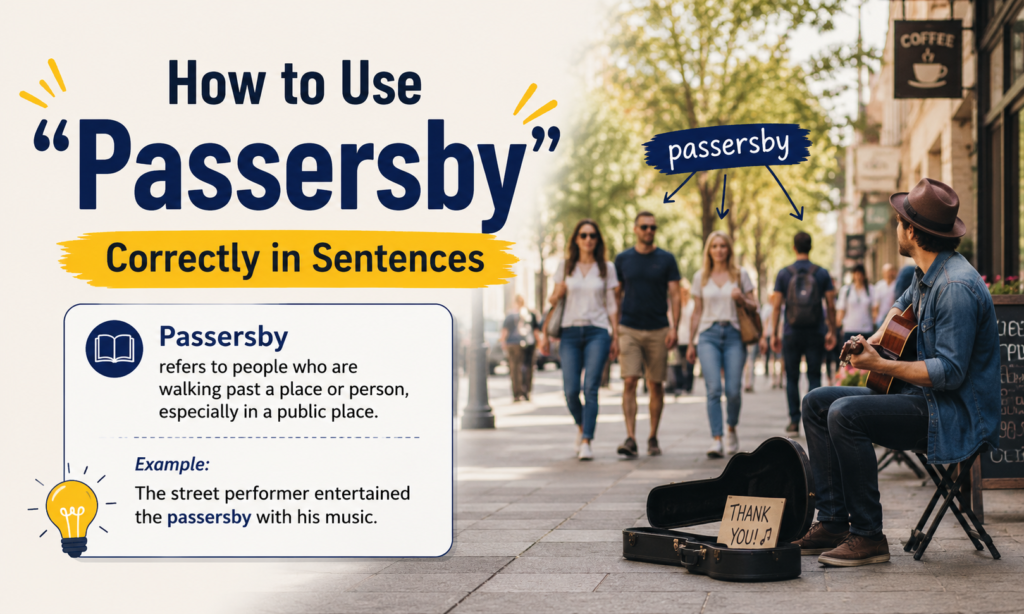
Seeing the word in real context is the fastest way to cement the correct form in your memory.
News and reporting:
- Several passersby witnessed the accident and called emergency services.
- Police interviewed two passersby who had seen the suspect flee the scene.
Everyday descriptions:
- The street musician attracted a small crowd of curious passersby.
- A kind passerby helped her pick up the groceries she’d dropped.
Formal and academic writing:
- Researchers surveyed passersby in three urban locations to measure foot traffic patterns.
- The installation was designed to engage passersby without requiring them to stop.
Possessive form:
When you need to show possession, use passersby’s:
- The passersby’s reactions were captured on CCTV footage.
Quick Reference Guide
Answer in one sentence: The passerby plural is passersby — you pluralize the noun passer, not the preposition by.
| Question | Answer |
| Singular | passerby |
| Plural | passersby |
| British English plural | passers-by (also acceptable) |
| Possessive plural | passersby’s |
| Is “passerbys” correct? | No — always avoid it |
| Is “passerbyers” a word? | No — not recognized in any dictionary |
| Which part gets pluralized? | The noun: passer → passers |
Memory trick: Think of mothers-in-law. You wouldn’t say mother-in-laws — you pluralize the main noun. Do the same with passersby. The passer becomes passers, and by stays exactly where it is.
Frequently Asked Questions
Is “passersby” one word or two?
One word. The modern standard form is written as a single closed compound: passersby.
Can I use “passers-by” with a hyphen?
Yes, especially in British English. Passers-by is the traditional hyphenated form and remains acceptable today, though passersby is now more common in American English.
How do I make “passersby” possessive?
Use passersby’s: for example, the passersby’s concern was evident.
Conclusion
The correct passerby plural is passersby — full stop. Both passerbys and passerbyers are errors that arise from applying regular pluralization rules to a word that follows a different, older pattern. The fix is simple: identify the main noun (passer), pluralize it (passers), and leave it untouched. The result — passersby — is what every grammar authority, dictionary, and style guide agrees on.
Getting this right matters. Whether you’re writing a news article, an academic paper, or a formal writing piece, passersby signal that you understand the structure of the language — not just the surface rules. And now you do.