Have you ever stopped mid-sentence wondering whether to say whole day or all day? You’re not alone. This small word choice trips up native speakers and English learners alike. Both phrases describe a full day, yet they work differently in a sentence — and using the wrong one can make your English sound slightly off, even if the listener still understands you.
This guide breaks down exactly what each phrase means, how grammar rules apply, and which one fits best in different situations. By the end, you’ll know precisely when to use whole day, when all day is the better pick, and how to avoid the most common mistakes English speakers make with both expressions. If you enjoy untangling phrases that look identical but work differently, our guide on In the Street or On the Street — Which Is Correct? covers another pair that trips up even fluent speakers.
What Does “All Day” Mean?

“All day” is an adverbial phrase that describes duration. It tells your listener or reader that something happened continuously, repeatedly, or without interruption from morning to evening. Think of it as a time-stretching expression — it attaches directly to a verb and requires no article before it.
Examples:
- She worked all day and forgot to eat.
- It rained all day in Chicago.
- I’ve been waiting all day for your call.
Notice that “all” functions here as a determiner, meaning “every part of” or “the entire extent of.” Merriam-Webster defines “all” as a determiner used to refer to the whole quantity or extent of something — which explains perfectly why it needs no article when expressing duration. That’s why you never say an all day — “all” isn’t an adjective, so it can’t follow an. However, when “all day” modifies a noun as a compound adjective, you do add a hyphen:
✅ an all-day workshop ✅ an all-day event
“All day” flows naturally in everyday conversation. It’s the go-to phrase for casual speech, text messages, social media, and informal writing. Native speakers rely on it constantly without a second thought.
What Does “Whole Day” Mean?

“Whole day” emphasizes completeness. Rather than describing an ongoing activity, it treats the day as one finished, single unit of time — the entirety of it from start to finish. This gives the phrase a slightly heavier, more dramatic emotional weight.
Examples:
- I spent the whole day at the museum.
- The whole day was ruined because of the storm.
- She wasted a whole day waiting for a response.
Here, “whole” acts as a standard adjective modifying the noun “day.” Because of this, English grammar requires a determiner (the, a, my, this, that) before it. On its own — without a determiner — the phrase breaks a fundamental grammar rule:
❌ I worked whole day. (Incorrect) ✅ I worked the whole day. (Correct) ✅ I needed a whole day to finish. (Correct) ✅ My whole day was exhausting. (Correct)
“Whole day” tends to appear more often in formal writing, narratives, and situations where you want to add emotional weight or emphasis. It often implies that something significant — and usually unwanted — consumed the entire day.
Whole Day or All Day — What’s the Real Difference?
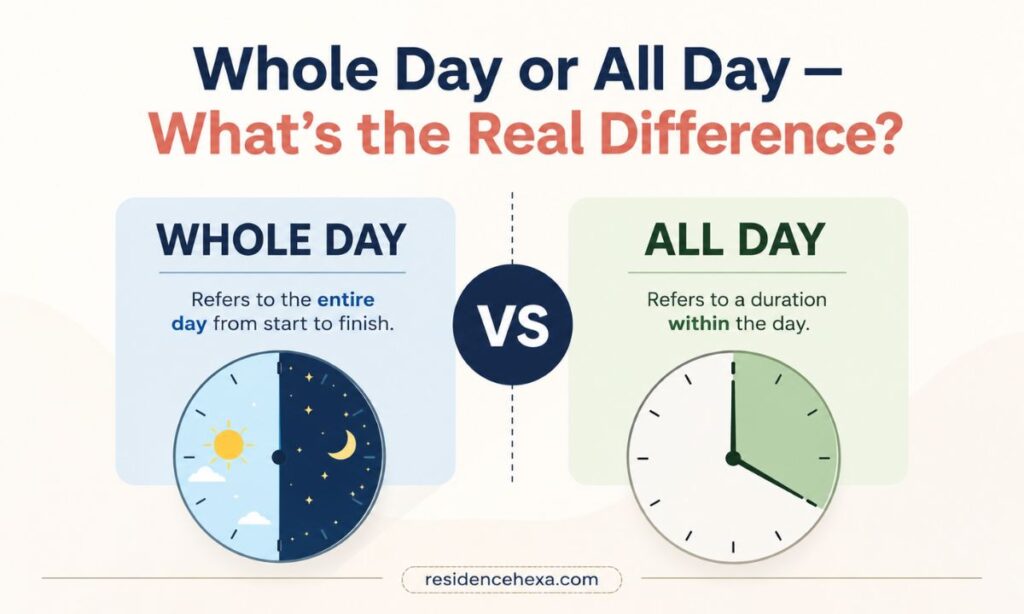
At first glance, both phrases seem interchangeable. They’re not. The distinction comes down to grammar structure and emotional tone.
| Feature | All Day | Whole Day |
| Part of speech | “All” = determiner | “Whole” = adjective |
| Requires article? | No — stands alone | Yes — needs the, a, my, etc. |
| Focus | Duration / continuous action | Completeness / entire unit |
| Tone | Neutral, casual | Emphatic, slightly dramatic |
| Register | Informal & formal | Formal, narrative, emphasis |
| Example | I cooked all day. | The whole day was stressful. |
The emotional weight difference is real. Compare these two:
- I waited all day. → Neutral statement of duration.
- I waited the whole day. → Sounds frustrated, more emphatic.
Same situation. Completely different emotional weight. That’s the hidden power behind this small grammar choice.
Grammar Rule Summary
- Use “all day” when describing how long an action lasted — no article needed.
- Use “the whole day” or “a whole day” when describing the day itself as a complete unit.
- Never use “whole day” alone without a determiner — it’s grammatically incomplete.
This same determiner-vs-adjective logic applies to many confusing word pairs in English. For another clear example of how verb forms carry hidden grammatical rules, see our guide on Given or Giving — Which Is Correct? — it follows the same principle of understanding the part of speech before choosing the right word.
American English vs. British English
Both dialects use these phrases the same way. The meanings don’t change across regions. However, British English occasionally uses “the whole of the day” in more formal contexts, while American English sticks closely to “all day” in everyday speech.
Quick-Use Guide — When to Use Each Phrase

Use this practical reference whenever you’re unsure which phrase fits your sentence.
Use “All Day” When:
- Describing a continuous or ongoing activity: She studied all day.
- Writing in a casual, conversational tone: I’ve been busy all day.
- Using it as part of a compound adjective before a noun: an all-day seminar.
- Talking about repeated actions throughout the day: He kept calling me all day.
Use “The Whole Day” When:
- Treating the day as one complete, finished block: The whole day felt wasted.
- Adding emphasis or emotional weight to a statement: I spent the whole day cleaning.
- Writing formal reports, essays, or narratives: The whole day was devoted to fieldwork.
- Stressing that nothing was left out of the day: She gave the whole day to her family.
Common Mistakes to Avoid
| Mistake | Why It’s Wrong | Correct Version |
| I worked whole day. | Missing determiner before “whole” | I worked the whole day. |
| an all day event | “All day” as compound adjective needs hyphen | an all-day event |
| I have worked all day yesterday. | Present perfect + past time = incorrect | I worked all day yesterday. |
| She stayed home whole day. | “Whole” needs article or possessive | She stayed home the whole day. |
Conclusion
Both all day and whole day are grammatically correct — but they are not the same. If you want to describe an ongoing activity that filled your hours, reach for all day. If you want to emphasize that an entire, complete day was consumed by something, use the whole day or a whole day with the right determiner in place.
When in doubt, all day is almost always the safer, more natural choice for everyday communication. It’s the phrase native speakers default to without thinking. But when you need that extra weight — when you want the reader to feel how much of your time something took — the whole day delivers that emphasis with quiet power. Master this small distinction, and your English instantly sounds more polished, precise, and natural. That’s the real value hiding inside this one tiny grammar choice.