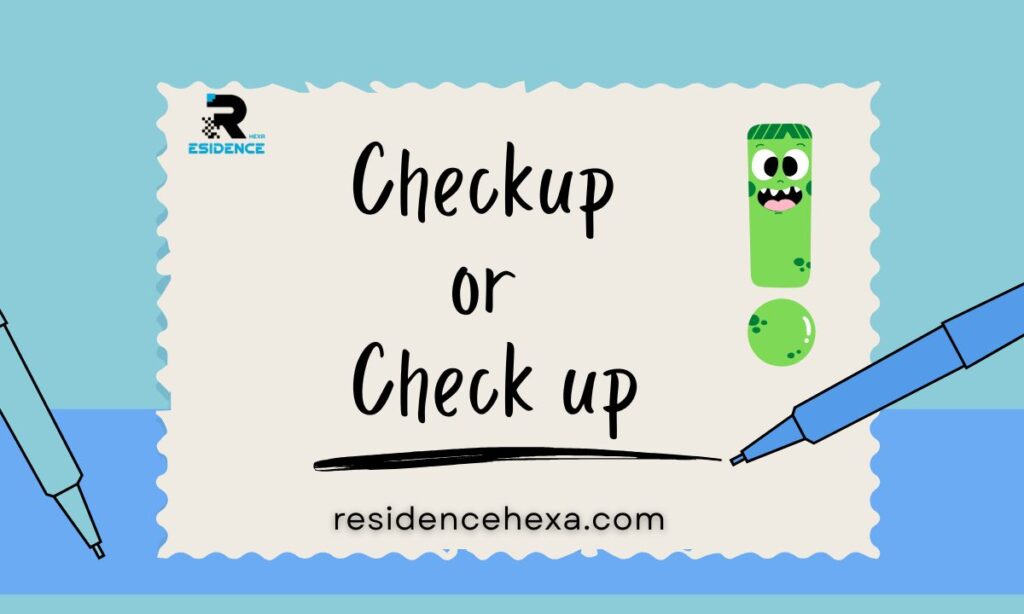
You’ve probably typed one of these words and paused — is it one word or two? You’re not alone. Even fluent English speakers get tripped up by checkup or check up every single day. They sound identical, look almost the same, but they play completely different roles in a sentence.
The good news? Once you understand the simple grammar rule behind them, you’ll never confuse the two again. This guide breaks down every form — checkup, check up, and check-up — with clear definitions, real-world examples, and an easy memory trick that sticks.
What Does Checkup Mean?
Checkup (one word) is a noun. It names a thing — specifically, a scheduled examination or routine inspection of some kind.
According to Merriam-Webster, a checkup is “a general physical examination of someone’s or something’s condition.” It first appeared in written English around 1920, built from the idea of a doctor working through a checklist of things to test or examine.
Common Types of Checkups
- Medical checkup — a visit to a doctor or dentist for preventive care
- Dental checkup — a routine oral health examination
- Vehicle checkup — a mechanic’s inspection of your car
- Financial checkup — a review of your savings, budget, or investment plan
- System checkup — a diagnostic scan of computer hardware or software
✅ “I have a checkup with my doctor on Thursday.” ✅ “She brought her car in for a 30,000-mile checkup.” ✅ “The dentist recommended a checkup every six months.”
Because checkup is a noun, you can use articles like a, an, or the in front of it — just like any other noun.
What Does Check Up Mean?
Check up (two words) is a phrasal verb. It describes an action — the act of investigating, monitoring, or verifying the condition of someone or something.
It most commonly appears with the preposition “on”: check up on someone/something.
Check Up — Usage as a Verb
| Sentence | Meaning |
| “I’ll check up on the patient tonight.” | Monitor/observe the patient |
| “She called to check up on her elderly mother.” | Verify someone’s well-being |
| “He checked up on the delivery status.” | Investigate the current progress |
| “Please check up on those test results.” | Follow up on information |
✅ “The nurse will check up on you in an hour.” ✅ “My manager always checks up on our progress every Friday.” ❌ “I will checkup on the patient.” ← Incorrect — checkup is a noun, not a verb
What Is Check-Up (Hyphenated)?
Check-up (with a hyphen) is used as a phrasal adjective — it modifies a noun that follows it.
✅ “My check-up appointment is at 2 p.m.” ✅ “She missed her check-up session with the therapist.”
However, in modern writing — especially American English — the hyphenated form is becoming less common. Most major style guides now prefer checkup as the standard noun. In British English, check-up is still widely used and accepted.
Checkup vs Check Up vs Check-Up — The Core Grammatical Difference
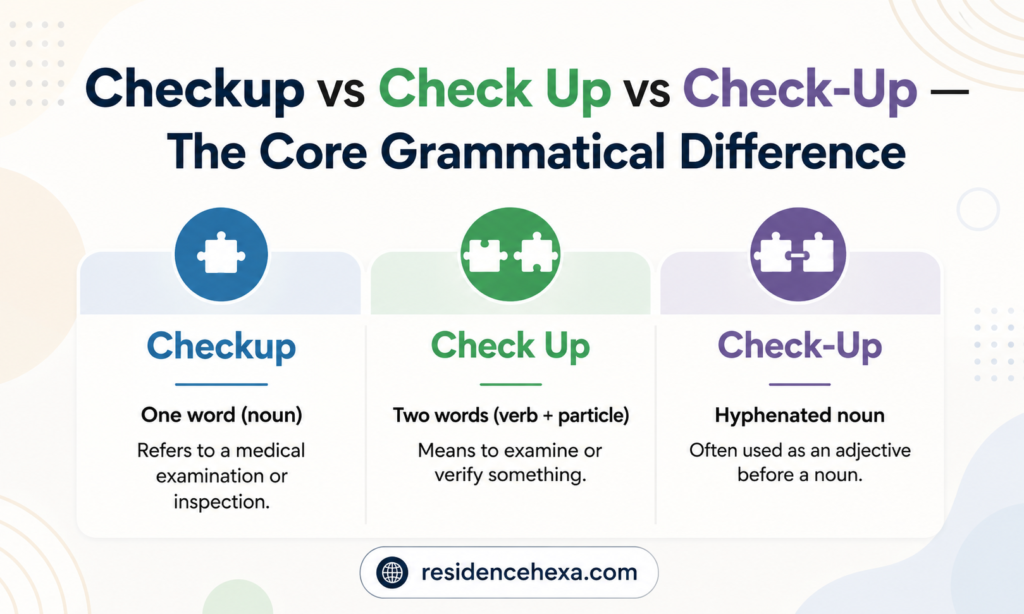
This is the heart of the matter. The three forms are not interchangeable — each one has a fixed grammatical role.
| Form | Part of Speech | Function | Example |
| Checkup | Noun | Names an event or appointment | “I need a checkup.” |
| Check up | Phrasal Verb | Describes the action of verifying | “I need to check up on him.” |
| Check-up | Phrasal Adjective | Modifies a following noun | “My check-up results were fine.” |
The one-sentence rule:
If it’s a thing, write it as one word: checkup. If it’s an action, write it as two words: check up.
Checkup vs Check Up — The Core Grammatical Difference Explained
English regularly compresses phrasal verbs into single-word nouns. Think about it:
- Work out (verb) → Workout (noun)
- Set up (verb) → Setup (noun)
- Check up (verb) → Checkup (noun)
This pattern shows up across many common word pairs in English. If you enjoy untangling these kinds of grammar puzzles, our guide on Thus Far vs So Far is another great example of how two similar phrases carry very different tones and uses.
The moment an action becomes a thing in English, the language tends to close the gap between the words. That’s exactly what happened with the checkup.
So when you’re scheduling something — it’s a checkup (noun). When you’re doing something — it’s check up (verb).
Real-World Uses of Checkup in Everyday English
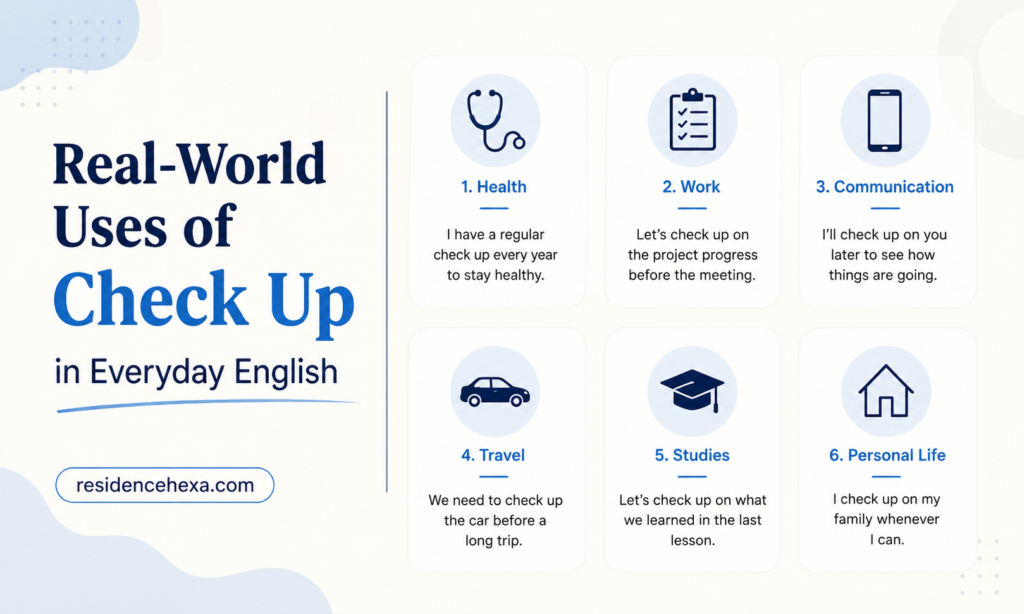
Where Do We Use the Word Checkup Most?
1. Healthcare & Medicine This is by far the most common context. A medical checkup refers to a routine appointment with a physician for preventive health assessment — measuring vital signs, reviewing medical history, and running standard tests.
“Annual checkups help detect health problems before they become serious.” — Mayo Clinic guidance
2. Dental Care A dental checkup typically involves cleaning, X-rays, and an examination for cavities or gum disease. Dentists generally recommend one every six months.
3. Automotive Mechanics perform a vehicle checkup to inspect brakes, fluid levels, tires, and engine performance — often at specific mileage milestones.
4. Finance A financial checkup is a review of your budget, debts, retirement savings, and investment strategy — usually done annually or before tax season.
5. Technology A system checkup refers to diagnostic software scans that identify errors, threats, or performance issues on a computer or server.
Real-World Uses of Check Up in Everyday English
As a phrasal verb, check up appears in both personal and professional contexts:
- A doctor checks up on patients during hospital rounds
- A manager checks up on team progress during a project
- Parents check up on their children after school
- A partner checks up on someone they care about
- A quality control officer checks up on manufacturing standards
It almost always pairs with “on”, though it can stand alone in informal speech:
“Did anyone check up?” (informal — meaning: did anyone follow up or verify?)
Easy Trick to Remember — Checkup or Check Up Every Time
Here’s the simplest memory trick you’ll ever need:
Noun vs Verb (One Word vs Two Words)
One word = One thing (noun) Two words = Two words doing something (verb)
Ask yourself this single question before writing:
“Am I naming something or doing something?”
| You’re naming something → | Use checkup (noun) |
| You’re doing something → | Use check up (verb) |
Additional quick tests:
- Can you put “a” or “the” in front of it? → It’s checkup (a checkup, the checkup)
- Can you replace it with a verb like investigate or monitor? → It’s check up
- Is it followed by “on”? → Almost certainly check up on
- Is it followed by another noun like appointment or results? → Try the hyphenated check-up as an adjective
American English vs British English
Style differences between the two major varieties of English are worth noting:
| Usage | American English | British English |
| Noun (one word) | Checkup ✅ preferred | Check-up (also common) |
| Verb (two words) | Check up ✅ | Check up ✅ |
| Hyphenated adjective | Check-up (less common) | Check-up ✅ preferred |
Google Trends data shows “checkup” has grown steadily as the dominant spelling since 2004, particularly in American English medical and digital content. The hyphenated “check-up” has declined in usage globally, though it remains standard in British publications.
Conclusion
The difference between checkup or check up comes down to one fundamental grammar rule: nouns become one word; verb phrases stay two words.
- Checkup (noun) = a thing — a scheduled examination, appointment, or inspection
- Check up (verb) = an action — to monitor, verify, or follow up on someone or something
- Check-up (adjective) = a modifier — describing the type of appointment or review
Every time you write one of these forms, just ask: Am I naming something or doing something? That one question will guide you to the right answer every time — whether you’re writing a medical note, a business email, or an everyday text message.
Clear writing builds trust. And now you have one less thing to second-guess. If you want to keep sharpening your word choices, check out our guide on Whole Day or All Day — another pair that confuses even native speakers every day.