
Ever paused mid-sentence, unsure whether to type “cosy” or “cozy”? You’re not alone. This tiny spelling swap trips up bloggers, students, and even native speakers, especially when writing for an audience outside their own country. The good news is that the confusion has a simple explanation, and once you understand it, you’ll never second-guess yourself again.
This guide breaks down exactly when to use cosy or cozy, where the difference comes from, and how to keep your writing consistent whether you’re targeting UK, US, or global readers. You’ll also find real examples, a quick comparison table, and answers to the most common questions people ask about this word pair.
Cosy or Cozy: Quick Answer
Is It “Cosy” or “Cozy”?
Both spellings are correct. “Cosy” is the standard British English spelling, while “cozy” is the standard American English spelling. There’s no difference in meaning — only in regional preference.
The Simple Rule to Remember
- Writing for UK, Australian, New Zealand, or Canadian readers → use cosy
- Writing for US readers → use cozy
- Whichever you pick, stay consistent throughout the entire piece
What Do Cosy and Cozy Mean?
Definition of Cosy
As an adjective, “cosy” describes something warm, snug, and comfortable — think a fireplace, a blanket, or a small café on a rainy day. In British usage, “cosy” can also be a noun, referring to a padded cover used to keep a teapot warm.
Definition of Cozy
“Cozy” carries the exact same meaning in American English. Dictionary sources confirm that cozy is simply the American English spelling of the adjective meaning warm and snug, while British English uses “cosy” instead. You can check the full entry on Merriam-Webster for more usage notes.
Are Cosy and Cozy the Same?
Yes. They describe identical feelings of warmth and comfort, and the word can even be used figuratively — for example, describing an overly close or convenient relationship between two parties, as in “a cozy arrangement between the company and its regulator.”
The Origin of Cosy and Cozy

Where Did the Word Come From?
The word is believed to have Scottish roots, entering English in the 18th century to describe a snug, sheltered feeling. Over time, it spread into everyday British vocabulary before crossing the Atlantic.
Why Two Different Spellings Exist
Spelling divergence between British and American English largely traces back to lexicographer Noah Webster, who pushed for simplified, more phonetic spellings in his American dictionaries during the 19th century. Words like colour, honour, and, eventually, cosy followed this pattern of Americanization, with the “s” shifting to a “z.”
British English vs American English Spelling
Why the UK Uses “Cosy”
British English tends to preserve older spelling conventions. “Cosy” fits the traditional British pattern of using “s” where American English later adopted “z,” similar to organise vs. organize.
Why the US Uses “Cozy”
American publishing embraced Webster’s simplified, phonetic-leaning spellings early on. “Cozy” stuck because it matched the sound of the word more directly and became standard in US dictionaries, style guides, and media.
Other Similar UK vs US Spelling Differences
| British English | American English |
| Cosy | Cozy |
| Colour | Color |
| Organise | Organize |
| Behaviour | Behavior |
| Travelling | Traveling |
| Theatre | Theater |
| Realise | Realize |
If you’d like a deeper dive into this pattern, Residence Hexa’s guide on Behaviour or Behavior: Which Is Correct? covers the same “s” vs “z” and “-our” vs “-or” logic in more detail.
Which Spelling Should You Use?
Writing for a UK Audience
Stick with “cosy,” along with its related forms: cosier, cosiest, and cosiness. This is also the expected spelling in Australia, New Zealand, and most Commonwealth countries.
Writing for a US Audience
Use “cozy,” along with cozier, coziest, and coziness. This is the standard across American blogs, marketing copy, and publishing houses.
SEO and Content Writing Tips
- Match your spelling to your target audience’s search intent — Google treats “cosy” and “cozy” as regionally distinct queries
- Use the spelling consistently across headings, meta descriptions, and body text
- If you’re writing for a global audience, consider creating separate content variants or defaulting to the more widely searched American spelling
- Avoid alternating spellings even when quoting different sources, since consistency signals professionalism to both readers and search engines
Common Mistakes with Cosy or Cozy
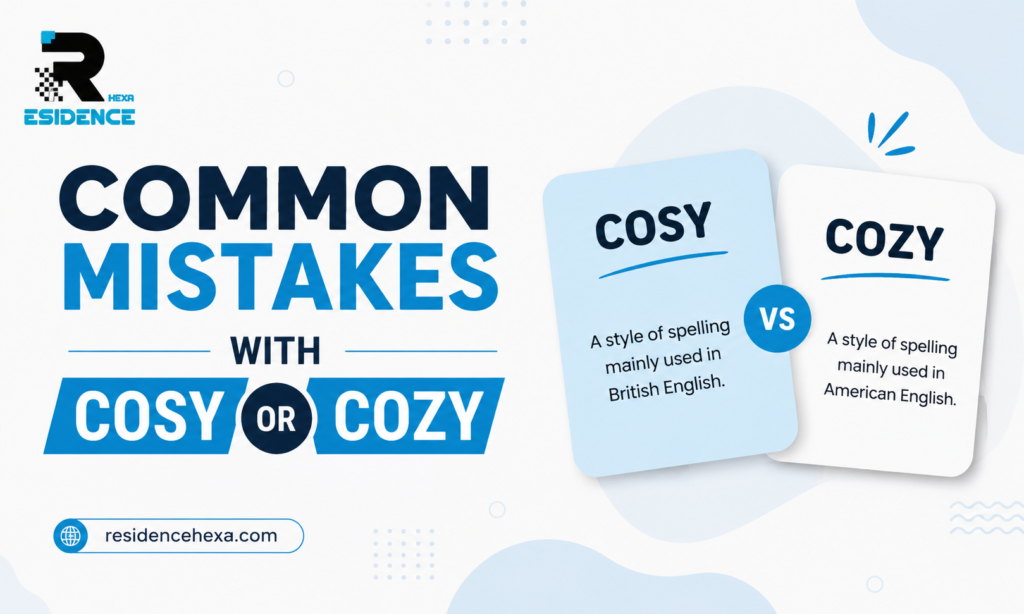
Mixing UK and US Spellings
A common slip-up looks like this: “The cabin felt cosy and cozy at the same time.” Pick one spelling and use it throughout the piece.
Using the Wrong Style for Your Audience
Writing “cozy” for a UK-based publication, or “cosy” for an American blog, can feel subtly off to native readers, even if they can’t immediately explain why. This kind of small inconsistency can also affect tone in professional writing — much like getting formal phrasing wrong, as explored in Residence Hexa’s breakdown of Yea or Nay: Meaning, Differences, Usage, and Examples.
Cosy vs Cozy in Everyday Examples
Examples Using “Cosy”
- The cottage looked small but very cosy.
- She wrapped herself in a cosy blanket by the fire.
- This café has a wonderfully cosy atmosphere.
Examples Using “Cozy”
- The cabin feels cozy even in the middle of winter.
- He curled up in a cozy armchair with a book.
- Their new apartment has a cozy, welcoming vibe.
Examples in Books, Blogs, and Social Media
British lifestyle blogs and novels set in the UK will almost always use “cosy,” while American Pinterest boards, home décor blogs, and product listings default to “cozy.” Publishers and brands typically follow their target market’s convention strictly, especially in titles and product names.
Cosy vs Cozy Comparison Table
| Feature | Cosy | Cozy |
| Region | UK, Australia, NZ, Canada | United States |
| Word type | Adjective / noun | Adjective / noun |
| Meaning | Warm, snug, comfortable | Warm, snug, comfortable |
| Related forms | Cosier, cosiest, cosiness | Cozier, coziest, coziness |
| Common in | British books, UK media | US blogs, American branding |
Common Synonyms of Cosy and Cozy
Snug, warm, comfortable, homely, comfy, inviting, intimate, sheltered.
Conclusion
At the end of the day, cosy or cozy are simply two regional spellings of the same warm, comforting idea. Use “cosy” for UK, Australian, New Zealand, or Canadian readers, and “cozy” for an American audience. The meaning never changes — only the letter does. Once you lock in this rule and stay consistent throughout your writing, you’ll never have to second-guess this spelling again.