If you have ever typed this word and paused mid-sentence, you are not alone. The debate around behaviour or behavior trips up students, writers, professionals, and even native English speakers every single day. Is one spelling a mistake? Do they mean different things? Which one should you use in your essay, email, or article?
The short answer is that both spellings are completely correct — but the right one depends entirely on your audience. Behaviour or behavior is one of the most well-known examples of the split between British English and American English. Understanding this difference will sharpen your writing, help you avoid embarrassing inconsistencies, and make you sound more confident and professional regardless of which side of the Atlantic you are writing for.
What Does “Behavior” Mean?
According to Merriam-Webster, behavior means “the way in which someone conducts oneself or behaves.” More broadly, it refers to any action, reaction, or response made by a person, animal, or even a non-living thing under given circumstances.
In grammar, behavior is a noun. It can function as a countable or uncountable noun depending on context. As a subject, object, or complement in a sentence, it works exactly the same way as any other abstract noun.
Examples of “Behavior” in Sentences
- The child’s behavior at the party impressed everyone.
- Scientists study the behavior of atoms under heat and pressure.
- His reckless behavior led to serious consequences.
- Good behavior is always rewarded in this classroom.
- Social media has a strong influence on teenage behavior.
What Does “Behaviour” Mean?
Behaviour carries the exact same meaning as behavior. It refers to the way a person, animal, or object acts or responds in a given situation. The only difference is the spelling — not the definition, pronunciation, or grammatical function.
This is the standard spelling in British English, used across the UK, Australia, Canada, India, New Zealand, and most other Commonwealth countries.
Examples of “Behaviour” in Sentences
- His behaviour during the meeting was perfectly calm.
- Good behaviour is expected from all students.
- The dog showed friendly behaviour toward strangers.
- The psychologist specialises in behaviour management.
- Workplace behaviour directly affects team morale.
Difference Between Behaviour and Behavior
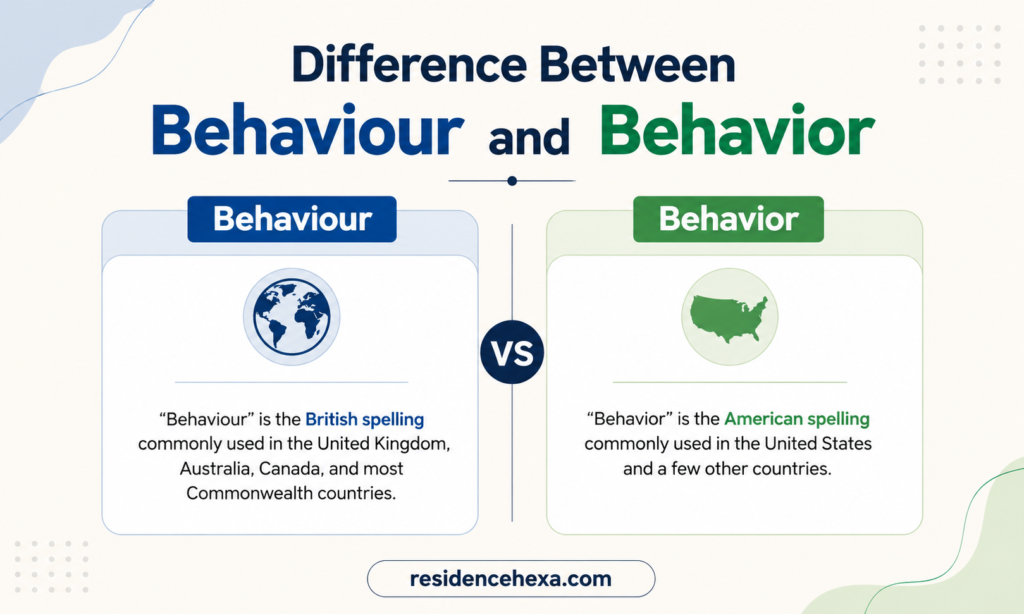
At their core, behaviour and behavior are the same word with the same meaning. The only real difference is the regional spelling convention. Here is a quick comparison:
| Feature | Behavior (American) | Behaviour (British) |
| Spelling | Without “u” | With “u” |
| Used in | USA | UK, Australia, Canada, India |
| Meaning | Identical | Identical |
| Pronunciation | Same | Same |
| Part of speech | Noun | Noun |
| Derivatives | behavioral, behaviorally | behavioural, behaviourally |
Why Do These Two Spellings Exist?
The reason behaviour or behavior exists in two forms comes down to history. In the 15th century, the word entered English from Middle English behave, influenced by the Old French word avoir (meaning “to have”). The original form carried the “-our” ending, which was standard in British English.
In the 19th century, the American lexicographer Noah Webster published his landmark dictionary and deliberately simplified many English spellings. He removed the “u” from dozens of words to make American English easier to write and more phonetically logical. That is how behaviour became behavior in the United States — and how the split was born.
Examples of Similar Spelling Differences
This same “-our vs. -or” pattern appears across many English words:
- colour (British) / color (American)
- honour (British) / honor (American)
- labour (British) / labor (American)
- favour (British) / favor (American)
- humour (British) / humor (American)
Every one of these pairs follows the exact same rule as behaviour or behavior — same meaning, different spelling based on regional English standards.
How Grammar Treats Behavior and Behaviour
Part of Speech
Both behavior and behaviour are nouns. They are abstract nouns because they describe a concept rather than a physical object.
Sentence Role
These words can play different roles in a sentence:
- Subject: Behavior in the workplace affects productivity.
- Object: The teacher monitored the students’ behavior.
- Complement: What we saw was unacceptable behavior.
- Possessive: His behavior shocked everyone in the room.
Behavior vs Behaviour in Sentence Structure
As a Subject
When behavior or behaviour acts as the subject, the verb must agree with it in number. Since both forms are usually uncountable nouns, they take a singular verb:
- Her behavior was outstanding during the interview.
- His behaviour speaks volumes about his character.
As an Object
When used as an object, both forms work identically:
- The researcher studied the behavior of dolphins.
- The school monitored students’ behaviour closely.
Contextual Examples of Behavior vs Behaviour
Here are real-world examples showing how context shapes which spelling to choose:
| Context | Correct Spelling | Example |
| US news article | behavior | The senator’s behavior was criticized. |
| UK academic paper | behaviour | Antisocial behaviour in adolescents was studied. |
| Australian workplace policy | behaviour | Expected workplace behaviour is outlined below. |
| American psychology journal | behavior | Behavioral therapy showed strong results. |
| Indian school curriculum | behaviour | Good behaviour earns merit points. |
Common Mistakes With Behavior vs. Behaviour
Mixing Spellings in the Same Text
This is the most frequent error. Writers begin with one spelling and switch to the other partway through their document. This makes writing appear careless and unprofessional.
❌ His behavior was noted. The school monitors student behaviour closely. ✅ His behavior was noted. The school monitors student behavior closely. (American)
Thinking One Spelling Is Wrong
Many writers — especially students — believe that one version is simply incorrect. This is not true. Both behaviour and behavior are fully accepted in their respective regions. Neither is a spelling error when used in the right context.
Changing Spelling Based on Sentence Position
Some writers mistakenly believe the spelling changes depending on whether the word is a subject or object. It does not. Choose your spelling based on your audience, not sentence position.
Behavior vs Behaviour in School and Exams
If you are preparing for a standardised exam, the spelling you use matters:
- IELTS / GCSE / A-Levels → Use behaviour (British English)
- SAT / ACT / US state exams → Use behavior (American English)
- TOEFL → Accepts both, but consistency is key
Teachers generally accept both spellings as long as you remain consistent throughout your paper. However, mixing them will almost certainly cost you marks for accuracy and style.
Behavior vs Behaviour in Professional Writing
In professional and corporate writing, consistency with the house style guide is everything. Most major publications use one of the following:
- AP Stylebook (used by most US journalists): behavior
- Oxford Style Guide (common in UK publishing): behaviour
- APA Style (American academic publishing): behavior
- Chicago Manual of Style: Follows American conventions → behavior
When writing for a global audience with no specific regional preference, many international brands lean toward American spelling for its simplicity and wider digital reach.
American vs. British English Differences
American English
American English, standardised largely through Noah Webster’s reforms, drops the “u” from words ending in “-our.” This applies to behavior, as well as color, honor, labor, and many others. American writers, publishers, and educators consistently follow this convention.
British English
British English retains the older French-influenced spelling with the “u” intact. Behaviour is the standard form used across the UK and most Commonwealth nations. It extends to all derived forms: behavioural and behaviourally are the British equivalents of behavioral and behaviorally.
For more on how British and American English differ in everyday grammar, you may find the article on Artefact vs Artifact helpful, as it explores the same pattern of regional spelling variation in depth.
Pronunciation of Behavior and Behaviour
Both words are pronounced identically: /bɪˈheɪvjər/
The extra “u” in behaviour is silent and makes no difference to how the word sounds. A British speaker and an American speaker would say this word in exactly the same way — only the written form differs.
Behavior vs. Behaviour in Academic Writing
In academic writing, following the correct regional convention is essential. Here are quick guidelines:
- For papers submitted to US universities or journals: use behavior, behavioral, behaviorally
- For papers submitted to UK, Australian, or Canadian institutions: use behaviour, behavioural, behaviourally
- For APA (7th edition): use behavior throughout
- Always check the journal’s or institution’s own style requirements before submitting
Idiomatic and Common Expressions
Both spellings appear in a number of common expressions in English:
Common Expressions
- On your best behavior / behaviour — acting as well as you possibly can
- Behavior modification / behaviour modification — a psychological technique to change habits
- Behavioral science / behavioural science — the scientific study of actions and decisions
- Model behavior / model behaviour — an example of excellent conduct
Examples
- Please be on your best behavior during the ceremony. (American)
- She was praised for her model behaviour at the conference. (British)
- The therapist used behavior modification to address anxiety. (American)
Behavior vs. Behaviour in Psychology and Science
In psychology and the behavioral sciences, spelling follows regional conventions just as in general writing. American psychology journals — including the Journal of Applied Behavior Analysis and the American Psychological Association publications — consistently use behavior. British and Australian research publications use behaviour.
The word carries the same technical meaning in both contexts: the observable actions or responses of an organism to its environment. Whether a researcher writes about human behavior or human behaviour, they are referring to the exact same scientific concept.
Plural Form: Behaviors and Behaviours
Both forms have standard plural versions:
- Behaviors (American English)
- Behaviours (British English)
The plural is used when referring to specific, distinct patterns of action:
- Several behaviors were identified as risk factors.
- The study examined antisocial behaviours in teenagers.
When used in a general, uncountable sense — referring to conduct as a whole — no plural is needed:
- Good behavior is the foundation of a respectful community.
Practical Tips to Choose the Correct Spelling
- Know your audience — writing for the US? Use behavior. Writing for the UK, Australia, or Canada? Use behaviour.
- Check your spell-checker language setting — make sure your word processor is set to the correct regional English.
- Pick one and stick to it — consistency across a document matters more than which spelling you choose.
- Follow the style guide — if your school, employer, or publisher has a preferred style, follow it without exception.
- When in doubt, ask — if you are writing for an international platform, clarify regional preferences before submitting.
Grammar Rules Applied
Noun Usage
Both behavior and behaviour function as nouns. They can be used with articles (“a behavior,” “the behaviour”), with possessives (“his behavior,” “her behaviour”), and in compound forms (“behavior pattern,” “behaviour management”).
Articles
- Use “a” before specific instances: a behavior that needs addressing
- Use “the” for specific references: the behavior we observed
- Use no article when speaking generally: behavior is shaped by environment
Subject-Verb Agreement
Because behavior and behaviour are typically uncountable in their general sense, they take singular verbs:
- Behavior is influenced by culture.
- Behaviour has improved this term.
When using the plural forms, match the verb accordingly:
- These behaviors were documented over six months.
Sentence Flow and Writing Style
Clear, confident writing depends on consistency. Whether you use behavior or behaviour, your sentences should flow naturally without awkward interruptions. Short, direct sentences work best when introducing the word for the first time. Longer, more complex sentences can follow once the context is established.
Active voice keeps behavior-related writing strong and direct:
- The manager addressed the employee’s behavior promptly.
- Parents play a key role in shaping children’s behaviour.
Passive voice works well in formal or scientific writing:
- Certain behaviors were found to correlate with academic success.
Rewritten and Polished Explanation (Clear and Simple)
Here is the cleanest summary of everything covered above:
Behavior and behaviour mean exactly the same thing. They describe how a person, animal, or object acts in a given situation. The only difference is where you are writing. In the United States, the correct spelling is behavior. In the United Kingdom, Australia, Canada, and India, the correct spelling is behaviour. This difference comes from Noah Webster’s 19th-century spelling reforms, which removed the “u” from many American English words.
Choose your spelling based on your audience, stay consistent throughout your document, and you will never go wrong.
Why This Practice Improves Writing
Understanding regional spelling differences like behaviour or behavior does far more than prevent typos. It signals to your reader that you know your audience, respect their conventions, and pay attention to detail. In professional and academic settings, this kind of precision builds credibility and trust. In everyday writing, it simply makes your work cleaner and easier to read.
If you enjoyed this guide, you might also want to explore Invision vs Envision — another example of commonly confused English words where choosing the right form matters for clarity and professionalism.
Conclusion
So — behaviour or behavior: which is correct? Both are. Behavior is the standard American English spelling, used across the US and in American-style publications. Behaviour is the British English spelling, used in the UK, Australia, Canada, India, and other Commonwealth nations. They are pronounced the same, mean the same thing, and follow the same grammar rules. The only factor that determines which one you should use is your audience and their regional English standard.
Master this distinction, stay consistent in your writing, and you will always spell it right — whether you are writing a psychology paper, a professional email, a school essay, or a blog post for a global readership.