
If you’ve ever paused mid-sentence wondering whether to type “modeling” or “modelling,” you’re not alone. This tiny extra letter trips up students, marketers, data scientists, and even native English speakers every single day especially when spellcheck flags one version but a colleague swears by the other.
The good news? Both spellings are completely correct. The version you should use simply depends on which English variety you’re writing in, and once you understand the underlying rule, you’ll never second-guess yourself again. This guide breaks down the spelling rule, the grammar behind it, and how the word is used across fashion, science, data, and finance.
Quick Answer: Modelling vs Modeling
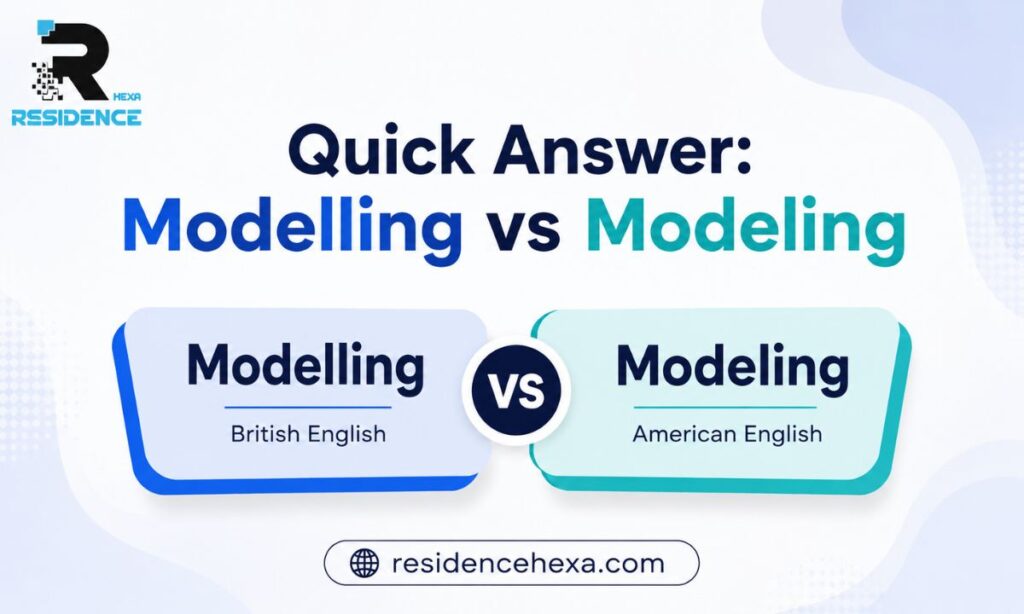
- Modeling (one “L”) is the standard American English spelling.
- Modelling (two “L”s) is the standard British English spelling, also used in Canada, Australia, and New Zealand.
- Both words carry the exact same meaning. Neither one is “more correct” — the choice depends on your audience and the style guide you follow.
| Spelling | Region | Example |
| Modeling | United States | She has been modeling for three years. |
| Modelling | UK, Canada, Australia, New Zealand | She has been modelling for three years. |
Why Does the Spelling Change? The “Double L” Rule
The difference comes down to a long-standing quirk in English spelling conventions: whether to double the final consonant before adding “-ing.”
American English: One L Before -ing
In American English, a final consonant is typically doubled only when the last syllable of the root word is stressed. Since “model” is stressed on the first syllable (MOD-el), American spelling rules don’t double the “L,” giving us modeling. This same logic applies to words like “traveling” and “canceling.”
British English: Double L Before -ing
British English follows an older rule: if a word ends in a single vowel plus a single consonant, that consonant is doubled before adding a suffix — regardless of where the stress falls. That’s why British English produces modelling, along with “travelling,” “labelling,” and “cancelling.” According to Merriam-Webster and other major dictionaries, both spellings are recognized as valid alternative forms of the same word.
Does the Meaning Change? No — Here’s Why
This is one of the most reassuring facts about the modeling/modelling debate: the meaning never changes. Both spellings describe the same actions — creating a representation of something, shaping an object, wearing clothing for display, or building a simulation of a system or process. The spelling is purely regional, not semantic.
Modeling in Different Professions and Contexts

The word “model” stretches across a surprising number of industries. Here’s how it functions in each one.
Fashion Modeling
This is the most familiar use — walking runways, shooting campaigns, or posing for a brand. Whether it’s written as modeling or modelling, agencies and publications use it to describe the profession of displaying clothing, accessories, or products.
3D and Digital Modeling
In design and animation, modeling refers to building three-dimensional objects using specialized software like Blender or Maya. Digital artists “model” characters, environments, and products before rendering them.
Mathematical Modeling
Mathematicians use equations and formulas to represent real-world systems — from population growth to orbital mechanics. This process is called mathematical modeling (or modelling), and it’s foundational to physics, economics, and engineering.
Data and Statistical Modeling
In data science, modeling means building a structure — usually statistical or algorithmic — that explains relationships within a dataset or predicts future outcomes. Regression models, classification models, and clustering models all fall under this umbrella.
Scientific and Engineering Modeling
Engineers and scientists use modeling to simulate physical systems before building them in the real world, from climate modeling used in meteorology to structural modeling used in civil engineering.
Financial Modeling vs Financial Modelling
In finance, professionals build spreadsheets and forecasts to project a company’s future performance. American analysts write “financial modeling,” while UK-based analysts write “financial modelling.” Both refer to the identical practice of building valuation and forecasting frameworks.
Modeling vs Modelling in Machine Learning
Machine learning engineers “train a model” to recognize patterns in data. Whether you write “model training and modeling workflows” or “model training and modelling workflows,” the process — feeding data into an algorithm to produce predictions — stays exactly the same.
Modeling vs Modelling in Data Science
Data science teams often use the term interchangeably with statistical modeling: building, testing, and refining predictive models. Global teams frequently mix both spellings depending on where team members are based, which is why establishing one house style matters for technical documentation.
Grammar Forms You Should Know
Beyond the “-ing” form, the same spelling split carries over to other verb tenses and related nouns.
| Form | American English | British English |
| Base verb | model | model |
| Present participle/gerund | modeling | modelling |
| Past tense | modeled | modelled |
| Noun (person) | modeler | modeller |
Modeled or Modelled?
Just like the “-ing” form, the past tense follows the same regional pattern:
- American English: “She modeled the new collection for the spring catalog.”
- British English: “She modelled the new collection for the spring catalogue.”
Common Mistakes Writers Make (And How to Avoid Them)
Mistake 1: Mixing Spelling in One Document
The most frequent error is switching between “modeling” and “modelling” within the same article, report, or website. This looks unpolished and can confuse readers or trigger inconsistency flags in editing tools.
Fix: Pick one spelling based on your target audience and use it consistently throughout the entire piece.
Mistake 2: Assuming One Version Is “Better”
Some writers assume the British double-L spelling is “more proper” because it looks more formal, or that the American spelling is “simpler” and therefore more modern. Neither assumption is accurate — both are equally correct within their respective regions.
Mistake 3: Ignoring Spellcheck Settings
Many writers get flagged by spellcheck simply because their document’s language setting doesn’t match their intended spelling. If your Microsoft Word or Google Docs language is set to “English (US),” it will underline “modelling” as an error — and vice versa.
Fix: Confirm your document’s language setting matches the English variant you’re writing in before you start editing.
History of the Word “Model”
Root Origins
The word “model” traces back to the Middle French modelle, which in turn descends from the Italian modello and ultimately the Latin modulus, meaning “a small measure.” The core idea of a scaled-down representation has remained remarkably consistent for centuries.
Why Spelling Split Happened
The American/British spelling divide largely traces back to Noah Webster, the lexicographer behind the first major American dictionary in the early 1800s. Webster deliberately simplified many English spellings — dropping unnecessary doubled letters — to distinguish American English from British English and make the language easier to teach. Words like “modeling,” “traveling,” and “canceling” are direct results of that reform.
Use Cases: When to Use Each Spelling
Use “Modeling” If:
- You’re writing for a US-based audience or publication.
- Your company style guide follows American English (AP Style, Chicago Manual of Style).
- You’re working in American tech, finance, or academic contexts.
Use “Modelling” If:
- Your audience is in the UK, Canada, Australia, or New Zealand.
- You’re following Oxford or Cambridge style guidelines.
- Your organization operates under British English conventions.
Related Words With the Same Spelling Rule
Several other common words follow this identical American vs. British doubling pattern:
- Traveling / Travelling
- Canceling / Cancelling
- Labeling / Labelling
- Fueling / Fuelling
- Signaling / Signalling
If you’d like a deeper look at a closely related spelling debate, check out this guide on whether it’s “targetted” or “targeted”, which covers the same double-consonant confusion. You may also find this comparison of “realist” vs “realest” useful if you’re generally curious about commonly confused word forms.
Case Study: Academic Writing Guidelines
Oxford and Cambridge (UK Focused)
UK universities, including Oxford and Cambridge, expect students to use British spelling conventions consistently throughout academic papers — meaning “modelling,” “modelled,” and “modeller” are the expected forms in essays, theses, and published research.
Harvard and Stanford (US Focused)
American institutions such as Harvard and Stanford follow US spelling standards, so students and researchers submitting papers are expected to use “modeling,” “modeled,” and “modeler” throughout their work.
Quotes From Style Guides
Style authorities are consistent on this point. As Grammarly’s editorial team notes, the two versions are simply regional equivalents — one spelling isn’t more correct than the other, only more common in a specific country. Academic and publishing style guides on both sides of the Atlantic simply ask writers to remain consistent once they’ve chosen a variant.
Conclusion
At the end of the day, “modeling” and “modelling” are two branches of the same word, split only by a regional spelling convention rather than any difference in meaning. American English drops the extra “L,” while British English (along with Canada, Australia, and New Zealand) keeps it doubled.
Whether you’re writing about fashion shoots, 3D design, financial forecasts, or machine learning models, the rule stays the same: pick the spelling that matches your audience, stay consistent across your writing, and you’ll never trip over this double-L debate again.