
If you’ve ever paused mid-sentence wondering “is this data correct” or “are this data correct,” you’re not alone. Even confident writers second-guess themselves when a sentence gets a little crowded — extra words between the subject and the verb, a tricky collective noun, or a pronoun like “everyone” that feels plural but technically isn’t. The good news is that the confusion almost always comes down to one simple question: is the real subject singular or plural?
This guide breaks that question down into plain, practical rules you can actually remember. You’ll learn how to spot the true subject of a sentence, handle compound subjects and indefinite pronouns, avoid the “there is / there are” trap, and fix the mistakes that quietly slip into emails, resumes, and everyday conversation. By the end, choosing between is and are will feel automatic instead of stressful.
Why Knowing When to Use Is or Are Matters
Subject-verb agreement is one of the first things readers notice — even if they can’t explain why a sentence “sounds off.” Getting is or are wrong can:
- Make professional writing (emails, reports, resumes) look careless
- Distract readers from your actual message
- Signal weaker English proficiency in academic or job-related writing
- Create genuine confusion in instructions or technical content
Mastering this one rule instantly makes your writing sound more polished, whether you’re a student, a non-native English speaker, or a professional writer polishing a final draft.
The Core Rule — Base of All Is or Are Decisions
Every “is or are” decision comes back to subject-verb agreement: the verb must match the number of the subject.
- Use is with singular subjects — one person, place, thing, or idea.
- Use are with plural subjects, or with the pronouns you, we, and they.
According to Merriam-Webster, “is” and “are” are both present-tense forms of the verb “to be,” and choosing correctly depends entirely on whether the subject they follow is singular or plural.
Examples
| Sentence | Why |
| The book is on the table. | “Book” is singular |
| The books are on the table. | “Books” is plural |
| She is my neighbor. | “She” is singular |
| They are my neighbors. | “They” is plural |
| You are always welcome here. | “You” always takes are |
How to Find the Real Subject in a Sentence
Most is-or-are mistakes happen because writers match the verb to the nearest noun instead of the actual subject. Before choosing a verb, ask: “Who or what is the sentence really about?”
Ignore Prepositional Phrases
A prepositional phrase (starting with words like of, in, with, along with, including) never contains the subject. Mentally cross it out.
- The basket of apples is fresh. (not “apples are”)
- The list of names is long.
- One of the students is absent.
Tip: Strip out everything between commas or prepositions, then re-read the sentence with just the subject and verb — the correct choice usually becomes obvious.
There Is vs There Are — The Most Common Usage Case
“There is” and “there are” trip up even advanced writers because the subject comes after the verb, not before it.
Rule
Look at the noun immediately following “is” or “are” — that noun is the real subject.
- There is a problem with the printer. (singular: “a problem”)
- There are several problems with the printer. (plural: “several problems”)
Table of Common Cases
| Sentence Starter | Subject That Follows | Correct Verb |
| There ___ a reason for this. | “a reason” (singular) | is |
| There ___ many reasons for this. | “many reasons” (plural) | are |
| There ___ no time left. | “no time” (uncountable) | is |
| There ___ two options available. | “two options” (plural) | are |
Tricky Singular and Plural Nouns
Not every noun follows the obvious “-s means plural” pattern, which is exactly where writers get stuck.
Singular Nouns That Look Plural
These end in “s” but take is:
- News is reported daily.
- Mathematics is her favorite subject.
- Physics is a challenging course.
- The United States is a large country.
Plural Nouns That Look Singular
These don’t end in “s” but still take are:
- Children are playing outside.
- People are waiting in line.
- Police are investigating the case.
- Men and women are equally represented.
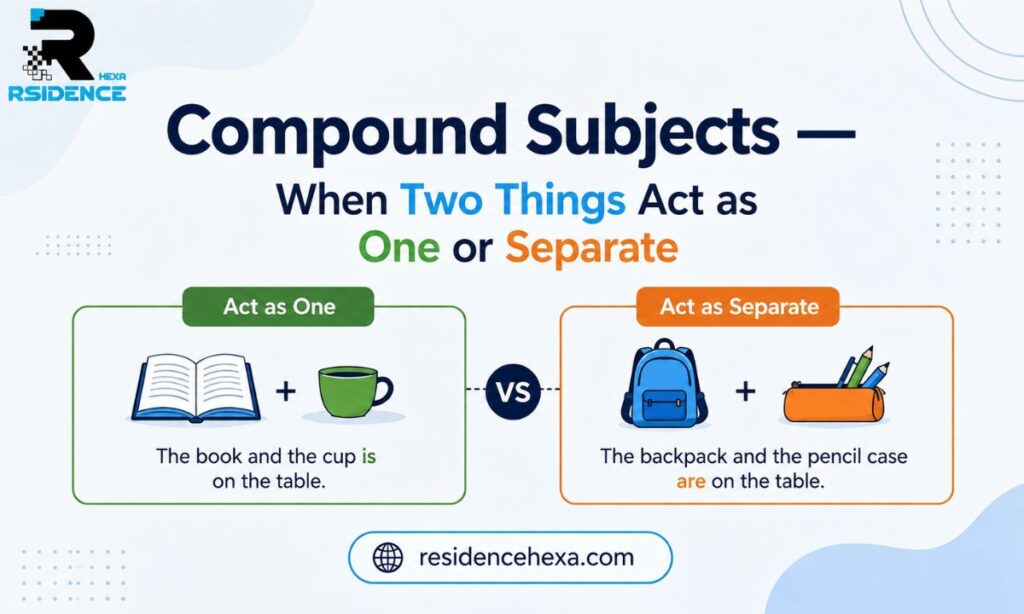
Compound Subjects — When Two Things Act as One or Separate
Joined by “And”
Subjects connected by and are almost always plural, so they take are.
- Tom and Jerry are best friends.
- Bread and butter are on the table.
Exception: If the two nouns form one single idea, treat it as singular.
- Bread and butter is my favorite breakfast. (one dish, one concept)
Joined by “Or / Nor / Either…Or / Neither…Nor”
With these connectors, the verb agrees with the subject closest to it.
- Neither the manager nor the employees are available.
- Neither the employees nor the manager is available.
- Either John or his friends are coming.
Indefinite Pronouns — Choose Carefully
Indefinite pronouns don’t refer to a specific person or thing, and they follow three distinct patterns.
Always Singular — Use Is
each, either, neither, everyone, everybody, someone, somebody, anyone, anybody, no one, nobody, one
- Everyone is invited to the party.
- Neither of the answers is correct.
Always Plural — Use Are
both, few, many, several, others
- Both of them are talented.
- Many are called, but few are chosen.
Can Be Singular or Plural
all, any, most, none, some — these depend on the noun they refer to.
- Some of the cake is gone. (uncountable)
- Some of the cookies are gone. (countable)
- All of the money is spent.
- All of the students are present.
If you’re also unsure how similar pronoun pairs behave in real sentences, this breakdown of Thank You Everyone or Thank You All shows how indefinite and collective pronouns shift meaning depending on context.
Collective Nouns — United vs Individual Meaning
Collective nouns (team, family, staff, jury, committee) name a group but can take either verb depending on meaning.
Acting as One Unit — Use Is
- The team is winning the championship.
- The family is moving next month.
- The jury is deliberating.
Acting as Individuals — Use Are in British English
In British English, collective nouns often take are when members are acting separately.
- The team are arguing among themselves.
- The committee are divided on the issue.
American English almost always prefers the singular form here, so stick with is unless your audience specifically expects British usage.
Mass (Uncountable) Nouns — Always Singular
Uncountable nouns — things you can’t count individually — always take is.
- Information is valuable.
- Advice is appreciated.
- Furniture is expensive this year.
- Water is essential for life.
Tricky Quantity Expressions
Expressions describing time, money, distance, or measurement are usually treated as a single unit, so they take is.
- Ten dollars is not enough.
- Five miles is a long walk.
- Two years is a long time to wait.
Is or Are in Questions
Questions follow the same logic, just with the verb moved to the front.
- Is she coming to the meeting?
- Are they finished with the project?
- Is there any coffee left?
- Are there any seats available?
Is or Are for a Company or Organization
Company and brand names are typically treated as singular entities in American English, even though they represent many people.
- Apple is launching a new product.
- The company is hiring for three positions.
- Google is known for its search engine.
British English again allows the plural form when emphasizing the people within the organization (“Apple are launching…”), but American style guides consistently prefer the singular.
Is or Are in Common Sentences
Seeing the rule applied across everyday situations makes it easier to remember:
- My phone is out of battery.
- The kids are doing their homework.
- This recipe is simple to follow.
- Our plans are still uncertain.
- The weather is unpredictable today.
Common Mistakes You Should Stop Making
Most is-or-are errors repeat the same handful of patterns — memorize these, and you’ll avoid the majority of mistakes automatically.
Incorrect → Correct
| Incorrect | Correct | Why |
| The box of chocolates are gone. | The box of chocolates is gone. | Subject is “box,” not “chocolates” |
| Everyone are ready. | Everyone is ready. | “Everyone” is always singular |
| There is many reasons. | There are many reasons. | “Reasons” is plural |
| My family are big. (in American English) | My family is big. | American English treats “family” as one unit |
| Ten dollars are too much. | Ten dollars is too much. | Treated as a single amount |
Is or Are in a Business Email — Mini Case Study
Consider this common workplace scenario:
“Attached is the report you requested. The figures are finalized, and the summary is ready for review. Please let me know if there are any questions.”
Notice how each verb matches its true subject: “the report” (singular) takes is, “the figures” (plural) takes are, and “the summary” (singular) takes is again. A single mismatched verb in a client-facing email can undercut an otherwise professional message — which is exactly why this rule matters beyond the classroom.
Is or Are Practice — Exercises and Examples
Fill in the blank with is or are:
- The dog ___ barking loudly.
- My friends ___ visiting this weekend.
- Neither of the options ___ ideal.
- The scissors ___ on the desk.
- There ___ a strong smell of coffee here.
Answers: 1. is 2. are 3. is 4. are 5. is
Is or Are Worksheet — Quick Practice
Use this checklist-style worksheet for classroom or self-study practice:
- Identify the subject in each sentence.
- Cross out any prepositional phrases.
- Decide if the subject is singular, plural, or an indefinite pronoun.
- Apply the matching verb (is/are).
- Read the sentence aloud to check it “sounds right.”
Quick Decision Checklist for When to Use Is or Are
- Find the true subject — ignore words in between.
- Singular subject → use is.
- Plural subject, or you/we/they → use are.
- Collective noun acting as one group → use is.
- Indefinite pronoun like everyone/each → use is.
- Indefinite pronoun like both/many → use are.
- “There is/are” → check the noun that follows.
Helpful Reference Table — Is or Are at a Glance
| Subject Type | Verb | Example |
| Singular noun | is | The car is fast. |
| Plural noun | are | The cars are fast. |
| He / She / It | is | It is raining. |
| You / We / They | are | You are right. |
| Collective noun (as a unit) | is | The staff is trained. |
| Collective noun (as individuals, British) | are | The staff are arguing. |
| Uncountable noun | is | Information is useful. |
| Indefinite pronoun (each, everyone) | is | Everyone is here. |
| Indefinite pronoun (both, many) | are | Both are correct. |
Conclusion
Choosing between is and are always circles back to one question: is the real subject of the sentence singular or plural? Once you learn to strip away distracting phrases, recognize tricky nouns like “news” or “children,” and handle special cases like “there is/are,” indefinite pronouns, and collective nouns, the decision becomes second nature.
Keep the reference table and checklist from this guide handy, and if you’d like to sharpen related grammar skills, this guide on whether All Is Well or All Is Good is correct tackles another common “is” mix-up worth knowing. With a little practice, you’ll never have to pause mid-sentence again.