
If you’ve ever typed “envolved” and wondered whether it looks right, you’re not alone. This is one of the most common spelling mistakes in English — and the answer is surprisingly simple. Only “involved” is a real word. “Envolved” does not exist in any recognized dictionary.
Whether you’re writing a professional email, an academic paper, or a casual social media post, using the correct spelling matters. This guide breaks down exactly what “involved” means, why “envolved” is never acceptable, and how to use “involved” correctly — with clear examples.
What Does “Involved” Mean?
“Involved” is a versatile English word that functions as both a past tense verb and an adjective. It traces its roots to the Latin word involvere, meaning “to roll into” or “to enfold.” Over centuries, it entered English as involve, and its past tense form involved became widely used across formal and informal contexts.
Three Core Meanings of “Involved”
| Meaning | Example Sentence |
| Participating in something | She has been involved in charity work for years. |
| Emotionally connected | He became deeply involved in the relationship. |
| Complex or difficult to understand | The legal process was too involved to explain briefly. |
The word “involved” appears across every context — professional writing, personal conversations, legal documents, and academic research. It is one of the most high-utility words in the English language, and its correct use reflects clarity and credibility.
Is “Envolved” a Real Word?
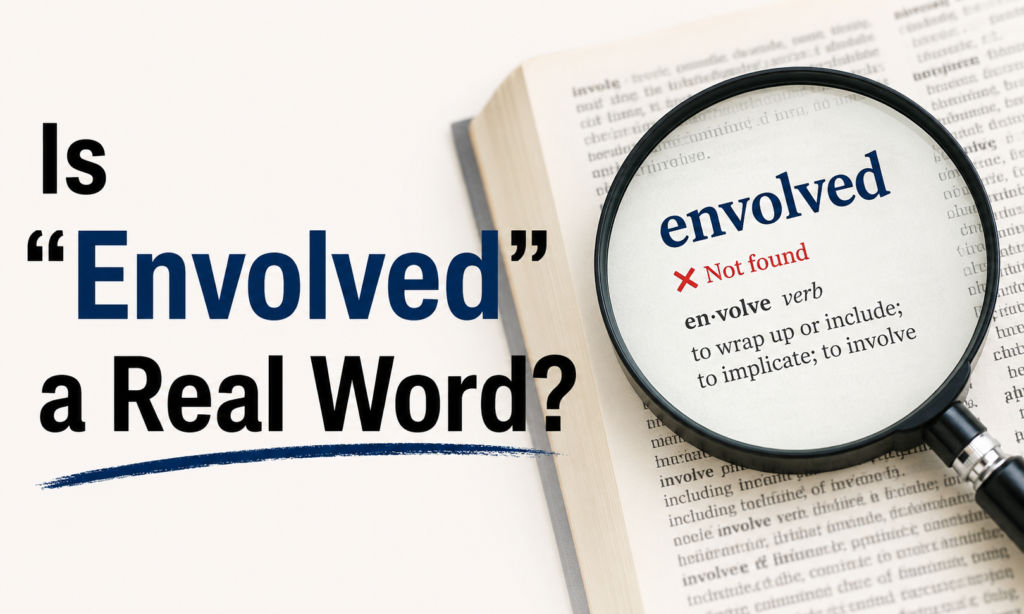
No. “Envolved” is not a real word.
You will not find it in:
- Merriam-Webster Dictionary
- Oxford English Dictionary
- Cambridge Dictionary
- Collins Dictionary
It has no definition, no etymology, no grammatical function. It is simply a misspelling — and a very common one at that.
Why Do People Write “Envolved”?
The confusion happens for two main reasons:
- The “en-” prefix pattern. English has many familiar words that begin with “en-” — enclose, engage, ensure, envelop, enlarge. Writers sometimes unconsciously apply this pattern to “involve,” writing “envolve” or “envolved” as if they follow the same logic. They don’t.
- Confusion with “evolved.” The word evolved (meaning developed or changed gradually over time) sounds similar to “involved” when spoken quickly. Some writers blend the two by accident, producing “envolved.”
Key insight: Spell-checkers like Grammarly, Microsoft Word, and Google Docs all flag “envolved” as incorrect immediately and suggest “involved” as the fix. That’s how non-existent this word really is.
Envolved vs Involved: Key Differences
Here’s a side-by-side comparison to make the distinction crystal clear:
| Feature | Involved | Envolved |
| Correct spelling | ✅ Yes | ❌ No |
| Found in dictionaries | ✅ Yes | ❌ No |
| Has a definition | ✅ Yes | ❌ No |
| Used in formal writing | ✅ Yes | ❌ Never |
| Accepted by spell-checkers | ✅ Yes | ❌ Flagged as error |
| Latin origin | ✅ involvere | ❌ No etymology |
The difference couldn’t be clearer. “Envolved” is not an alternate spelling, a regional variant, or an informal version. It is purely a spelling error.
A useful memory trick: When you are involved, you are IN something. The word starts with “in” because it means being inside or part of something. “Involve” → “involvement” → the “in” is always there.
How to Use “Involved” Correctly in Sentences
Now that we’ve confirmed “involved” is always correct, let’s look at how to use it properly across different contexts.
As a Verb (Past Tense of “Involve”)
When “involved” acts as a verb, it describes an action of including or bringing something into a process or situation.
- The project involved weeks of research and planning.
- The new policy involved all departments across the company.
- Building the app involved dozens of developers working in parallel.
As an Adjective — Participation or Engagement
When describing someone actively taking part in something:
- She has been involved in environmental advocacy since 2018.
- Parents who stay involved in their children’s education see better outcomes.
- He was deeply involved in the negotiations from the start.
As an Adjective — Emotional Connection
When describing emotional investment or a personal relationship:
- They became romantically involved after working together for months.
- She felt too emotionally involved to make an objective decision.
- He’s personally involved in the outcome of this case.
As an Adjective — Complexity
When describing something difficult to understand or intricate:
- The tax code is far too involved for the average person to navigate alone.
- It’s a long, involved process that requires careful attention at every step.
- The instructions were more involved than expected.
Common Incorrect vs. Correct Usage
| Incorrect (Never Use) | Correct (Always Use) |
| She was envolved in the meeting. | She was involved in the meeting. |
| The plot was too envolved. | The plot was too involved. |
| He got envolved in the dispute. | He got involved in the dispute. |
| We’re proud to be envolved. | We’re proud to be involved. |
Frequently Asked Questions
What is the correct spelling — “envolved” or “involved”?
“Involved” is always the correct spelling. It starts with “in-,” not “en-.”
What is the difference between “involved” and “evolved”?
“Involved” means participating in or connected to something. “Evolved” means developed or changed gradually over time. They are completely different words.
Can “involved” be used as both a verb and an adjective?
Yes. As a verb, it’s the past tense of “involve.” As an adjective, it describes participation, emotional connection, or complexity.
What tools catch the “envolved” error?
Grammarly, Microsoft Word, Google Docs, LanguageTool, and virtually all AI writing assistants flag “envolved” as a misspelling and recommend “involved.”
Conclusion
The answer is definitive: “involved” is correct, and “envolved” is not a word.
“Envolved” has no place in the English language — no dictionary entry, no etymological history, no grammatical function. It is a misspelling that persists because of how certain English prefixes work and because “involved” can sound like “evolved” in fast speech.
Every time you write “envolved,” you introduce an error that undermines your credibility — especially in professional and academic writing. The fix is simple: always start the word with “in”, not “en.” Remember, when you’re part of something, you are in it — and so is the word: in-volved.