
You just wrapped up a team meeting, closed out a wedding speech, or hit “reply all” on a group email, and now you’re staring at the cursor wondering which phrase to type: “Thank you everyone” or “Thank you all”? It feels like a small decision, but the wrong choice can make a warm message sound stiff, or a formal note sound too casual.
Here’s the good news you’re not choosing between right and wrong. Both phrases are grammatically sound, and native speakers switch between them constantly without a second thought. What actually separates them is tone, setting, and the subtle feeling each one leaves behind. This guide breaks down exactly when to use each phrase, why they feel different even though they mean the same thing, and how to sound polished no matter who you’re thanking.
Are “Thank You Everyone” or “Thank You All” Grammatically Correct?
Yes, both phrases are correct in standard English, and neither one is slang or a shortcut. You’ll find them in professional emails, graduation speeches, social media captions, and classroom farewells alike.
Technically, “thank you” already functions as a complete expression of gratitude, with an implied subject (“I thank you”). Adding “everyone” or “all” simply clarifies who the thanks is directed toward. According to Merriam-Webster, “everyone” is defined as “every person,” confirming that it functions here exactly as grammar rules expect — as a pronoun standing in for the whole group, not a casual add-on.
A quick note on punctuation: many people wonder if a comma belongs before “everyone,” as in “Thank you, everyone.” Both the comma and no-comma versions appear in everyday writing, and grammar guides are split on whether direct address strictly requires it. In casual writing, most people drop it. In formal or edited writing, adding the comma is safer.
The Real Difference Between “Thank You Everyone” and “Thank You All”
Since both phrases are correct, the real question isn’t grammar — it’s feel. Each one carries a slightly different emotional temperature, even though the meaning is identical.
“Thank You Everyone”
“Thank you everyone” treats the group as a collection of individuals. “Everyone” is singular in form, which gives the phrase a slightly more personal, deliberate rhythm — almost as if you’re acknowledging each person one by one, even while addressing them together. This is why it often shows up in written communication, formal speeches, and public announcements where the speaker wants to sound thoughtful and inclusive.
“Thank You All”
“Thank you all” treats the group as a single unit. “All” is a collective pronoun, so the phrase feels quicker, tighter, and more conversational. It’s the version you’ll hear most often in spoken language — at the end of a meeting, after a toast, or when wrapping up a casual thank-you note to friends or coworkers.
Neither version is more “correct” than the other. The difference is closer to word choice in tone than a grammar rule — similar to choosing between “big” and “large.”
How Native Speakers Choose Without Thinking
Fluent speakers rarely pause to analyze grammar before picking one phrase over the other. Instead, they react instinctively to three things happening in the moment:
- The setting — a boardroom versus a backyard barbecue calls for different energy.
- The medium — spoken words move faster than written ones, so shorter phrases like “thank you all” tend to win out loud.
- The relationship — close friends get casual phrasing; new clients or large audiences often get something that feels a touch more composed.
Over time, this instinct becomes automatic. You don’t consciously decide “I am now selecting the more formal option” — you simply say what fits, the same way you’d naturally say “hey” to a friend and “hello” to a stranger.
When to Use “Thank You Everyone”
Ideal Situations for “Thank You Everyone”
“Thank you everyone” tends to fit best in situations where structure, professionalism, or written polish matters:
- Closing lines in a formal email or newsletter
- Corporate announcements or company-wide memos
- Award acceptance speeches or graduation addresses
- Public thank-you posts aimed at a broad or unfamiliar audience
- Messages meant to sound warm but composed, like a retirement send-off
Why It Feels More Intentional
Because “everyone” implies individual recognition, the phrase naturally reads as more thoughtful. It suggests you’re not just closing out a message — you’re genuinely acknowledging each person’s part in something. That’s part of why it appears so often in written formats: readers process it more slowly than a listener would, so the slightly more deliberate phrasing lands well.
Examples of “Thank You Everyone” Used Naturally
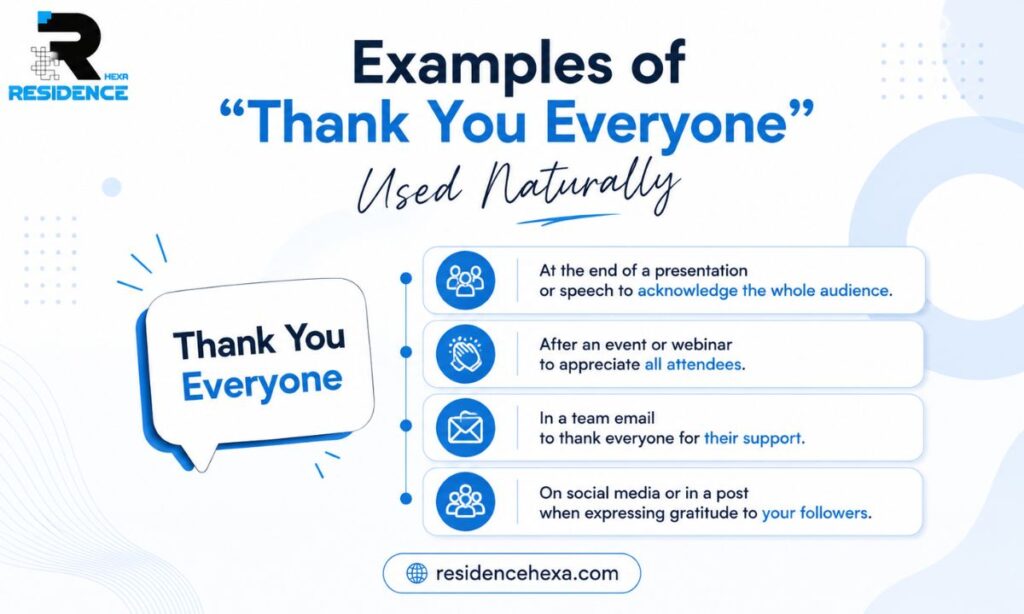
- “Thank you everyone for making this year’s fundraiser our most successful one yet.”
- “Thank you everyone who joined today’s call — your input shaped the roadmap.”
- “Thank you everyone for the birthday wishes; I read every single message.”
- “Thank you everyone for your patience during the system upgrade this week.”
- “Thank you everyone for attending the ceremony despite the weather.”
When to Use “Thank You All”
Ideal Situations for “Thank You All”
“Thank you all” shines in faster-paced, more informal moments, especially spoken ones:
- Wrapping up a team meeting or quick huddle
- Ending a toast at a party or celebration
- Group texts, casual Slack messages, or DMs
- Thanking friends or family after an event
- Verbal announcements where brevity matters
Examples of “Thank You All” Used Naturally
- “Thank you all for coming out tonight — it means the world to us.”
- “Thank you all for staying late to finish the project.”
- “Thank you all for the birthday cake, it was delicious!”
- “Great job today, team — thank you all for pushing through the deadline.”
- “Thank you all so much, see you at the next meetup!”
Tone, Audience, and Medium: How to Choose Instantly
Ask Yourself Three Questions
Before typing or saying either phrase, run through this quick mental checklist:
- Am I writing or speaking? Writing leans toward “everyone”; speaking leans toward “all.”
- Is this formal or casual? Formal settings favor “everyone”; casual settings favor “all.”
- Is my audience broad or close-knit? Wide or unfamiliar audiences often get “everyone”; close teams or friends often get “all.”
If you answer these three questions honestly, the right phrase usually becomes obvious within seconds.
Quick Comparison Table
| Factor | Thank You Everyone | Thank You All |
| Formality | Slightly more formal | Slightly more casual |
| Best medium | Written (emails, posts, speeches) | Spoken (meetings, toasts, calls) |
| Tone | Deliberate, individual-feeling | Quick, collective-feeling |
| Common setting | Corporate, public, ceremonial | Team, social, everyday |
| Grammar structure | “Everyone” = singular pronoun | “All” = collective pronoun |
Common Mistakes People Make
Thinking One Is Always Politer
Neither phrase outranks the other in politeness. Formality is not the same as respect — “thank you all” can be just as sincere and courteous as “thank you everyone” when the moment calls for warmth over polish.
Overusing One Phrase
Repeating the same thank-you phrase in every email or speech can make gratitude feel automatic rather than genuine. Mixing in alternatives keeps your appreciation sounding fresh and specific to the moment.
Overthinking Grammar
Because both phrases are correct, spending too much time worrying about “proper” usage often does more harm than good. The bigger risk isn’t grammar — it’s misjudging tone for the audience in front of you.
Polished Alternatives to “Thank You Everyone” and “Thank You All”
Sometimes neither phrase quite fits. Here are refined alternatives for different situations.
Formal Alternatives
- “I want to extend my sincere gratitude to all of you.”
- “Thank you to everyone who contributed to this outcome.”
- “With heartfelt thanks to the entire team.”
Friendly Alternatives
- “You guys are the best, thank you!”
- “Couldn’t have done it without you all.”
- “Big thanks to everyone who showed up today!”
Professional Email Alternatives
- “I appreciate everyone’s effort on this project.”
- “Thank you to the whole team for your hard work.”
- “Many thanks to all involved for a smooth rollout.”
Situational Alternatives Table
| Situation | Suggested Phrase |
| Closing a formal email | “Thank you for your continued support.” |
| Ending a wedding speech | “Thank you all for being here to celebrate with us.” |
| Wrapping up a work meeting | “Thanks, everyone, let’s touch base next week.” |
| Social media caption | “Thank you all for the love on this post!” |
| Award or achievement speech | “Thank you to everyone who believed in this project.” |
Case Studies: How These Phrases Are Used in Real Life
Case Study: Workplace Announcement
A department head sending a company-wide email about a successful product launch chose “Thank you everyone for the incredible teamwork this quarter.” The written, formal format made “everyone” the natural fit — it read as sincere without sounding overly casual to employees across different seniority levels.
Case Study: Charity Event Post
A local charity closing out an Instagram recap wrote, “Thank you all for showing up and donating — we hit our goal!” Because the tone was upbeat and the audience was a community of supporters rather than strangers, “thank you all” matched the celebratory, conversational energy of the post.
Case Study: Classroom Setting
A teacher ending the last class of the semester said out loud, “Thank you all for such a great year.” Spoken, warm, and quick — exactly where “thank you all” tends to feel most natural, reinforcing group camaraderie without sounding scripted.
What Style Guides and Usage Experts Agree On
Most usage authorities agree that both phrases are grammatically valid and that the decision comes down to register rather than correctness. Style guides consistently point out that “everyone” behaves as a singular pronoun while “all” behaves as a collective one, but both correctly address a group. The consensus across grammar resources is simple: match the phrase to your audience and medium, not to a strict rule, since none exists that makes one version universally superior.
If you’re refining other everyday phrases beyond this one, Residence Hexa’s guide on whether “Happiest Birthday” is grammatically correct tackles a similar case of a popular phrase that sounds right through repetition, while the breakdown of “Any Day” vs. “Anyday” covers another common mix-up worth double-checking before you hit send.
Conclusion
“Thank you everyone” and “thank you all” are both correct, both sincere, and both capable of carrying real warmth — the only real difference is the impression they leave. “Everyone” leans formal and written, treating the group as individuals worth acknowledging one by one. “All” leans casual and spoken, wrapping the group into one quick, heartfelt gesture.
Once you get a feel for tone, audience, and medium, choosing between them becomes second nature — exactly the way native speakers do it, without ever pausing to think twice.