Have you ever typed “eventhough” in an email, paused, and wondered if it looked wrong? You’re not alone. This is one of the most common spelling mix-ups in English, and it trips up students, professionals, and even confident native speakers who type faster than they think.
The short answer is simple: “even though” is always two separate words, and “eventhough” is not a real word in standard English. But knowing the rule isn’t the same as understanding why the mistake happens so often. In this guide, we’ll break down the grammar, the history, and the psychology behind the confusion, and give you practical tools to get it right every time.
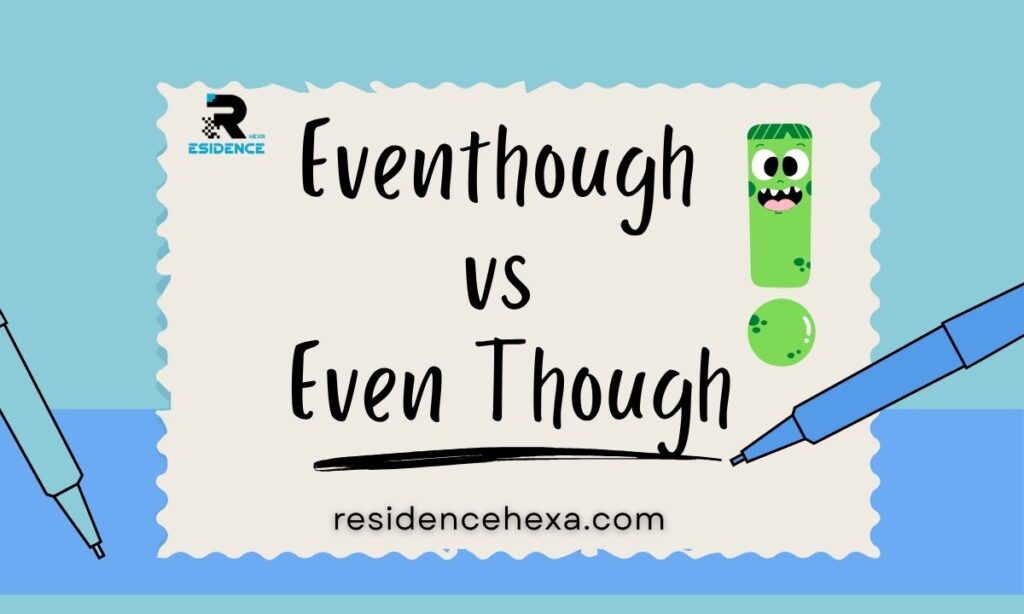
Eventhough vs Even Though
At its core, this isn’t really a “versus” comparison — it’s one correct form and one common error.
- Even though is a subordinating conjunction made of two words. It introduces a clause that contrasts with the main idea of the sentence.
- Eventhough is a merged spelling that doesn’t appear in any major dictionary and is incorrect in every style guide and professional publication.
Think of “even” and “though” as two tools that only work well kept apart. “Even” adds emphasis; “though” introduces contrast. Fuse them, and the sentence loses its grammatical footing, even if the meaning still feels obvious.
Why This Tiny Spelling Error Matters More Than You Think
A single missing space might seem trivial, but small errors add up fast. Here’s why this one deserves attention:
- It signals rushed writing to teachers, editors, and hiring managers.
- It disrupts reading flow, forcing the brain to pause and mentally correct the word.
- It appears repeatedly, since it’s a habit rather than a one-off typo.
- It affects content quality scores for bloggers, since search engines reward clean, well-structured writing.
This isn’t just a nitpicky rule — it’s a small detail that quietly shapes how credible your writing looks.
The Root of the Confusion: Why “Eventhough” Feels Right but Isn’t
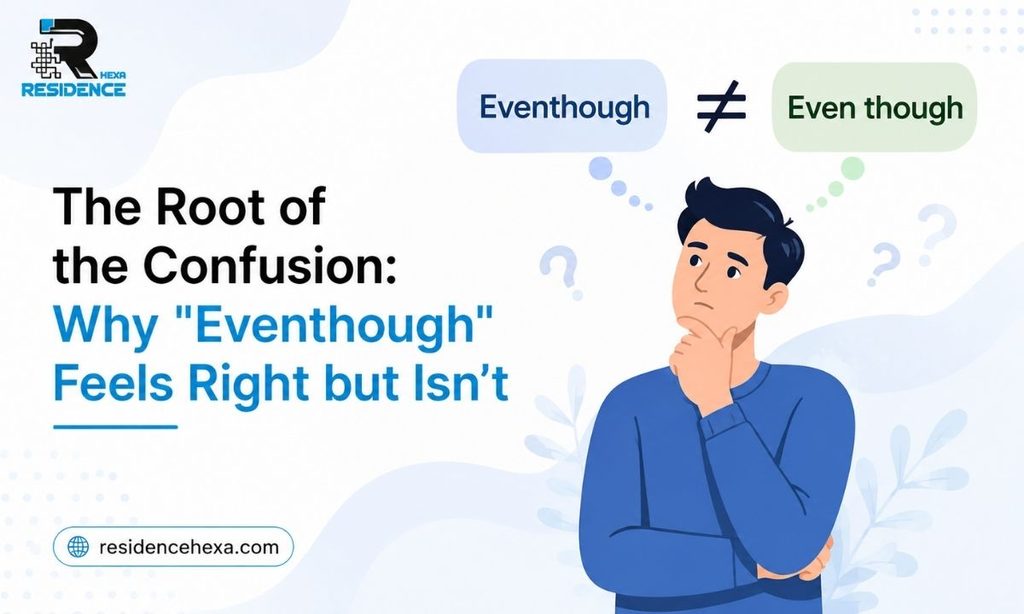
English is full of compound words — “everyday,” “anyone,” “cannot,” “somebody.” So it’s reasonable to assume “even” and “though” might follow the same pattern. But English vocabulary doesn’t grow through logic alone; it grows through historical usage, and “even though” simply never merged the way other word pairs did.
A few practical reasons the mistake keeps happening:
- Speed typing. On phones, people often skip spaces between short, familiar words.
- Pattern matching. The brain sees short two-word phrases and assumes they behave like known compounds.
- Spoken rhythm. In fast speech, “even though” often blends into what sounds like a single word.
- Autofill habits. Repeated typos on mobile devices can become muscle memory.
Understanding why the error happens is often the fastest way to stop making it.
The Grammar Rule Explained Simply
Here’s the rule in plain language: “even though” functions as a subordinating conjunction, connecting a dependent clause to an independent clause while showing contrast.
- Even though it was raining, we went for a walk.
- She stayed calm even though the situation was stressful.
In both examples, “even though” introduces a fact that makes the rest of the sentence surprising. It behaves the same way grammatically as “although,” and like “although,” it must remain a separate phrase — never fused into a single word.
According to Merriam-Webster, “even though” is defined and listed strictly as a two-word phrase, with no single-word variant recognized anywhere in the entry.
A Quick Look Back: Origin & Historical Usage of “Even Though”
Both words have deep roots in Old English:
- Even comes from efen, meaning “level” or “equal,” which evolved into a term used for emphasis.
- Though comes from þēah, meaning “nevertheless” or “although.”
These words existed independently for centuries and were combined as a spoken phrase long before modern grammar rules were formalized. At no point in that history did “even though” fuse into a single accepted word — which is why dictionaries and style guides still treat it as two words today.
Why “Eventhough” Will Never Be Correct — Linguistically or Grammatically
Some English compounds do eventually merge over time (think “today” or “cannot”), but that only happens through decades of consistent, dictionary-sanctioned usage. “Eventhough” has never crossed that threshold, for a simple reason: “even” still functions independently as its own word in dozens of other contexts (“even so,” “even if,” “even now”). Because “even” retains its own grammatical role, merging it permanently with “though” would create confusion rather than clarity — which is exactly what language evolution tends to avoid.
Real Costs of Using the Wrong Form
Using “eventhough” instead of “even though” isn’t just a stylistic nitpick — it carries measurable consequences:
| Area Affected | Real-World Impact |
| Academic writing | Professors may deduct marks for repeated errors |
| Job applications | Recruiters often screen out resumes with basic typos |
| Business communication | Clients may question attention to detail |
| Blog and website content | Poor grammar can hurt readability and trust |
| Everyday messaging | Can make writing look rushed or careless |
None of these costs are severe alone, but together they shape how readers judge your competence.
Common Myths & Misconceptions About “Eventhough”
- “It’s fine in informal writing.” False — informal writing still benefits from correct spelling.
- “If it’s common online, it must be acceptable.” Frequency doesn’t equal correctness.
- “Autocorrect will always catch it.” Not always — tools flag it inconsistently across apps and keyboards.
- “It’s a regional spelling variation.” No English-speaking country recognizes “eventhough” as standard.
How to Use “Even Though” Naturally in Sentences
“Even though” works at the start of a sentence or in the middle, in both formal and conversational writing.
- Even though he was tired, he finished the project.
- I enjoyed the movie even though the ending felt rushed.
- Even though prices went up, sales remained strong.
Quick tip: whenever “although” fits the sentence, “even though” almost certainly fits too.
Common Mistakes and How to Fix Them
| Mistake | Correction |
| Eventhough she studied hard, she failed. | Even though she studied hard, she failed. |
| He smiled eventhough he was nervous. | He smiled even though he was nervous. |
| Eventhough it’s late, let’s continue. | Even though it’s late, let’s continue. |
Quick fix tip: Before submitting any document, search for “eventhough” and correct it immediately.
Table of Comparison: Eventhough vs Even Though
| Feature | Even Though (Correct) | Eventhough (Incorrect) |
| Dictionary status | Recognized in all major dictionaries | Not recognized anywhere |
| Grammatical role | Subordinating conjunction | No valid grammatical function |
| Formal writing | Fully accepted | Always flagged as an error |
| Informal writing | Accepted | Still incorrect |
| Word count | Two words | Incorrectly merged into one |
Why the Ear Tricks the Eye: Pronunciation vs. Spelling
When spoken naturally, “even though” often blends together, especially in fast or casual speech — a normal feature of spoken English, where sounds link and shorten constantly. The problem arises when writers transcribe that spoken rhythm directly into text. Written English follows its own rules, independent of how a phrase sounds spoken quickly, and spelling should follow the written standard, not pronunciation shortcuts.
The Global View: Do Other Languages Merge Similar Phrases?
Some languages do allow similar contrastive phrases to merge into single compound words, which is part of why non-native English speakers — especially those from languages with flexible compounding rules — sometimes assume “eventhough” should follow the same logic. English, however, tends to preserve clarity through word separation rather than fusion, particularly for conjunctions and connector phrases.
The Digital Factor: Autocorrect, Spellcheck & Internet Trends
Modern writing tools have made this error both easier to catch and easier to spread:
- Spellcheck tools usually flag “eventhough,” but not always in every browser, app, or plain-text editor.
- Social media and texting normalize casual spelling, which can bleed into formal writing.
- Predictive text occasionally reinforces merged forms based on common (but incorrect) typing patterns.
Relying entirely on software isn’t a reliable substitute for knowing the rule yourself.
Linguistic Insight: Why Word Separation Matters
Word separation in English often preserves meaning and function. “Even” plays a flexible, standalone grammatical role across many phrases, while “though” independently functions as both a conjunction and, in some contexts, an adverb. Keeping them separate lets each word retain its own grammatical identity, supporting clarity in longer, more complex sentences.
Expert Opinion: What Grammar Authorities Agree On
Every major English-language authority — dictionaries, academic style guides, and professional editing standards alike — agrees on one point: “even though” must remain two words in all standard writing. There is no dialect, register, or context in which the merged spelling is considered acceptable.
Tricks to Remember the Correct Form (Mnemonic Magic 🧠)

- Pause test: Say the phrase slowly. The natural pause between “even” and “though” represents the space.
- Swap test: Replace it with “although.” If the sentence still works, “even though” needs a space too.
- Two-job rule: “Even” and “though” each do a separate job — emphasis and contrast — so they need separate spaces.
- Search-before-you-send: Search your document for “eventhough” before hitting publish.
Quick Grammar Check: Smart Alternatives to “Even Though”
To vary sentence structure, these alternatives carry a similar contrastive meaning:
- Although
- Though
- Despite the fact that
- Regardless of the fact that
- Even if (for hypothetical contrast)
Each shifts tone slightly, so pick based on formality and rhythm.
Fix Your Writing Instantly: Real-Life Examples
Before: Eventhough the deadline was tight, the team delivered great results. After: Even though the deadline was tight, the team delivered great results.
Before: She kept working eventhough she was exhausted. After: She kept working even though she was exhausted.
Small fix, noticeably cleaner result.
Why Getting It Right Boosts Credibility and Confidence
Correct grammar signals more than technical skill — it signals attention to detail. Readers, employers, and clients often associate clean writing with reliability, and small, consistent errors can quietly undermine that trust. Getting “even though” right is a simple, low-effort way to sharpen your overall writing.
Self Assessment
Test yourself quickly with these short questions:
- Is “eventhough” ever correct? No, it is never recognized as correct in standard English.
- Can “even though” start a sentence? Yes, it can begin or appear in the middle of a sentence.
- Is “even though” formal or informal? Both — it works in academic, professional, and casual writing.
- What part of speech is “even though”? It functions as a subordinating conjunction.
- What’s a good synonym for “even though”? “Although” is the closest and most common alternative.
Continue Improving Your English Writing Skills
Mixing up similar-looking word pairs is one of the most common ways small grammar habits creep into everyday writing. It’s worth reviewing other frequently confused pairs that follow the same “merged vs. separate” pattern, such as Of Course or Ofcourse? Correct Spelling, Meaning & Usage Guide, which covers a very similar mistake. You may also find Modelling vs Modeling: Which Spelling Is Correct? useful for another common spelling comparison.
Conclusion
The difference between “eventhough” and “even though” comes down to one simple, unchanging rule: only the two-word form is correct. While the confusion is understandable — driven by speech patterns, fast typing, and English’s many genuine compound words — “even though” has never merged into a single accepted word, and there’s no indication it ever will.
Once you internalize the pause test, the swap test, and a habit of proofreading before you publish, this mistake becomes easy to eliminate for good. Clean, accurate grammar might seem like a small detail, but it consistently adds up to writing that reads as more confident, more credible, and more professional.