Have you ever paused mid-sentence, unsure whether to write “the disease is associated with poor diet” or “the disease is associated to poor diet”? You’re not alone. This is one of the most common preposition mix-ups in English, and it trips up native speakers, students, and professional writers alike. The confusion usually comes from the fact that both phrases sound like they should work, since “to” and “with” both show up constantly in everyday English sentences.
The good news is that the answer isn’t complicated once you understand the logic behind it. In this guide, you’ll get a clear, direct answer, along with real examples, common mistakes, and simple rules that make this grammar point easy to remember for good. By the end, you’ll never have to second-guess this preposition again.
Associated With vs Associated To – The Quick Answer
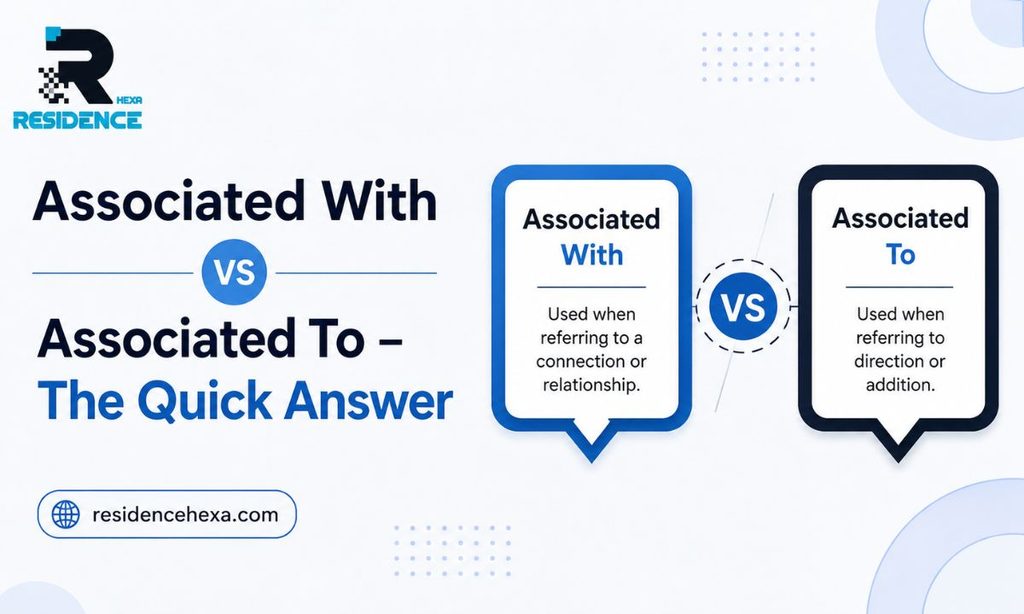
“Associated with” is correct. “Associated to” is not standard English.
The verb “associate” always pairs with the preposition “with” when describing a connection, relationship, or link between two things. This holds true in academic writing, medical research, business communication, and everyday conversation. “Associated to” occasionally shows up in casual writing or translated text, but grammar authorities and style guides consistently treat it as incorrect.
Associated With vs Associated To Sentences
Here’s a side-by-side look at how each phrase behaves in a real sentence:
| Sentence Type | Associated With (Correct) | Associated To (Incorrect) |
| Health | Obesity is associated with heart disease. | Obesity is associated to heart disease. |
| Business | She is associated with several major brands. | She is associated to several major brands. |
| Everyday | Winter is often associated with cold weather. | Winter is often associated to cold weather. |
| Academic | The study is associated with a leading university. | The study is associated to a leading university. |
Associated With in a Sentence
To see the correct form in action, look at how naturally it fits into different kinds of writing:
- The color red is often associated with passion and energy.
- He has been associated with the charity for over a decade.
- Poor sleep is associated with reduced concentration.
- The brand is closely associated with luxury and quality.
Notice that in every example, “with” connects two ideas, people, or things without implying direction or movement — and that’s exactly the job “with” is built for.
What Does “Associate” Mean in English?
Before diving deeper into prepositions, it helps to understand where the confusion starts. The word “associate” comes from the Latin associare, meaning “to join” or “to unite.” In modern English, it’s used as a verb, noun, and adjective, but the meaning always circles back to connection.
Core Meaning of Associate
As a verb, “associate” generally means one of three things:
- To connect two ideas mentally — People associate summer with vacations.
- To link one thing with another in a factual or statistical sense — Smoking is associated with lung cancer.
- To be involved or affiliated with a person, group, or organization — She is associated with the research team.
According to Merriam-Webster’s definition of “associate,” the word describes joining as a partner, connecting in thought, or linking two things together — and in every standard definition, the preposition that follows is “with,” never “to.”
How to Use “Associate” Correctly
Understanding the sentence patterns that “associate” naturally forms makes it much easier to avoid mistakes.
Associate With Something
This pattern describes being connected, affiliated, or involved with a person, group, or entity.
- He associates with a group of local entrepreneurs.
- The company associates with several nonprofit organizations.
Associate Someone With Something
This pattern is used when you mentally connect one person or thing to a quality, idea, or reputation.
- People associate Elon Musk with electric vehicles.
- Critics associate the director with bold storytelling.
Associate Something With an Experience
This pattern links an object, place, or sensation with a memory, feeling, or experience.
- She associates the smell of cinnamon with her childhood.
- Many people associate the beach with relaxation.
In all three patterns, “with” is the only preposition that fits naturally. This consistency is exactly why “associated with” has become the fixed, standard collocation in English.
Why “Associated With” Is the Correct Standard Form
English grammar relies heavily on fixed word pairings called collocations — combinations that simply “sound right” to native speakers because they’re used so consistently. “Associated with” is one of these fixed collocations, much like “interested in” or “married to.” Swapping the preposition breaks the pattern and immediately sounds off to a native ear.
Natural Collocations With Associated With
Some of the most common collocations built around this phrase include:
- Associated with a risk
- Associated with a brand
- Associated with a condition
- Associated with a group
- Associated with a cause
Associated With Examples in Different Contexts
The phrase adapts smoothly across formal and informal writing. Here’s how it looks in four common settings.
Academic Research
Academic papers rely on “associated with” constantly to describe correlations and relationships between variables.
- Higher education levels are associated with improved job stability.
- Increased screen time is associated with disrupted sleep patterns.
Medical Studies
Medical writing is perhaps the most frequent user of this phrase, especially when discussing risk factors and symptoms.
- High blood pressure is associated with an increased risk of stroke.
- Vitamin D deficiency is associated with weakened bones.
Business Communication
In professional settings, the phrase often describes reputation, partnership, or affiliation.
- Our brand is associated with reliability and innovation.
- He has been associated with the firm since 2015.
Everyday Conversation
In casual speech, the phrase usually links feelings, seasons, or memories.
- I associate that song with my college years.
- Rainy days are associated with cozy evenings for a lot of people.
Associated To or Associated With: Grammar and Usage
At this point, the pattern should be clear — but it’s worth understanding why “associated to” feels wrong, not just accepting that it is.
Why Associated To Sounds Incorrect
The preposition “to” typically expresses direction, destination, or a recipient — think “give it to her” or “walk to the store.” “Associated,” however, doesn’t describe movement toward something; it describes a mutual connection between two things that already exist side by side. Because “with” naturally expresses togetherness and connection, it fits the meaning of “associate” far better than “to” ever could.
Associated To vs Associated With Examples
| Incorrect (Associated To) | Correct (Associated With) |
| The symptoms are associated to stress. | The symptoms are associated with stress. |
| His name is associated to the scandal. | His name is associated with the scandal. |
| The logo is associated to the company’s early years. | The logo is associated with the company’s early years. |
Correct and Incorrect Sentences
A quick way to test your sentence is to read it aloud. If it sounds like a direct translation from another language, it’s probably wrong. Compare:
- ❌ The disease is associated to genetic factors.
- ✅ The disease is associated with genetic factors.
Can You Ever Use “Associated To”?
While “associated with” is the standard rule, there are a few narrow situations where “associated to” appears — though even then, it’s rarely the preferred choice.
Technical and Scientific Writing
In some technical, mathematical, or programming contexts, “associated to” occasionally appears when describing a fixed, one-directional mapping — for example, in set theory or database relationships, where one value is mapped or assigned to another. Even here, though, many style guides still recommend “associated with” for clarity and consistency.
Translation and Non-Native English
The most common reason “associated to” shows up is direct translation from other languages. In Spanish, the phrase is asociado a; in French, it’s associé à. Both use a preposition that translates literally to “to.” When non-native speakers translate word-for-word, “associated to” is the natural, though incorrect, result in English. This is a textbook example of language transfer, and it’s one of the most common patterns you’ll notice while proofreading or editing internationally translated content — a subtle issue similar to other preposition mix-ups readers often run into, such as confusion between saying something is in the street or on the street.
Associated With vs Related To: What’s the Difference?
“Associated with” isn’t the only connection-related phrase in English, and it’s easy to mix it up with similar expressions.
Associated With vs Related To
“Related to” usually implies a more direct, often causal or familial connection, while “associated with” implies a broader, sometimes statistical or observational link.
- Diabetes is related to insulin production. (direct, causal)
- Diabetes is associated with a higher risk of heart disease. (broader link)
Connected To vs Associated With
“Connected to” often suggests a physical, structural, or logical link, while “associated with” leans more toward mental or statistical association.
- The wire is connected to the power source. (physical)
- The brand is associated with sustainability. (perception)
Linked To vs Associated With
“Linked to” is close in meaning to “associated with,” but it often implies a stronger or more established connection, especially in news and research contexts.
- The outbreak was linked to contaminated water.
- Poor posture is associated with back pain.
What Is a Synonym for “Be Associated With”?
If you’re looking to vary your sentence structure, several alternatives capture a similar meaning.
Common Synonyms and Alternatives
- Connected with
- Linked to
- Affiliated with
- Related to
- Tied to
- Correlated with
Each of these carries a slightly different shade of meaning, so choose based on how strong or formal the connection needs to sound.
Common Mistakes With Associated With and Associated To
Even experienced writers slip up occasionally. Here are the three most frequent errors.
Direct Translation Mistakes
As mentioned earlier, non-native speakers often translate their native preposition literally, producing “associated to” instead of “associated with.”
Confusing Similar Prepositions
Writers sometimes borrow the preposition from a similar phrase, like “related to” or “connected to,” and mistakenly apply it to “associated.”
Overusing “To” in English
Because “to” is one of the most frequent prepositions in English, learners sometimes default to it out of habit, even when “with” is grammatically required.
Associated With Examples in Everyday and Professional English
Here’s a broader collection of examples across different fields to reinforce the correct usage.
Health and Medicine
- Chronic stress is associated with a weakened immune system.
- Regular exercise is associated with better cardiovascular health.
Psychology
- Positive childhood memories are associated with emotional resilience.
- Anxiety is often associated with overthinking and rumination.
Business and Branding
- The company is associated with cutting-edge technology.
- His name is closely associated with successful startups.
Everyday Communication
- I always associate autumn with pumpkin spice and cool weather.
- That restaurant is associated with excellent customer service.
Simple Rule: When to Use Associated With
If you only remember one thing from this guide, remember this rule.
Easy Grammar Rule to Remember
Whenever you’re describing a connection, relationship, or link between two things, use “with” — never “to.” Think of “with” as standing side-by-side (connection), while “to” points toward a direction or destination. Since “associate” always describes togetherness, “with” is the only preposition that logically fits — a distinction similar to word-choice questions readers ask about phrases like whether “too bad” or “to bad” is correct, where the wrong preposition or spelling quietly changes the meaning of the sentence.
Associated With vs Associated To: Quick Practice Quiz
Test yourself with these three quick questions before you go.
Question 1
“Lack of sleep is often ___ poor concentration.” Answer: associated with
Question 2
“She has been ___ the nonprofit for many years.” Answer: associated with
Question 3
“High cholesterol is ___ an increased risk of heart disease.” Answer: associated with
If you answered “associated with” for all three, you’ve fully grasped the rule.
Final Verdict
“Associated with” is the correct, standard, and widely accepted form in English, used consistently across academic writing, medical research, business communication, and everyday conversation. “Associated to” is considered nonstandard and typically results from direct translation or habit rather than proper grammar.
The next time you’re unsure, remember the simple test: if you’re describing a connection or relationship, “with” is always your answer.