
Every day, thousands of writers pause mid-sentence and second-guess themselves: is it referred or refered? Both sound identical when spoken aloud, but only one of them belongs in a dictionary. The other is a spelling error that quietly chips away at your credibility — in professional emails, academic papers, medical records, and legal documents alike.
This guide settles the debate once and for all. You will learn exactly why referred or refered trips people up, which spelling is correct, the grammar rule that explains it, and practical tricks to make sure you never get it wrong again.
Referred or Refered: Which Spelling Is Correct?
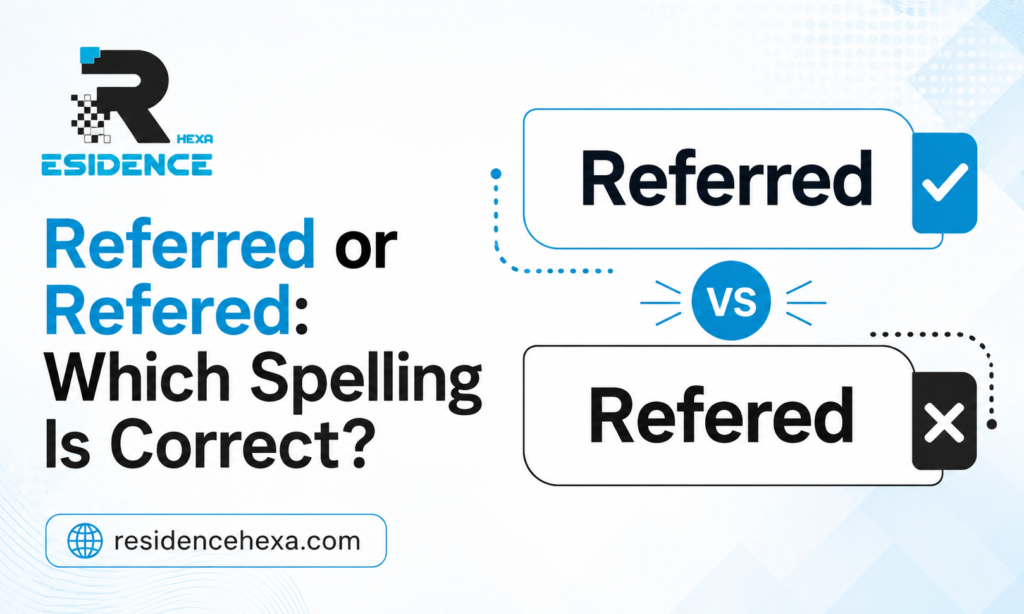
The answer is clear: referred is the only correct spelling. Refered does not exist in standard English — in any region, in any context, at any level of formality. It is a common misspelling, not an accepted variant.
Is “Refered” a Real Word?

No. Refered is not a real word. It does not appear in any major English dictionary, style guide, or grammar reference. It is simply a misspelling of referred — one that happens to be surprisingly widespread, especially in informal digital writing and non-native English contexts.
The Correct Spelling: Referred
Simple Definition
According to Merriam-Webster, referred is the past tense and past participle of the verb refer, meaning to direct someone’s attention to a source, person, or thing, or to mention something in speech or writing.
Examples in Context
- The doctor referred the patient to a specialist.
- My colleague referred me to this report yesterday.
- The article referred to several peer-reviewed studies.
- He was referred for further testing after the initial evaluation.
Why “Referred” Has Two R’s (The Real Grammar Rule)
The Consonant-Doubling Rule Explained Simply
English has a specific spelling rule for verbs: when a verb ends in a consonant-vowel-consonant (CVC) pattern and the stress falls on the final syllable, you double the last consonant before adding -ed or -ing.
This rule applies consistently across dozens of English verbs:
| Base Verb | Stressed Syllable | Past Tense |
| run | RUN | running |
| stop | STOP | stopped |
| commit | com-MIT | committed |
| occur | oc-CUR | occurred |
| prefer | pre-FER | preferred |
| refer | re-FER | referred |
| transfer | trans-FER | transferred |
How “Refer” Fits the Rule
The verb refer ends in e-r (vowel + consonant), and when you say it aloud — re-FER — the stress clearly lands on the second syllable. This triggers the consonant-doubling rule. The r doubles, and the result is referred, not refered.
The same logic explains referring and referral — all forms of this verb follow the same doubling pattern.
Why People Commonly Misspell Referred as Refered

Silent Stress Confusion
Most people write by sound, not by rule. When you pronounce referred, the double r in the middle does not create a noticeable sound difference from a single r. So writers skip the doubling and land on refered without realizing the error.
Influence of Similar Words
Words like offered, suffered, and covered follow a different pattern — they do not double the final consonant. That is because the stress in those verbs falls on the first syllable (OF-fer, SUF-fer, COV-er), so the rule does not apply. Writers sometimes apply that logic incorrectly to refer, producing refered.
Fast Typing and Digital Habits
Autocorrect and spell-check tools catch many errors, but not all writing tools flag refered consistently. In fast-paced digital communication — instant messages, emails, social media posts — the misspelling slips through and gets repeated.
ESL and Non-Native Challenges
For learners of English as a second language, consonant doubling is one of the more unpredictable rules in the language. Without a clear explanation of syllable stress patterns, non-native writers often default to a single consonant, which produces refered instead of referred.
Referred vs Refered: Side-by-Side Comparison
| Feature | Referred ✅ | Refered ❌ |
| Correct spelling | Yes | No |
| Accepted in English | Always | Never |
| Follows grammar rule | Yes (CVC + stress) | No (rule ignored) |
| In dictionaries | Yes | No |
| Professional use | Required | Avoid at all costs |
| British English | Referred | Still incorrect |
| American English | Referred | Still incorrect |
Correct Usage of “Referred” in Real Sentences
Professional Writing Examples
- She was referred to the HR department for further assistance.
- The client was referred by a trusted partner at a leading firm.
- The case was referred to the senior management team for review.
Academic Writing Examples
- The author referred to earlier research on behavioral psychology.
- Several sources referred to in the literature review support this conclusion.
- The study referred to a dataset compiled over a five-year period.
Medical and Legal Contexts
- The patient was referred for a blood test and follow-up imaging.
- The physician referred the case to an oncology specialist.
- The matter was referred to the district court for further proceedings.
- The defendant was referred to legal counsel before the hearing.
Everyday Usage
- My neighbor referred me to a great plumber last week.
- I was referred to this podcast by a friend.
- He referred to the incident several times during the conversation.
Common Phrases That Always Use “Referred”
These high-frequency phrases appear in formal and informal writing alike — and every one of them uses referred, never refered:
- Referred to as — used to name or label something: The condition is referred to as chronic fatigue syndrome.
- Referred by — used to indicate who made the recommendation: She was referred by her previous manager.
- Previously referred — used to indicate something mentioned earlier: As previously referred to, the data supports this claim.
- Referred for treatment — standard medical phrasing: The patient was referred for treatment at a specialist clinic.
Referred vs Similar-Looking Words That Cause Confusion
Referred vs Preferred
Both follow the exact same consonant-doubling rule. Pre-FER has final syllable stress, so: prefer → preferred. If you can remember preferred has two r‘s, you can remember that referred does too.
Referred vs Offered
This is where many writers go wrong. OF-fer is stressed on the first syllable, so no doubling applies: offer → offered (single r). The contrast between offered and referred is a textbook example of why syllable stress determines the spelling rule.
Referred vs Transferred
Another parallel: trans-FER carries final syllable stress, so transfer → transferred (double r). If you are unsure about referred or refered, think of transferred — the same logic applies.
For a deeper look at how English handles regional spelling differences in words that look similar, the guide on Behaviour or Behavior: Which Is Correct? explores how stress, etymology, and geography all interact in English spelling.
How to Remember the Correct Spelling Every Time
The Stress Test
Say the word refer out loud. You naturally emphasize the second syllable: re-FER. That stress is your cue — double the r before adding -ed. Stressed final syllable = doubled consonant. Always.
The “Preferred” Trick
If you already know how to spell preferred, you know how to spell referred. Both words follow the same rule, end in -ferred, and take exactly the same logic. Remember one, remember both.
Visual Cue
Think of the word refer + red: re-FER + RED = re-FERRED. The color red is hiding right inside the correct spelling of referred. It is a small trick that sticks.
Is “Refered” Ever Acceptable in Any Context?
No. There is no context — informal, creative, regional, or digital — where refered is considered correct or acceptable. It is always a spelling error. Unlike words with genuine regional variants (such as colour/color or behaviour/behavior), referred is universal. Both American and British English agree on the spelling completely.
Where It Hurts Most
The damage from writing refered is greatest in:
- Job applications and resumes — signals carelessness to hiring managers
- Medical documentation — creates ambiguity in clinical records
- Legal writing — undermines the authority and professionalism of the document
- Academic submissions — may affect grades on exams like IELTS or TOEFL
- Business communications — erodes trust with clients and colleagues
British vs American English: Any Difference?
None at all. Unlike spelling debates such as artefact vs artifact (explored in detail at Residence Hexa’s Artefact vs Artifact: Common Confusion Explained Clearly), there is no regional split with referred. Both British and American English require the double r. There is no alternative form, no Commonwealth variant, and no historical exception. Referred is the only correct spelling worldwide.
Real-World Case Study: When One Letter Costs Credibility
Imagine a job applicant submitting a cover letter that reads: “I was refered to this role by your senior marketing director.” To a careful recruiter, that single missing r raises an immediate question: how much attention does this person pay to detail? In high-stakes writing — whether a legal brief, a medical referral form, or a business proposal — one spelling error can shift perception in ways that are difficult to undo. The word referred appears constantly in professional English. Getting it right every time is not pedantic. It is professional.
Quick Facts About “Referred”

- Word type: Past tense and past participle of the verb refer
- Syllables: 2 (re-ferred)
- Stress: Falls on the second syllable (re-FER)
- Grammar rule applied: Consonant doubling rule (CVC + final syllable stress)
- Related forms: referring, referral, referrer, reference
- Used in: Professional, academic, medical, legal, and everyday writing
- British vs American: Identical spelling in both — no regional variation
- Common error: Refered (missing one r) — always incorrect
Conclusion
The question of referred or refered has one clean answer: referred is correct, and refered is always wrong. The double r is not optional, not regional, and not a stylistic choice — it follows directly from one of the most consistent rules in English grammar. When a verb ends in a consonant-vowel-consonant pattern and carries stress on the final syllable, you double the last consonant before adding -ed or -ing. Refer becomes referred. Every time.
Whether you are writing a medical referral, a job application, an academic paper, or a professional email, the correct spelling is the one that shows you know your grammar. Write referred with confidence — because now you know exactly why that second r belongs there.