If you have ever stopped mid-sentence wondering whether to write donar or donor, you are far from alone. This is one of the most frequently searched spelling questions in English — showing up on hospital intake forms, charity websites, blood donation campaigns, school essays, and professional documents. The confusion feels real because both versions look plausible, and a fast typist can easily miss the difference between them.
Here is the short answer you need right away: donor is the correct and only accepted spelling in standard English. The version “donar” is a common misspelling that no major English dictionary recognizes as a valid word. Understanding why this confusion happens — and how to avoid it — will sharpen your writing, protect your credibility, and make you a more confident communicator in any formal or informal setting.
Donar or Donor Meaning
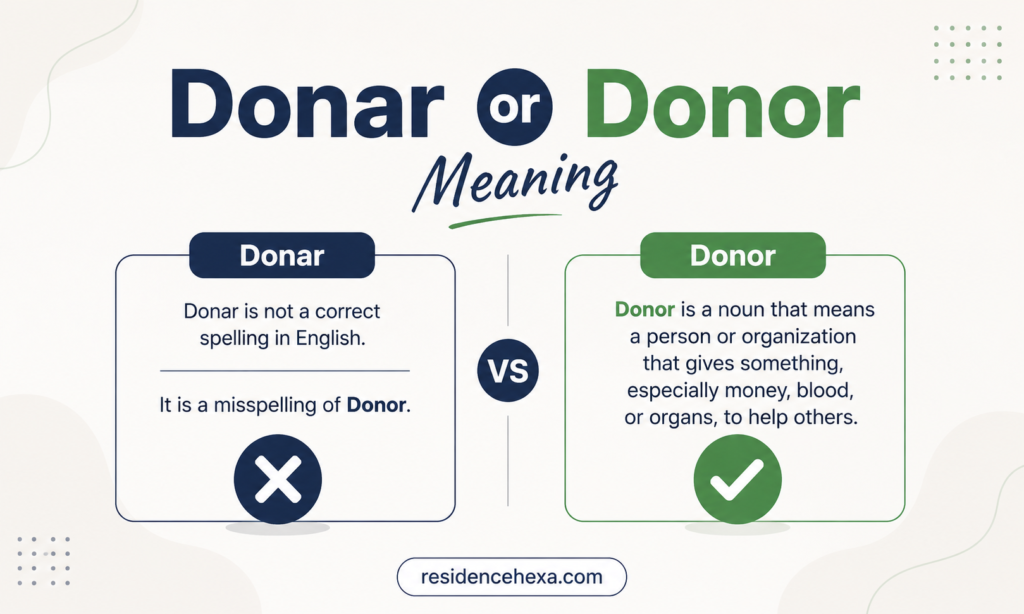
The word donor is a noun. It refers to a person, organization, or entity that gives something — whether that is money, blood, organs, tissues, or any other form of support — typically without receiving anything in return.
According to Merriam-Webster, a donor is defined as “one that gives, donates, or presents.” The word is widely used across medical, legal, charitable, and everyday contexts.
Here is a quick reference:
| Term | Correct? | Meaning |
| Donor | ✅ Yes | A person who gives blood, money, organs, or support |
| Donar | ❌ No | A misspelling; not recognized in standard English |
The word traces its roots to the Latin donare, meaning “to give.” That same Latin root gives us related English words like donation, donate, and donator — all of which share the core meaning of giving generously.
Why “Donar” Is Incorrect
So if “donar” is wrong, why does it keep appearing everywhere? There are a few clear reasons:
- Pronunciation blur: When spoken casually, “donor” can sound like “donar.” The second syllable’s vowel blends in natural speech, making both versions feel equivalent to the ear.
- Keyboard proximity: The letters “o” and “a” sit close together on a standard QWERTY keyboard. A fast typist can easily hit the wrong key without noticing.
- Cross-language influence: In Spanish, donar is a perfectly valid verb meaning “to donate.” For bilingual speakers or language learners, this overlap creates genuine confusion.
- Autocorrect failures: Spellcheck tools occasionally miss “donar” or even learn the misspelling over time, especially if the user has typed it repeatedly.
It is worth noting one narrow exception: Donar (capitalized) appears in Germanic mythology as an alternate name for the thunder god Thor. However, this is a proper noun used only in mythological or historical contexts — never as a substitute for the English word donor.
Outside of Spanish writing or mythology references, there is no scenario in standard English where “donar” is acceptable.
Common Confusions and Mistakes (How Do You Spell Donor / How to Spell Donor)
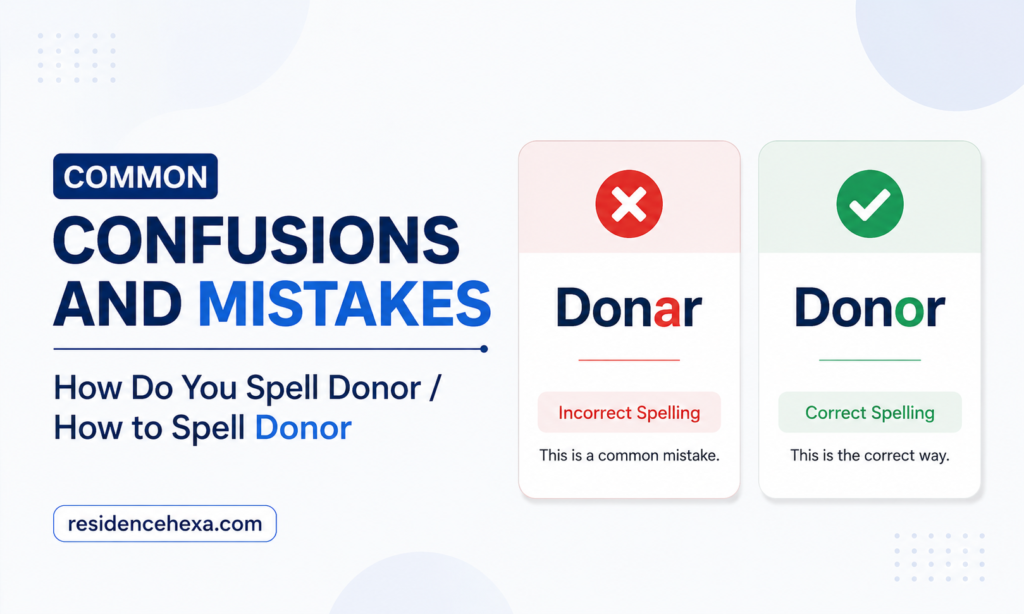
People searching “how do you spell donor” or “how to spell donor” often land on pages full of contradicting information. Here are the most common mistakes writers make, along with the correct versions:
Incorrect vs. Correct Usage:
| Incorrect ❌ | Correct ✅ |
| She is a blood donar. | She is a blood donor. |
| We need more organ donars. | We need more organ donors. |
| Thank you to every donar who contributed. | Thank you to every donor who contributed. |
| He registered as a donar at the hospital. | He registered as a donor at the hospital. |
One important point many writers miss: unlike words such as colour/color or organise/organize, the spelling of donor does not change between British and American English. Whether you are writing for a UK nonprofit or a US medical journal, the correct spelling is always donor — no exceptions, no regional variants.
Just as you would want to understand whether you are using behaviour or behavior based on your audience’s dialect, the good news with “donor” is that there is no such regional dilemma — one spelling serves every English-speaking audience worldwide.
Usage in Context
Seeing donar or donor used correctly in real sentences is one of the best ways to lock in the right form. Here are examples across different real-world contexts:
Medical and Healthcare:
- The hospital urgently needs blood donors to replenish their supplies.
- Each organ donor can save up to eight lives.
- She signed the donor card at her local clinic.
Charitable and Nonprofit:
- The foundation thanked every donor who contributed to the annual fundraiser.
- Anonymous donors funded the new wing of the children’s hospital.
- Without our generous donors, this program would not exist.
Legal and Formal:
- The donor signed a binding agreement before the transfer of assets.
- Estate planning often involves naming a donor-advised fund as the vehicle for charitable giving.
Everyday Writing:
- He has been a regular blood donor for over ten years.
- Our top donor this year contributed more than any individual in our history.
- Every donor makes a measurable difference in someone’s life.
Donar or Donor Synonyms
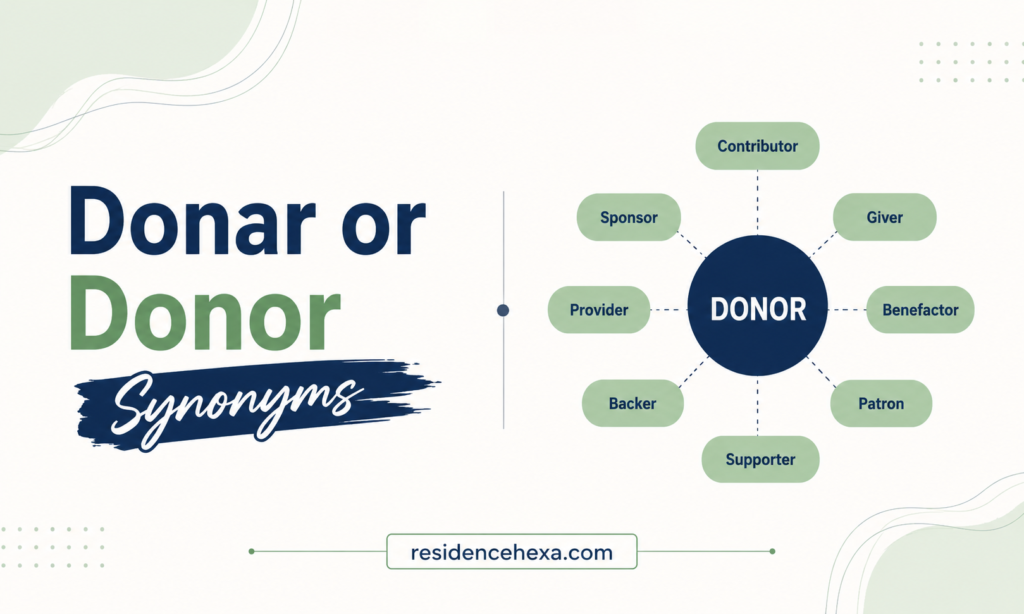
Expanding your vocabulary around the word donor makes your writing richer and more varied. Here are the most commonly used synonyms, each with a slightly different nuance:
| Synonym | Best Used When… |
| Benefactor | Emphasizing financial generosity, especially ongoing support |
| Contributor | Referring to someone who gives money or resources to a group effort |
| Philanthropist | Describing large-scale charitable giving, often by wealthy individuals |
| Patron | Referring to someone who supports the arts, education, or institutions |
| Sponsor | When a donor’s name or brand is publicly associated with an event or cause |
| Giver | A simple, informal alternative for any act of giving |
| Grantor | Formal or legal contexts involving the transfer of assets or funds |
Note that these synonyms work well for charitable and financial contexts. In medical contexts — such as blood donation or organ donation — donor remains the most precise and appropriate term and should not be substituted.
Tips to Remember the Correct Spelling
Spelling donor correctly every time is easier than you might think. These practical memory strategies will help the right form stick:
- Link it to “donation.” If the act is a donation, the person doing it is a donor — not a donar. The shared letters “d-o-n” appear in both, and neither word ever uses an “a” after the “n.”
- Use the replacement test. Can you replace the word with “giver”? If yes, you need donor, spelled with an “o.”
- Think of the Latin root. The word comes from donare (to give), which evolved through French into English as donor. The English spelling preserved the “o.”
- Create a visual mnemonic. Picture someone handing over a gift — that person is always a donor, with two O’s like two hands giving.
- Proofread, don’t rely on autocorrect. Spellcheck tools can miss “donar” in some contexts. Always read your writing carefully, especially in professional or medical documents.
- Practice in writing. Use donor deliberately in your daily emails, notes, or writing exercises. Muscle memory reinforces the correct form.
Much like understanding the difference between artefact vs artifact, where one variant is tied to regional usage, the spelling of donor is refreshingly simple — there is only one right answer, and it never changes.
Case Study: Blood Donation Campaign
A real-world example perfectly illustrates why correct spelling matters more than people assume.
During a 2025 awareness campaign by a major international blood donation organization, an early round of social media posts went out using the misspelling “donar” across several posts and graphics. The result was immediate and measurable: engagement dropped, and several healthcare commentators publicly flagged the error, with some questioning the campaign’s professionalism.
Once the spelling was corrected to “donor” across all materials, engagement climbed significantly — and the organization’s credibility was restored. The campaign’s communications team later noted that a single spelling error had created outsized doubt about an otherwise well-designed initiative.
This case underscores a simple but important truth: correct spelling is not a minor detail. In medical and charitable writing especially, precision builds trust. When donors, patients, and the public see a misspelling in a serious context, it creates a split-second hesitation — a question about whether the organization is reliable. Getting the spelling right is the easiest way to avoid that entirely.
Conclusion
The answer to the donar or donor question is clear and final: donor is always correct. It is the only spelling recognized by standard dictionaries in English, and it applies equally in British English, American English, medical writing, legal documents, charity campaigns, and everyday conversation.
The misspelling “donar” persists online due to pronunciation blur, keyboard errors, and cross-language influence — but frequency of a mistake does not make it acceptable. Every time you write about blood donors, organ donors, financial contributors, or charitable givers, the word you need is donor, spelled with two O’s and no “a” after the “n.”
Use this guide as your go-to reference. The next time someone asks you how to spell donor, you will know the answer instantly — and you will know exactly why.