Have you ever been typing a quick text or shooting off an email and paused mid-sentence, unsure whether to write too bad or to bad? You are not alone. This tiny two-letter difference trips up thousands of English speakers every single day — native speakers included. The mistake is so common precisely because both versions sound completely identical when spoken out loud, making it nearly invisible to the ear but glaringly obvious on the page.
In this guide, you will get the definitive answer to the too bad or to bad grammar question, understand exactly why the confusion happens, and walk away with a simple memory trick you will never forget. Whether you are writing a professional email, a casual text, or a social media post, this article will make sure you always get it right the first time.
The Straight Answer Most People Want
“Too bad” is the correct phrase. “To bad” is a grammatical error and should never be used when expressing disappointment, regret, or sympathy. If you have been writing “to bad,” it is time to add that second “o.”
In short:
- ✅ Too bad — correct
- ❌ To bad — incorrect
Why People Confuse “Too Bad” or “To Bad”
The root of the too bad or to bad confusion is simple: both words — “to” and “too” — are homophones. Homophones are words that sound identical when spoken but have different spellings and entirely different meanings. Because your ear cannot tell the difference between “to” and “too,” the mistake creeps into your writing unnoticed.
Add fast typing, autocorrect interference, and the casual pace of texting and social media, and you have a recipe for a mistake that spreads quietly and feels completely normal. Studies on English learner errors consistently rank to/too confusion among the top repeated writing mistakes — comparable to confusing your/you’re and its/it’s.
What Does “Too Bad” Mean?
According to Merriam-Webster, “too bad” is a standard idiomatic expression used in two primary ways:
- To express sympathy or regret — when something unfortunate has happened.
- It’s too bad you couldn’t make it to the party.
- To express indifference (often with a sarcastic or firm tone) — when you mean “that’s your problem, not mine.”
- “I don’t like the new schedule.” “Too bad — those are the rules.”
The too bad meaning stretches across both genuine empathy and playful sarcasm depending entirely on tone and context. The popular phrase “too bad, so sad” is a common sarcastic expression used to dismiss a complaint, and it works precisely because “too” carries that sense of excess or emphasis.
What Does “To” Mean?
“To” is one of the most versatile words in the English language, but it is not an adverb — it is primarily a preposition or part of an infinitive verb form.
“To” is used to:
- Show direction or destination: She walked to the store.
- Indicate purpose: He studied to pass the exam.
- Form the infinitive of a verb: I want to learn.
The critical point here is that “to” connects a verb to something or points toward a noun or action. It never functions as an intensifier for an adjective. Since “bad” is an adjective, you cannot place “to” directly before it to create a meaningful phrase on its own.
Why “Too Bad” Is the Correct Phrase
“Too” is an adverb, and adverbs modify adjectives, verbs, and other adverbs. In the phrase too bad, the word “too” is intensifying the adjective “bad.” It signals that something is beyond acceptable — excessively bad, unfortunate, or regrettable.
Think of it this way: you can substitute “too” with “very” in most cases and the sentence still makes sense.
- It’s very bad you missed the flight. ✅ → It’s too bad you missed the flight. ✅
- It’s to bad you missed the flight. ❌ (no substitution works)
Because “bad” is an adjective that needs an adverb to be intensified — and “too” is that adverb — too bad or to bad has only one correct answer: too bad.
When Can “To Bad” Be Grammatically Correct?
This is where it gets interesting. There is one rare scenario where the words “to” and “bad” can appear next to each other in a sentence — but crucially, they are not functioning as a fixed phrase.
For example:
- The situation went from good to bad. ✅
Here, “to” is a preposition indicating a shift or transition, and “bad” is the endpoint of that movement. This is grammatically valid, but it is not the same as the idiomatic expression. In this sentence, “to bad” is part of a larger prepositional construction, not a standalone phrase.
Outside of this very narrow context, “to bad” on its own is simply not correct English.
Common Examples of “Too Bad” in Everyday English
Too bad appears across all registers of communication — from the most casual to the moderately formal. Here is how it naturally shows up in real life.
Text Messages
Texting is where this mistake is most common, and it is also where too bad or to bad clarity matters most for quick comprehension.
- “I can’t come tonight.” “Aw, that’s too bad! We’ll miss you.”
- “I forgot my umbrella.” “Too bad — it’s pouring out there.”
Emails
In email communication, “too bad” is appropriate for conversational or semi-formal exchanges.
- It’s too bad the meeting had to be rescheduled; everyone was looking forward to it.
- That’s too bad about the project delay — please keep us posted on the new timeline.
Social Media Posts
On platforms like Twitter, Instagram, and Facebook, “too bad” appears regularly to express reactions or opinions.
- “The concert got cancelled. Too bad — it was supposed to be amazing.”
- “Not too bad for a Monday!” (here used to mean “not terrible”)
Workplace Communication
In professional settings, “too bad” is perfectly acceptable in conversational internal messages, though more formal alternatives like “unfortunately” may suit client-facing communication better.
- It’s too bad we couldn’t meet the original deadline, but the revised plan looks solid.
- That’s too bad to hear about the client feedback — let’s discuss how to address it.
Correct vs Incorrect Usage Examples
The table below makes the too bad or to bad distinction concrete at a glance.
| ✅ Correct (Too Bad) | ❌ Incorrect (To Bad) |
| It’s too bad you missed the show. | It’s to bad you missed the show. |
| Too bad the deadline passed. | To bad the deadline passed. |
| That’s too bad — I hope things improve. | That’s to bad — I hope things improve. |
| Not too bad for a first attempt! | Not to bad for a first attempt! |
| Too bad, so sad — you should have planned ahead. | To bad, so sad — you should have planned ahead. |
Read these aloud. The incorrect versions sound fine to the ear — which is exactly the problem. On the page, they fall apart entirely.
“Too Bad” vs Other Commonly Confused Word Pairs
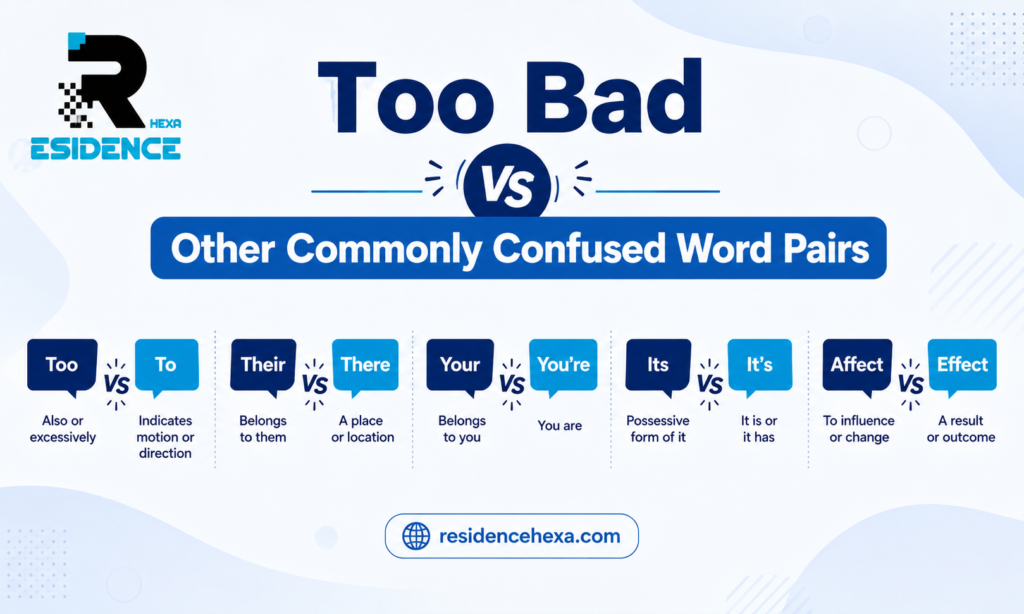
The is it too bad or to bad in English debate is part of a much wider pattern of homophone confusion in English. Understanding this pattern helps sharpen your overall writing instincts.
| Confused Pair | Correct Usage | Incorrect Usage |
| Too / To | Too bad (very bad) | To bad |
| Your / You’re | You’re welcome | Your welcome |
| Its / It’s | It’s too bad | Its to bad |
| Their / There | Their loss | There loss |
| Affect / Effect | It affects the outcome | It effects the outcome |
For a deeper dive into similar grammar puzzles, check out this helpful guide on Behaviour or Behavior: Which Is Correct? — another commonly confused pair that follows the same logic of knowing the grammatical role of each word before using it.
Is There a Difference Between American and British English?
Good news: this is one grammar question with a perfectly clear, universal answer. Both American English and British English agree completely — “too bad” is correct, and “to bad” is not.
There is no regional split here. Whether you are writing an email in New York, sending a message in London, or posting from Sydney, the rule is identical. Style guides on both sides of the Atlantic follow the same standard.
The only subtle difference you might notice is in tone. American usage tends to embrace “too bad” more casually and frequently, including in its sarcastic form. British speakers may sometimes opt for equivalent expressions like “what a shame” or “pity” in more formal settings — but when they do use “too bad,” the spelling is always the same.
Why Using the Correct Phrase Matters
A single extra letter might seem insignificant, but the impact of getting not too bad or to bad right extends further than you might think.
Improves Credibility
Readers notice grammar mistakes even when they do not consciously realize it. Writing “to bad” signals inattention to detail, which can quietly undermine your authority — whether you are a blogger, a professional, or a student submitting an assignment. Correct grammar reinforces that you know what you are saying and how to say it.
Sounds More Professional
In workplace communication, emails, reports, and client-facing content, precision matters. Writing “too bad” correctly shows grammatical competence, which translates directly into professional credibility. Incorrect usage, on the other hand, can distract readers and shift focus away from your message.
Builds Better Writing Habits
Every grammar rule you internalize becomes automatic over time. Learning the too bad or to bad grammar rule today means one less thing to second-guess tomorrow. Strong writing habits compound — small correct choices stack up into a noticeably clearer, more confident writing style overall. If you enjoy strengthening these habits, you might also find this guide on Any Problem or Any Problems — Which Is Correct? worth reading.
Easy Trick to Remember “Too Bad”
Here is the simplest memory trick you will ever need for the too bad or to bad question:
“Too” has one too many O’s — and that extra O means MORE.”
“Too” literally contains more letters than “to,” and it means more or excessively. When you want to say something is more than just bad — unfortunate, regrettable, disappointing — you need the word with more letters.
Try the replacement test:
- Replace “too” with “very” in your sentence.
- If it still makes sense → use too.
- If it sounds odd → you probably need “to” as a preposition.
“It’s very bad you missed the meeting.” ✅ → Use too bad.
One more way to think about it: “too bad, so sad” is a rhyme — and rhymes depend on both sound and spelling matching up. “To bad, so sad” breaks the spelling pattern. The correct version is always “too bad, so sad.”
Conclusion
The answer to is it too bad or to bad is clear and definitive: too bad is always correct. “Too” is an adverb that intensifies the adjective “bad,” expressing that something is unfortunate, disappointing, or regrettable. “To bad,” on the other hand, is a grammatical error with no standard usage in English.
Both American and British English follow the same rule. The confusion exists solely because these two words sound identical when spoken — but on the page, only one version works. Whether you are dashing off a text, crafting a professional email, or writing for an audience online, the rule never changes: reach for the double-O every time.
Remember the trick: “too” has more letters, and it means more. So when something is more than just bad, use too bad — and never look back.