You’re writing an email and you type “I have taking the report to the manager.” Something feels off, but you’re not sure why. Or maybe you write “She is taken photos all afternoon” and pause, unsure which word actually belongs there. If this has happened to you, you’re not alone — it’s one of the most common verb-form mix-ups for English learners and native speakers alike.
The good news is that the confusion has a simple fix. “Taken” and “taking” both come from the same root verb, “take,” but they belong to different grammatical families and show up in different kinds of sentences. Once you understand the pattern behind each one, you’ll stop guessing and start choosing the right form automatically. This guide breaks down the rules, shares real examples, and gives you quick tools — including tables and a self-test — so you can fix this mistake for good.
Taken vs Taking: The Core Difference
At the simplest level, the difference comes down to time and grammatical role, not meaning.
- Taking is the present participle of “take.” It describes an action that is happening right now, was happening at a certain point, or will be happening — and it can also act like a noun (a gerund).
- Taken is the past participle of “take.” It describes an action that is already finished, and it’s the form used in perfect tenses and passive sentences.
A quick way to remember it: taking is in motion, taken is done. If you can point to an auxiliary verb like “is,” “am,” “are,” “was,” or “were” right before the word, you’re probably looking at “taking.” If you see “has,” “have,” “had,” or a form of “be” used passively, you’re looking at “taken.”
Understanding the Verb “Take”
Before comparing the two forms directly, it helps to look at where they come from.
Meaning of “Take”
“Take” is an irregular verb, and it’s also one of the most flexible verbs in English. Depending on context, it can mean:
- To grab or pick something up (“Take the plate off the table.”)
- To receive or accept something (“She took the offer.”)
- To require or need something (“It takes patience to learn grammar.”)
- To experience or undergo something (“He took a big risk.”)
Merriam-Webster’s dictionary entry for “take” confirms this broad range of meaning, describing it as gaining possession of something or bringing it under one’s control — which is why the verb shows up in so many everyday expressions, from “take a break” to “take responsibility.”
Forms of “Take”
Because “take” is irregular, it doesn’t follow the standard “-ed” pattern. Here are all its forms:
| Form | Type | Example |
| take | Base/present | I take the bus every morning. |
| takes | Present (3rd person) | She takes notes in class. |
| took | Past simple | He took the wrong turn. |
| taken | Past participle | They have taken the exam. |
| taking | Present participle/gerund | We are taking a break. |
Quick Summary of Grammatical Functions
Here’s a snapshot of how “taken” and “taking” behave grammatically, before we go deeper into each one.
| Feature | Taking | Taken |
| Type | Present participle / gerund | Past participle |
| Tense use | Continuous (progressive) tenses | Perfect tenses |
| Voice | Active only | Passive voice |
| Can it act as a noun? | Yes (gerund) | No |
| Common helper verbs | is, am, are, was, were, been | has, have, had, is/was (passive) |
| Example | She is taking a nap. | She has taken a nap. |
Understanding Participles and Gerunds
To fully grasp “taken” vs “taking,” it helps to understand two grammar terms: participles and gerunds.
- A present participle ends in “-ing” and combines with “be” verbs to form continuous tenses (“is taking,” “was taking”). It can also work as an adjective (“a taking personality,” though rare) or start a descriptive phrase (“Taking a deep breath, she began.”).
- A gerund also ends in “-ing,” but instead of describing an action tied to a subject, it functions as a noun. “Taking risks builds confidence” uses “taking” as the subject of the sentence, just like any noun would be.
- A past participle, on the other hand, pairs with “have/has/had” to build perfect tenses, or with “be” verbs to build the passive voice. “Taken” always plays this role — it never functions as a subject or object on its own.
The key takeaway: “taking” can wear two hats (verb or noun), while “taken” only ever completes a verb phrase.
When to Use “Taking”
Use “taking” whenever an action is ongoing, was ongoing, will be ongoing, or when the “-ing” word is standing in for a noun.
“Taking” in Continuous (Progressive) Tenses
“Taking” appears after a form of “be” — am, is, are, was, were, will be, has been, or had been — to show an action in progress:
- I am taking a course this semester.
- She was taking photos when the storm started.
- They will be taking the earlier train tomorrow.
- He has been taking painting classes for months.
“Taking” as a Gerund (Noun Form)
When “taking” functions as a noun, it can be the subject, object, or part of a prepositional phrase:
- Taking notes helps you remember details. (subject)
- She enjoys taking long walks. (object)
- He got tired of taking orders. (object of preposition)
Common Expressions with “Taking”
English is full of set phrases built around “taking.” A few worth knowing:
- Taking charge – She’s taking charge of the project.
- Taking part – Everyone is taking part in the event.
- Taking place – The ceremony is taking place downtown.
- Taking care of – He’s taking care of his grandmother this week.
- Taking a chance – They’re taking a chance on a new supplier.
Quick Reference Table for “Taking”
| Structure | Example |
| am/is/are + taking | I am taking a shower. |
| was/were + taking | We were taking a break. |
| will be + taking | She will be taking the exam next week. |
| taking as gerund | Taking initiative impressed the boss. |
When to Use “Taken”
Use “taken” once an action is complete — for perfect tenses, passive constructions, and adjective-like descriptions of a finished state.
“Taken” in Perfect Tenses
“Taken” follows has, have, or had to link a past action to a later point in time:
- I have taken the medicine already.
- She had taken the last seat before we arrived.
- By next year, he will have taken every course in the program.
“Taken” in the Passive Voice
Whenever the subject of a sentence receives the action instead of performing it, “taken” pairs with a form of “be” — is, was, were, or been:
- The photo was taken last summer.
- Notes are taken during every meeting.
- The decision has been taken by the board.
Common Expressions with “Taken”
- Taken for granted – She felt taken for granted at work.
- Taken aback – He was taken aback by the news.
- Taken ill – The passenger was taken ill mid-flight.
- Taken care of – The paperwork has already been taken care of.
- Taken over – The startup was taken over by a larger firm.
Quick Reference Table for “Taken”
| Structure | Example |
| has/have + taken | They have taken their seats. |
| had + taken | He had taken the wrong exit. |
| is/was/were + taken | The exam was taken by 200 students. |
| taken as adjective | He looked taken aback. |
Common Prepositions Used with Taken and Taking
Both words often pair with specific prepositions, and getting these right adds fluency to your writing. If preposition pairing is something you struggle with more broadly, it’s worth reading up on how prepositions attach to specific words, similar to the confusion many people have between associated with and associated to.
- Taken by surprise
- Taken into account
- Taken from a source
- Taking on a challenge
- Taking after a parent (resembling them)
- Taking to something (developing a liking for it)
Active vs. Passive Voice with Taken and Taking
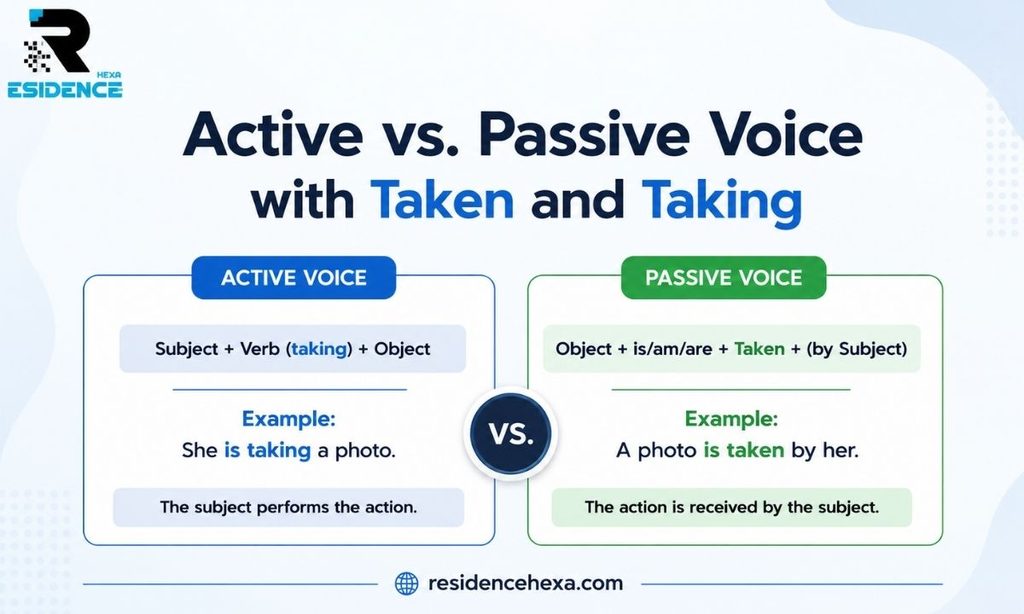
One more distinction worth remembering: “taking” only appears in active voice, because it always shows the subject performing the action. “Taken,” by contrast, is the backbone of passive voice, since the subject is the one receiving the action.
- Active with taking: The chef is taking orders. (chef performs the action)
- Passive with taken: The order was taken by the chef. (order receives the action)
This is also why, no matter what overall tense a passive sentence is written in — past, present, or future — the participle stays “taken.” Only the helper verb changes: “is taken,” “was taken,” “will be taken.”
Comparing “Taken” vs “Taking”
Common Confusions
Most mistakes happen in three situations:
- Using “taking” after “have/has/had” instead of “taken” (e.g., incorrectly writing “I have taking the bus” instead of “I have taken the bus”).
- Using “taken” after “am/is/are/was/were” when describing an ongoing action instead of a passive one (e.g., “She is taken pictures” instead of “She is taking pictures”).
- Forgetting that “taking” can be a gerund, which leads to awkward substitutions like using “take” where a noun form is needed.
Tricky Pairs Explained
| Confusing Pair | Correct Version | Why |
| “has taking” | “has taken” | Perfect tense needs the past participle. |
| “is taken photos” | “is taking photos” | Continuous tense needs the present participle. |
| “taken place” vs “taking place” | Both correct, different meaning | “Has taken place” = event is over; “is taking place” = happening now. |
| “taken care” vs “taking care” | Both correct, different meaning | “Taken care of” = finished; “taking care of” = ongoing. |
Real English in Action
Seeing these forms in natural sentences makes the pattern stick faster than memorizing rules alone:
- “The meeting is taking longer than expected.” (ongoing)
- “I’ve already taken care of the tickets.” (completed)
- “She was taken to the hospital after the accident.” (passive)
- “Taking responsibility is the first step toward change.” (gerund)
Noticing these forms in shows, articles, and everyday conversation is one of the fastest ways to make the distinction feel automatic.
Quick Grammar Hacks to Remember
- am/is/are/was/were + word → usually taking (unless the sentence is passive, in which case it’s “taken”).
- has/have/had + word → always taken.
- The “-ing” word acting as a subject or object → taking (gerund).
- The subject receiving the action, not doing it → taken.
Common Mistakes to Avoid

- ❌ “I have taking my medicine.” → ✅ “I have taken my medicine.”
- ❌ “She is taken care of the kids right now.” → ✅ “She is taking care of the kids right now.”
- ❌ “The photo taking last year was beautiful.” → ✅ “The photo taken last year was beautiful.”
- ❌ “They was taking the wrong bus.” → ✅ “They were taking the wrong bus.”
- ❌ “He has took the wrong exit.” → ✅ “He has taken the wrong exit.” (Note: “took” is simple past and never follows “has/have/had.”)
If mix-ups like this trip you up regularly, it’s worth comparing how the same issue shows up with other verbs — the confusion around I sent vs I have sent vs I had sent follows the identical perfect-tense logic explained above.
Examples Section: Taken vs Taking in Sentences
| Sentence | Correct Form | Reason |
| She ___ the lead in the project. | has taken | Perfect tense (completed) |
| He is ___ a shower right now. | taking | Present continuous |
| The cake was ___ out of the oven. | taken | Passive voice |
| ___ risks is part of growth. | Taking | Gerund (subject) |
| We had already ___ our seats. | taken | Past perfect |
| They are ___ turns driving. | taking | Present continuous |
| The award was ___ by a young engineer. | taken | Passive voice |
| I enjoy ___ long walks in the evening. | taking | Gerund (object) |
Self Assessment: Test Yourself
Fill in each blank with “taken” or “taking”:
- She has already ___ the test.
- We are ___ a short break.
- The decision was ___ last night.
- ___ notes helps me focus during lectures.
- He had ___ the wrong road before realizing his mistake.
- They will be ___ the 9 a.m. flight.
- The photo was ___ during sunset.
- I don’t mind ___ the early shift.
Self Assessment Answers
- taken (present perfect)
- taking (present continuous)
- taken (passive voice)
- Taking (gerund, subject)
- taken (past perfect)
- taking (future continuous)
- taken (passive voice)
- taking (gerund, object)
Final Conclusion
The difference between “taken” and “taking” isn’t about meaning — both come from the same verb, “take.” It’s about timing and grammatical function. “Taking” belongs to ongoing actions and gerund uses, while “taken” belongs to completed actions, perfect tenses, and passive voice. Once you check the helper verb sitting right before the word, the correct choice becomes almost automatic.
The fastest way to lock this in is practice: read the examples above out loud, retry the self-assessment in a day or two, and start spotting “taken” and “taking” in the articles and conversations around you. With a little attention, this common mix-up will disappear from your writing for good.