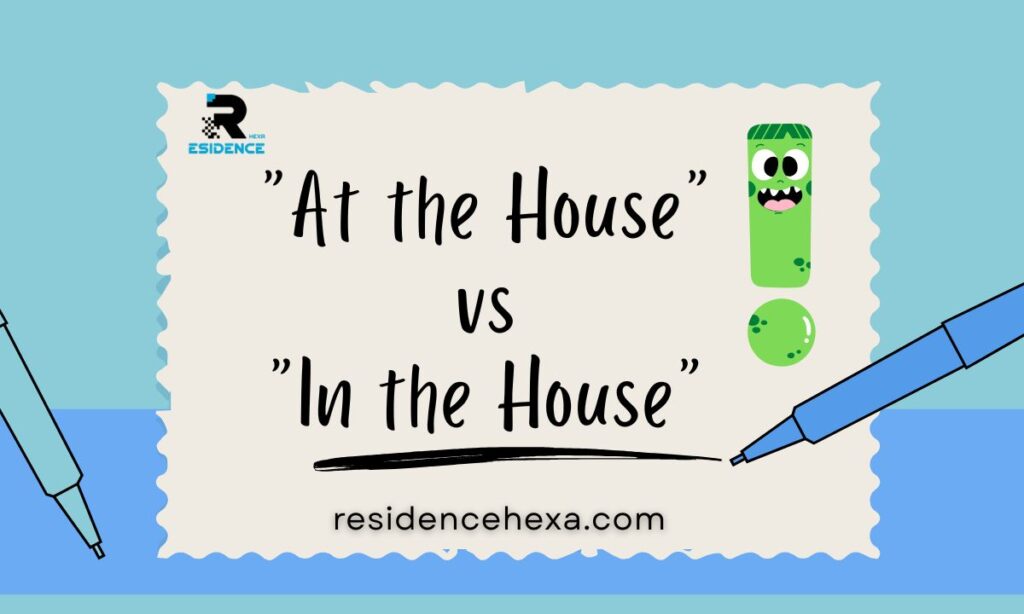
Do you ever pause mid-sentence wondering whether to say “I’m at the house” vs “in the house”? You’re not alone. These two phrases look nearly identical, yet they carry distinctly different meanings in everyday English. Choosing the wrong one can make your message unclear — or even give the wrong impression entirely.
The good news? The rule is simpler than it seems. Once you understand how the prepositions “at” and “in” work in terms of location specificity, you’ll never second-guess yourself again. This guide breaks down both phrases with real examples, a side-by-side comparison, common mistakes, and the bonus meaning of “in the house” in popular culture.
When to Use “At the House”
“At the house” uses the preposition at, which signals a general location or meeting point. It tells someone where but not exactly where within that place. Think of it as pointing to a property on a map — the driveway, the front porch, the backyard, or even just nearby all count.
Common Situations to Use “At the House”:
- Arranging a meetup: “I’ll see you at the house around 7.”
- Hosting a gathering: “The party is at the house tonight.”
- Describing someone’s general whereabouts: “She’s at the house right now.”
- Referring to an address or property as a whole: “Your package was left at the house.”
Notice that none of these sentences confirm the person is inside. They could be in the driveway, on the steps, or out back. The preposition “at” simply doesn’t require that level of detail — and that’s exactly its purpose. If you enjoy mastering these kinds of subtle preposition choices, our full guide on By Which or In Which Meaning explores similar prepositional distinctions in even greater depth.
Key Rule: Use “at the house” when location doesn’t need to be exact.
When to Use “In the House”
“In the house” uses the preposition in, which signals physical enclosure. It places a person or thing inside the building — within its walls, rooms, and interior space. The structure itself becomes the container.
Common Situations to Use “In the House”:
- Confirming someone is inside: “Don’t worry — the kids are in the house.”
- Describing interior activity: “There’s a strange smell in the house.”
- Giving a warning or instruction: “Everyone get in the house — it’s about to storm!”
- Referring to something located indoors: “I left my phone in the house.”
If you remove the walls from your mental image and the sentence stops making sense, “in” is the right choice. Interior space matters here — the phrase won’t work without it.
Key Rule: Use “in the house” when you specifically mean inside the building.
“In the House” Meaning — Beyond Literal Usage

Beyond its grammatical role, “in the house” carries a well-known slang and idiomatic meaning in popular culture.
Used as an announcement phrase, “in the house” means “present,” “here,” or “having arrived.” It originated in hip-hop and radio culture and is commonly used to build excitement around someone’s appearance or presence.
Examples of the Slang Usage:
- “Ladies and gentlemen, DJ Marcus is in the house!” — Announcing an arrival to a crowd
- “Is there a doctor in the house?” — A classic phrase asking if someone with a skill is present
- “Creativity is in the house today!” — A figurative use meaning inspiration has arrived
According to The Free Dictionary’s Idioms, “in the house” means “present before an audience” and is used as an announcement, especially to generate excitement. Urban Dictionary further notes it can describe someone performing at their very best — for example, “Another three-pointer? Bro’s in the house tonight!”
This slang sense has nothing to do with physical location and everything to do with presence, energy, and arrival.
“At the House” vs “In the House” — Usage Comparison
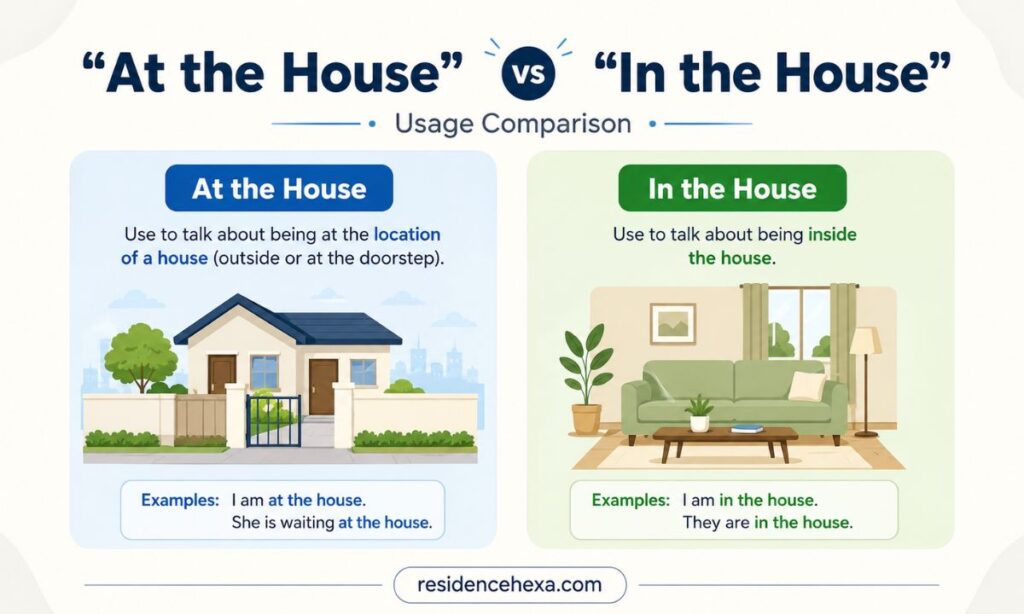
| Feature | “At the House” | “In the House” |
| Preposition | At | In |
| Location Type | General / broad | Specific / interior |
| Enclosure Required? | No | Yes |
| Includes exterior? | Yes | No |
| Best used for | Meetups, gatherings, arrivals | Interior activity, safety, description |
| Example | “Meet me at the house at 6.” | “The dog is in the house.” |
| Swappable? | Only if meaning doesn’t change | Not always — context-dependent |
Quick Decision Test:
Ask yourself: Does the exact position inside the building matter?
- Yes → Use “in the house”
- No → Use “at the house”
American English vs British English Usage
Americans tend to use “at the house” more when referring to a property as a destination, while British speakers sometimes use “in the house” more naturally in similar contexts. Despite these tendencies, the core meanings remain consistent across both dialects. Neither usage is incorrect — context and intention drive the choice more than geography. For more guides on tricky grammar distinctions like this one, browse the full Residence Hexa Grammar collection.
Common Mistakes to Avoid
- ❌ “My family was waiting at the house” (when you mean they were inside) → ✅ “in the house”
- ❌ “I left my keys in the house” (when you mean somewhere on the property) → ✅ “at the house”
- ❌ Using both phrases interchangeably without considering physical position
Frequently Asked Questions
Are “at the house” vs “in the house” both grammatically correct?
Yes, both are grammatically correct — they just carry different meanings based on location specificity.
Can I use “at the house” to mean someone is inside?
Not precisely. “At the house” includes both inside and outside, so it’s too vague to confirm someone is indoors.
Is “at my house” the same as “at the house”?
Yes, they function the same way. “At my house” simply adds personal ownership, while “at the house” refers to a specific known location.
Is “in the house” used in formal writing?
Yes, in formal or descriptive writing it is appropriate when referring to something physically inside a building.
Final Thoughts
The difference between “at the house” vs “in the house” comes down to a single word — and that word changes the entire picture. “At” points broadly to a location; “in” places you firmly inside. Use “at the house” when talking about meetups, gatherings, or a property in general. Use “in the house” when interior location matters — or when announcing someone’s exciting arrival.
Once you internalize this distinction, your everyday English becomes sharper, clearer, and far more natural. Small grammar details like this are what separate good communicators from great ones.