Every writer hits that moment of doubt — fingers hovering over the keyboard, wondering: “as evidenced by” or “as evident by”? They look almost identical, they sound nearly the same, and yet only one of them belongs in your writing. Using the wrong version in an academic paper, legal document, or business report can quietly undermine your credibility — even if the rest of your content is flawless.
The answer is straightforward: “as evidenced by” is correct, and “as evident by” is not. The difference comes down to a single grammar rule — one phrase is built on a verb, the other misuses an adjective. Once you understand why, you’ll never mix them up again. This guide breaks it all down with clear examples, a simple comparison, and ready-to-use alternatives so you can write with precision every time.
Why “As Evidenced By” Is the Correct Form
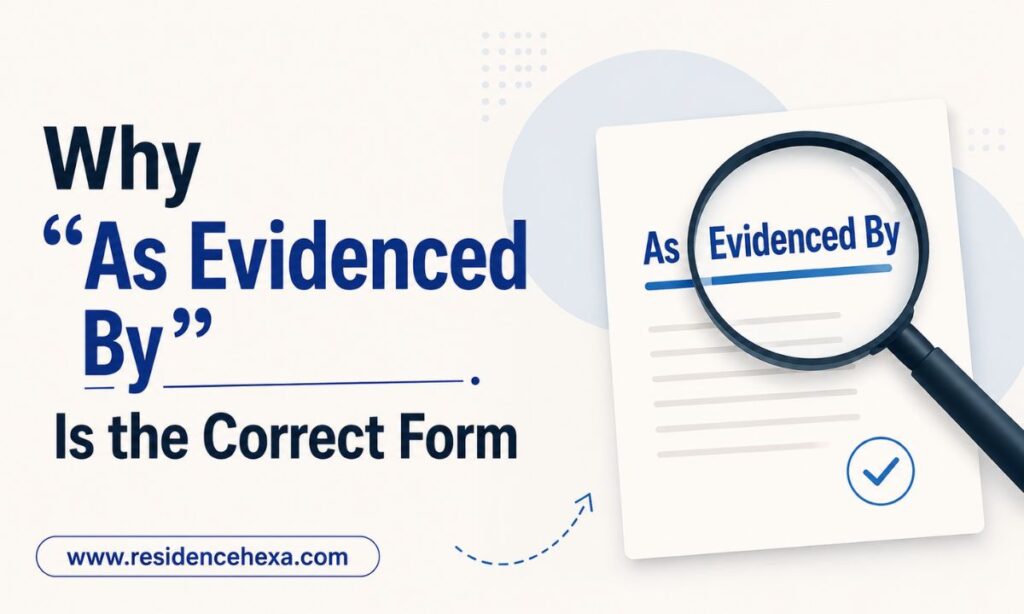
“As evidenced by” is the correct phrase. Full stop.
The key lies in the part of speech. Evidenced is the past participle of the verb to evidence, meaning “to show, demonstrate, or prove.” When paired with as and by, it creates a grammatically sound passive construction that links a claim to its supporting proof.
Here’s the implied full structure:
“as [is] evidenced by” → meaning: “as shown/proven by”
The phrase works because it follows standard English passive voice rules — a past participle verb paired with the preposition by to indicate the source of evidence.
As Evidenced By vs As Evident By
This is where writers get confused. Let’s compare them directly.
| Phrase | Part of Speech | Grammatically Correct? | Used In |
| As evidenced by | Past participle (verb form) | ✅ Yes | Formal, academic, legal, professional writing |
| As evident by | Adjective | ❌ No | Informal/incorrect usage |
Why “as evident by” fails:
Evident is an adjective — it describes something as clear or obvious. Adjectives in English don’t pair with the preposition by in this construction. The correct adjective-based alternative is “as is evident from“ — notice the change from by to from, plus the addition of is.
- ❌ As evident by the results…
- ✅ As is evident from the results…
- ✅ As evidenced by the results…
Both corrected versions are acceptable. But in formal writing, “as evidenced by” remains the stronger, more widely accepted choice.
“As Evidenced By” Meaning
“As evidenced by” means: as shown by, as demonstrated by, or as proven by.
You use it to connect a claim or conclusion to the proof that supports it. It signals to the reader: “Here is the evidence backing up what I just said.”
It’s most commonly found in:
- Academic writing (research papers, essays, dissertations)
- Legal documents (briefs, contracts, case summaries)
- Business reports (performance reviews, market analyses)
- Scientific writing (lab reports, clinical studies)
The phrase carries authority and precision — two qualities every professional writer should aim for.
According to the Cambridge Dictionary definition of “evidenced”, the word means “shown to be true” — which confirms exactly why this verb form is the right choice.
Correct Examples of “As Evidenced By” in Sentences
Here are real-world sentence examples across different contexts:
Academic / Research:
- The treatment proved effective, as evidenced by a 45% reduction in symptoms over six weeks.
- Climate patterns have shifted dramatically, as evidenced by temperature data collected over the past three decades.
Business / Professional:
- The new marketing strategy delivered results, as evidenced by a 30% rise in quarterly revenue.
- Employee engagement improved significantly, as evidenced by the latest internal satisfaction survey.
Legal / Formal:
- The defendant had prior knowledge of the risk, as evidenced by internal communications dated March 2024.
- The contract was breached, as evidenced by the failure to deliver goods within the agreed timeframe.
General / Everyday Formal:
- The program has had a lasting impact, as evidenced by participant outcomes over five years.
- Public interest in the issue remains strong, as evidenced by record attendance at town hall meetings.
Quick test: Replace “as evidenced by” with “as shown by” — if the sentence still makes sense, your structure is correct.
Alternative Phrases You Can Use Instead
Repetition weakens writing. If you’ve already used “as evidenced by” in the same paragraph, here are strong alternatives that carry the same meaning:
| Alternative Phrase | Best Used When |
| As shown by | Simple, clear proof in any context |
| As demonstrated by | Academic or technical writing, emphasizing proof |
| As indicated by | Pointing to suggestive (not conclusive) evidence |
| As proven by | Strong, definitive conclusions |
| As reflected by | Data, statistics, or measurable outcomes |
| As illustrated by | Using examples or case studies as support |
| As supported by | Research-backed claims |
Each alternative maintains grammatical correctness. Choose based on how strong your evidence is and the formality of your writing.
“As evidenced by” is just one of many common grammar mistakes in English writing that can quietly hurt your credibility.
Frequently Asked Questions
Is “as evident by” ever acceptable?
No. It is grammatically incorrect in both formal and standard English. Avoid it in all professional writing.
Can I use “as evidenced by” in casual writing?
It’s primarily a formal phrase. In casual conversation, simpler alternatives like “as shown by” or “proven by” work better.
Is “as evidenced by” passive voice?
Yes — it uses a passive participle structure, which is standard and acceptable in formal writing.
Final Takeaway
The answer is clear: “as evidenced by” is correct. “As evident by” is not.
The difference comes down to grammar fundamentals — evidenced is a verb (past participle), while evident is an adjective. Only the verb form pairs correctly with the preposition by to form a complete, meaningful clause.
Use “as evidenced by” when you want to link a statement to the proof that supports it. When you want variety, reach for alternatives like “as shown by,” “as demonstrated by,” or “as indicated by.”
Mastering this one distinction immediately sharpens your writing — whether you’re drafting a research paper, a business proposal, or a professional email. Small grammar choices like this signal precision and credibility to every reader.