Have you ever typed “onsite” in an email, then paused and wondered if it should really be “on site”? You’re not alone. This is one of the most common word-pair mix-ups in professional and everyday English, and it shows up everywhere — job postings, IT support tickets, construction reports, and office memos.
The short answer is that both forms are correct, but they aren’t interchangeable. One works as a single-word adjective that describes something, while the other is a two-word phrase that tells you where something is happening. Get the two mixed up and your sentence can look sloppy, even if your meaning is still clear. In this guide, you’ll learn exactly how each form works, why the confusion happens in the first place, and how to pick the right one every time you write.
Comparison Overview
Before diving into definitions and rules, here’s a quick snapshot of how these two forms differ:
| Feature | Onsite | On Site |
| Word count | One word | Two words |
| Part of speech | Adjective | Prepositional/adverbial phrase |
| Position in sentence | Before a noun | After a verb |
| Common use | Business, tech, marketing | Formal writing, location description |
| Example | onsite training | working on site |
Both spellings appear across professional writing, but they serve different grammatical jobs — and that’s the key to using them correctly.
Definition of Onsite
Onsite is a single-word adjective used to describe a service, activity, role, or resource that takes place at a specific physical location. It almost always sits directly before the noun it modifies, such as “onsite support,” “onsite training,” or “onsite parking.”
This form is common in business, technology, and marketing copy because it reads as compact and modern. Many companies use it in job titles and service descriptions to keep language quick and scannable.
- Onsite technician
- Onsite childcare
- Onsite security team
- Onsite repairs
It’s worth noting that major dictionaries, including Merriam-Webster, still list the hyphenated form as the primary entry, while treating the closed, one-word spelling as a widely used variant. That doesn’t make “onsite” wrong — it simply means style guides haven’t fully standardized around it yet.
Definition of On Site
On site is a two-word prepositional phrase that describes physical presence or location. Unlike “onsite,” it typically follows a verb rather than coming before a noun, and it answers the question “where?” rather than describing a type of service.
- The inspector is on site.
- Please remain on site until further notice.
- Our crew starts work on site at 8 a.m.
Here, “on site” functions as an adverbial phrase telling you where the action happens. It doesn’t describe a category of service — it simply places someone or something at a location.
Main Differences Between Onsite and On Site
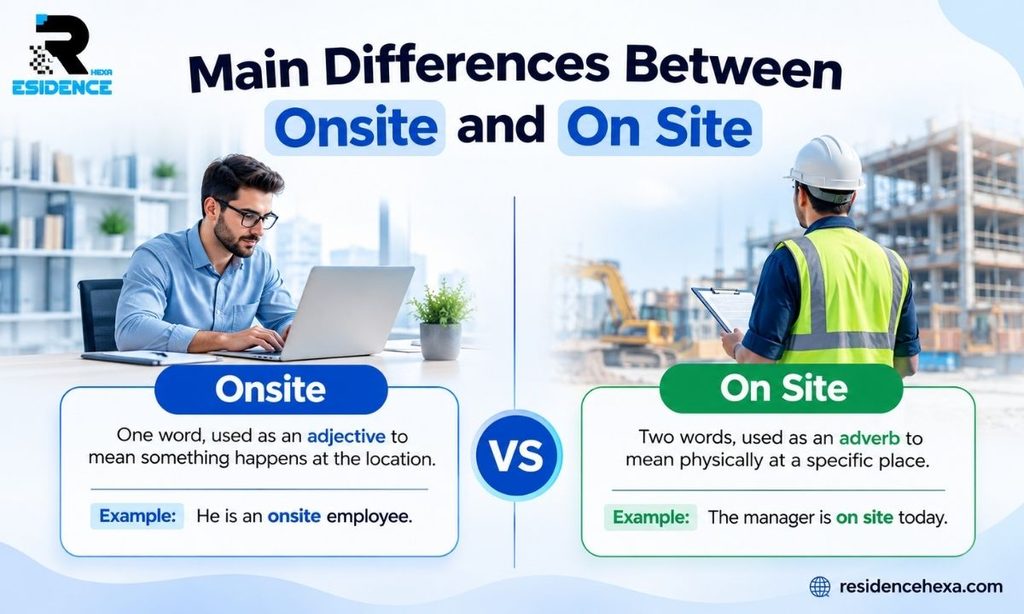
The clearest way to separate these two forms is to look at grammar, not just spelling. Here are the core distinctions:
- Word structure: Onsite is closed (one word); on site is open (two words).
- Grammatical role: Onsite acts as an adjective; on site acts as an adverbial or prepositional phrase.
- Sentence position: Onsite comes before a noun; on site usually follows a verb.
- Function: Onsite describes a service or feature; on site describes a location or presence.
- Formality: On site is generally preferred in formal, academic, and journalistic writing; onsite is common in casual and business contexts.
Why This Confusion Happens
English has a long history of merging two-word phrases into single compound words over time. Think of pairs like:
- online vs. on line
- overtime vs. over time
- setup vs. set up
“Onsite” is following the same natural drift, which is exactly why writers struggle to keep it straight. As a phrase becomes more common in everyday speech, people start writing it as one word, even in contexts where the two-word or hyphenated form is technically expected. Add in inconsistent style guide rules — some publications hyphenate, some close the word entirely, and some keep it as two words — and the confusion multiplies.
Comparison Table with Sentence Examples
| Form | Grammar Role | Example Sentence |
| Onsite | Adjective | We offer onsite technical support for all customers. |
| On site | Adverbial phrase | The technician is on site right now. |
| On-site (hyphenated) | Adjective (formal style) | The company scheduled an on-site inspection. |
Notice how the hyphenated version, “on-site,” often appears in formal or edited writing as the preferred adjective form — a detail covered in more depth in the grammar guide below.
Grammar Guide
How Each Term Is Used in Sentences
Onsite (or its hyphenated cousin, on-site) modifies a noun and usually answers “what kind?” On site tells you “where?” Compare:
- “We provide onsite consultations.” (describes the type of consultation)
- “Our consultant is on site today.” (tells you the consultant’s location)
Common Mistakes Learners Make
- Using “onsite” after a verb: The manager is onsite today. ❌ → The manager is on site today. ✅
- Using “on site” before a noun: We need on site support. ❌ → We need onsite (or on-site) support. ✅
- Assuming one form is always wrong — both are acceptable, just in different roles.
Simple Rules to Remember
- If it comes before a noun, use onsite or on-site.
- If it comes after a verb, use on site.
- When in doubt in formal writing, choose the hyphenated on-site — it satisfies most style guides at once.
Quick Tips for Writing and Speaking
- Read the sentence aloud and check what word immediately follows the term. A noun signals the adjective form; a location question signals the two-word phrase.
- In job postings and business documents, stay consistent — don’t switch between forms in the same piece.
- When editing for a client or publication, check their house style guide first, since AP, Chicago, and in-house standards don’t always agree.
When to Use Each One
Use onsite (or on-site) when:
- Describing a service, feature, role, or resource tied to a location
- Writing marketing copy, job titles, or product descriptions
- The word appears directly before a noun
Use on site when:
- Describing where someone or something physically is
- The phrase follows a verb like “is,” “works,” “remains,” or “arrives”
- You’re emphasizing presence or location rather than a category of service
When NOT to Use Each One
- Don’t use on site before a noun — it will read awkwardly, as in “on site manager” instead of “onsite manager.”
- Don’t use onsite immediately after a verb describing presence — “She is onsite” is common in casual speech but considered nonstandard in formal or edited writing.
- Avoid mixing all three forms (onsite, on-site, on site) inconsistently within the same document, resume, or webpage.
Which One to Use (Decision Guide)
Ask yourself these two quick questions:
- Is the word placed right before a noun? → Use onsite or on-site.
- Is the word describing where someone or something is located, usually after a verb? → Use on site.
If you’re writing for a formal publication, business report, or academic paper, default to the hyphenated on-site for the adjective form, since it’s the version most consistently recommended by traditional style authorities.
Real World Practical Examples
Onsite Examples
- The hotel offers onsite dining and onsite laundry service.
- Our IT team provides onsite troubleshooting for all offices.
- The school has an onsite health clinic for students.
- This job requires onsite attendance three days a week.
On Site Examples
- The safety officer must remain on site during construction hours.
- All visitors are required to sign in when they arrive on site.
- The film crew set up on site before sunrise.
- Repairs will begin once the parts arrive on site.
Self Assessment (Fill in the Blanks)
Test what you’ve learned. Choose “onsite” or “on site” for each sentence.
- The engineer is ______ inspecting the damage.
- We offer ______ support for all new customers.
- Please check in with security once you’re ______.
- The company built an ______ daycare for employees.
- The technician will arrive ______ by noon.
Answers
- on site
- onsite
- on site
- onsite
- on site
Conclusion
Both “onsite” and “on site” are grammatically valid — the real difference comes down to sentence structure, not correctness. Use the one-word or hyphenated form as an adjective before a noun, and reserve the two-word phrase for describing location after a verb. Once you internalize that simple pattern, you’ll never second-guess yourself again, whether you’re drafting a job listing, a business report, or a quick email to your team.
If compound-word confusion like this trips you up often, you might also enjoy Residence Hexa’s breakdown of At Least or Atleast: Meaning, Correct Spelling, and Examples, which covers a very similar one-word-versus-two-word dilemma. For another common spacing mistake that follows the same logic, take a look at Of Course or Ofcourse? Correct Spelling, Meaning & Usage Guide.