If you’ve ever paused mid-sentence wondering whether to say “in the street” or “on the street,” you’re not alone. This is one of the most common preposition dilemmas in the English language — and the answer isn’t simply one or the other. (If you’ve wrestled with similar location-based preposition choices, our guide on “At the House” vs “In the House” covers the same spatial logic in detail.) Both phrases are grammatically correct, but they carry different meanings depending on context, and even differ between American and British English.
Understanding this distinction can sharpen your writing, make your speech sound more natural, and help you avoid the kind of subtle errors that native speakers notice immediately. Whether you’re a student, a content writer, or someone brushing up on English grammar, this guide will walk you through everything you need to know.
What Does “On the Street” Mean?
“On the street” treats the street as a surface — like a line or path you stand beside or along. It’s the dominant choice in American English and covers most everyday situations involving location, addresses, and general outdoor activity.
Common uses of “on the street”:
- Addresses and location: “The bakery is on Maple Street.”
- General walking or positioning: “I saw her standing on the street corner.”
- Idiomatic/figurative use: “After losing his job, he ended up on the street.” (meaning homeless)
- Public rumor: “Word on the street is they’re closing the shop.”
The preposition on suggests surface contact or proximity — you are near or alongside the street, not physically in the middle of the road.
What Does “In the Street” Mean?
“In the street” places someone or something physically inside the roadway — where vehicles travel. It implies being surrounded by the street itself, often in the middle of traffic lanes.
Common uses of “in the street”:
- Physical presence in the roadway: “Don’t play in the street — it’s dangerous!”
- Objects in the road: “There’s a ball in the street that rolled away.”
- Dramatic or scene-setting writing: “Fear spread in the street as sirens echoed.”
- British English general use: In British English, “in the street” is used more freely for general outdoor activity, even when no danger is implied.
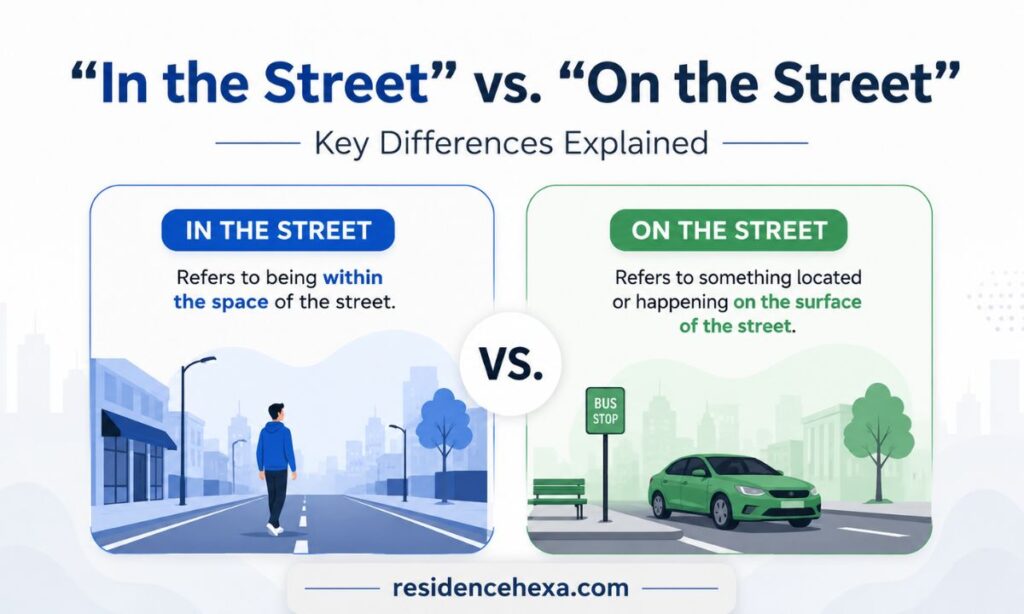
Key visual cue: Think of “in” as being surrounded or enclosed — you are within the road space. Think of “on” as contact with a surface — you are upon or along the street.
“In the Street” or. “On the Street” – Key Differences Explained
| Feature | “In the Street” | “On the Street” |
| Position | Inside the roadway (traffic area) | Along or beside the road surface |
| Common in | British English | American English |
| Typical use | Physical danger, drama, road-related events | Addresses, walking, general location |
| Figurative meaning | Rarely figurative | Homelessness, rumors, public life |
| Tone | More dramatic, immersive | Neutral, factual |
| Example | “A car stopped in the street.” | “She lives on this street.” |
British English vs. American English
This is one of the clearest regional preposition differences in the English language. According to the Oxford Learner’s Dictionaries, prepositions like in and on carry distinct spatial meanings that vary by regional convention:
- British English treats the street as an enclosed space — something you can be in. Saying “children playing in the street” sounds completely natural in the UK.
- American English treats the street as a surface — something you stand on. Americans prefer “children playing on the street” for general activity, and reserve “in the street” for situations involving the actual traffic lane.
Common Phrases: Which Preposition Should You Use?
Playing in the Street vs. Playing on the Street
“Playing in the street” is the more commonly used phrase. It refers to children or people playing in the physical road area — in or near where traffic moves. This is why parents warn kids not to do it.
“Playing on the street” also works, particularly in American English, when the activity happens on the pavement or sidewalk area alongside the road.
✅ “The kids were playing in the street when the car turned the corner.” ✅ “They were playing on the street outside their house.”
Dancing in the Street vs. Dancing on the Street
“Dancing in the street” is the more vivid and commonly recognized phrase — made famous by the classic Motown hit. It describes dancing in the middle of the road, suggesting joy, celebration, or spontaneity.
“Dancing on the street” suggests dancing on the pavement or sidewalk, keeping safely to the side rather than in the traffic zone.
✅ “Fans were dancing in the street after the championship win.” ✅ “Street performers were dancing on the street outside the café.”
Walking in the Street vs. Walking on the Street
“Walking on the street” is the standard phrase in American English for normal pedestrian activity — walking along a sidewalk, road, or public path. It’s the most natural and widely used option. Speaking of people you might encounter while walking, you may also want to know the correct plural of passerby — is it passersby or passerbys?
“Walking in the street” specifically means walking directly in the roadway where cars travel. This phrasing is often used to describe unsafe behavior or situations where no sidewalk is available.
✅ “I was walking on the street when I ran into an old friend.” ✅ “He was walking in the street because the sidewalk was blocked.”
Living in the Street vs. Living on the Street
This pair has the clearest distinction of all.
“Living on the street” (or on the streets) is the correct idiomatic phrase to describe homelessness. It means someone lacks permanent shelter and lives in public spaces.
“Living in the street” is generally considered awkward and non-standard in English. It implies literally living inside the roadway, which doesn’t make logical sense.
✅ “After the eviction, he spent months living on the street.” ❌ “He has been living in the street for years.” ← Avoid this form
Frequently Asked Questions
Is “in the street” or “on the street” more correct?
Both are grammatically correct. “On the street” is standard in American English for most situations; “in the street” is used when someone is physically inside the roadway, or in British English contexts.
What does “word on the street” mean?
It’s an idiom meaning public rumor or gossip — information circulating among ordinary people.
When should I use “at the street”?
“At the street” is used for specific reference points, such as intersections or corners — for example, “Meet me at the street corner.”
Which is better for formal writing?
“On the street” is generally preferred in formal American writing. In British formal contexts, both can appear depending on the meaning.
Conclusion
The difference between “in the street” or “on the street” comes down to two things: position and context. Use “on the street” when you’re talking about location along a road, addresses, general activity, or figurative meanings like homelessness. Use “in the street” when you want to describe something physically inside the roadway — in the middle of traffic — or when writing for a British English audience.
A simple mental trick: if the street is a surface you’re beside or upon, choose on. If it’s a space you’re surrounded by or inside, choose in. Once that visual clicks, the right preposition becomes second nature every time.