If you have ever typed a sentence and paused at “given” or “giving,” you are not alone. Both words come from the same root verb — give — but they work in completely different ways inside a sentence. Getting them wrong can make your writing sound unnatural, even if your meaning is technically clear.
This guide gives you a simple, practical breakdown of given or giving: what each form is, when to use it, and how to avoid the most common mistakes. By the end, you will choose the right word instinctively — every single time.
Quick Answer: Both “given” or “giving” are correct — but in different situations. “Giving” is the present participle, used for ongoing or continuous actions. “Given” is the past participle, used in passive voice, perfect tenses, and as an adjective or preposition. They are not interchangeable.
Understanding the Verb “Give” — All Four Forms
English verbs transform into different forms to show tense and function. Here are all the principal forms of give:
| Form | Word | Example |
| Base Form | Give | I give every day. |
| Simple Past | Gave | She gave him a book. |
| Present Participle | Giving | He is giving a speech. |
| Past Participle | Given | She has given her best. |
The focus of this guide is on the two most commonly confused forms: giving and given.
When to Use “Giving” (Present Participle)
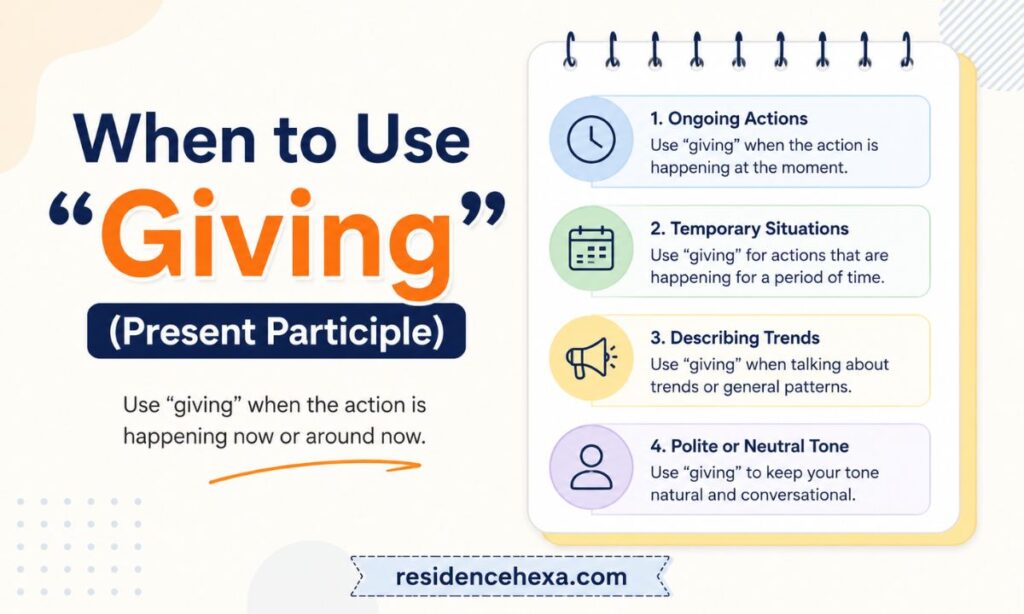
“Giving” is the present participle of give. It shows an action that is currently happening, was happening in the past at a specific moment, or is scheduled to happen. It always pairs with a form of the verb be (am, is, are, was, were).
Main Uses of “Giving”
· Present continuous — action happening right now
· Past continuous — action was in progress at a past moment
· Future continuous — action will be ongoing in the future
· Gerund (noun form) — when “giving” acts as a noun itself
· Adjective — describing someone as generous
Examples with “Giving”
| Tense / Use | Example Sentence |
| Present continuous | She is giving a presentation right now. |
| Past continuous | He was giving instructions when I arrived. |
| Future continuous | They will be giving out awards tomorrow. |
| Gerund (noun) | Giving back to the community is important. |
| Adjective | She is a very giving person. |
Memory Tip: If you can replace the word with “in the process of giving,” the correct form is giving. If not, switch to given. This same past participle logic applies to other verbs too — for a parallel example with “risen,” see our guide on He Is Risen or He Has Risen – Which Is Correct?.
When to Use “Given” (Past Participle)
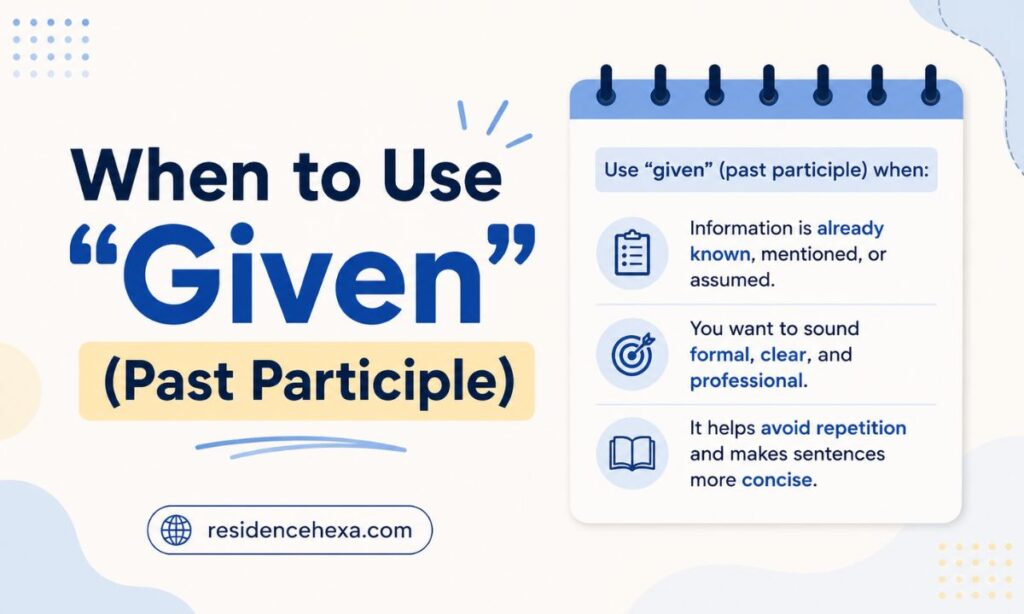
“Given” is the past participle of give. It is more versatile than “giving” because it can serve as a past participle in perfect tenses, a passive voice marker, an adjective, or even a preposition.
Main Uses of “Given”
· Perfect tenses — with have, has, had (completed actions)
· Passive voice — when the subject receives the action
· Adjective — describing something assumed or specified
· Preposition / conjunction — meaning “considering” or “taking into account”
Examples with “Given”
| Use | Example Sentence |
| Present perfect | She has given her approval. |
| Past perfect | He had given the report before the meeting. |
| Passive voice | The award was given to her yesterday. |
| Adjective | At a given moment, everything changed. |
| Preposition | Given the circumstances, we acted correctly. |
Important Rule: “Given” never pairs with am / is / are in active voice. You would never say “She is given a speech.” The correct form there is “She is giving a speech.”
Side-by-Side Comparison: Given or Giving
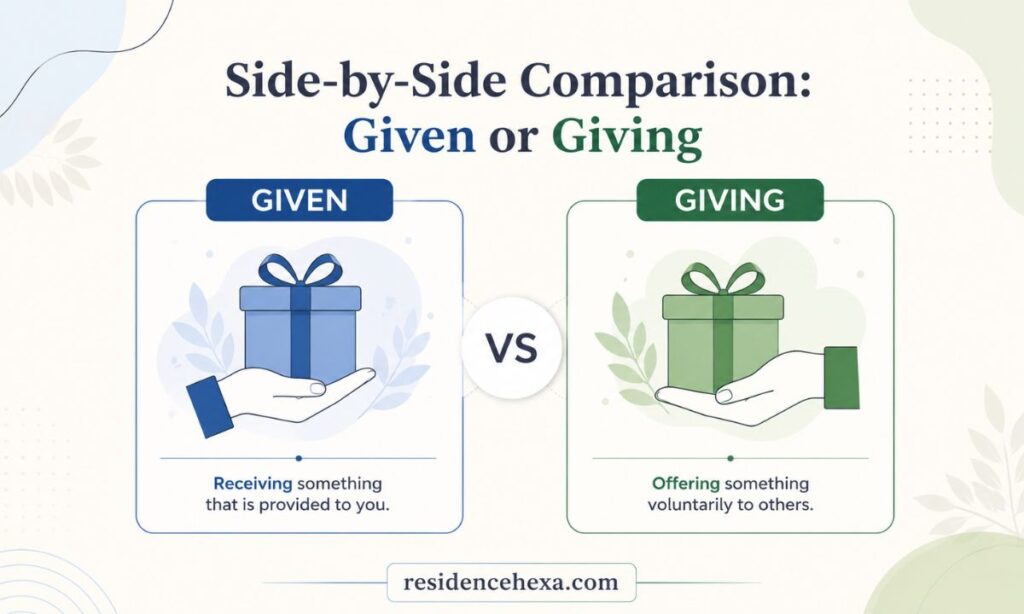
Here is a direct comparison to lock in the difference at a glance:
| Feature | Giving | Given |
| Grammatical form | Present participle | Past participle |
| Action status | Ongoing / in progress | Completed / received |
| Tense usage | Continuous tenses | Perfect tenses & passive |
| Helper verb | am / is / are / was / were | have / has / had / was / were |
| Used as adjective? | Yes (generous person) | Yes (assumed/specified) |
| Used as preposition? | No | Yes (“given the fact that…”) |
| Used as gerund (noun)? | Yes (“giving is caring”) | No |
Quick Example Pairs
Correct Use of “Giving”
· I am giving a talk today.
· They were giving out samples.
· Giving time is priceless.
· She is a giving soul.
· He keeps giving excuses.
Correct Use of “Given”
· She has given her word.
· The task was given to me.
· At a given point, stop.
· Given the delay, we left.
· He had given his best.
Common Mistakes to Avoid
Even fluent speakers mix these up. Here are the errors to watch out for:
✗ Wrong: The award is giving to her yesterday.
✓ Correct: The award was given to her yesterday.
✗ Wrong: I have giving him all the information.
✓ Correct: I have given him all the information.
✗ Wrong: Given a lecture at this moment.
✓ Correct: She is giving a lecture at this moment.
Frequently Asked Questions
Is “given” or “giving” used after “have”?
Always use given after “have,” “has,” or “had” — for example, “I have given my answer.”
Can “giving” be used as a noun?
Yes. As a gerund, “giving” acts as a noun — “Giving is an act of love” is perfectly correct.
What is the difference between “given” as an adjective and “given” as a preposition?
As an adjective, it means “specified” (a given day). As a preposition, it means “considering” (Given the traffic, we were late). For a full breakdown of its preposition usage, Merriam-Webster’s entry on “given” provides authoritative definitions and usage examples.
Can I say “she was giving the prize”?
Yes — it means the action was in progress. But “she was given the prize” means she received it (passive voice).
Is “it’s a given” correct?
Yes. “It’s a given” is a common idiom meaning something is an accepted or obvious fact.
Which is more versatile — “given” or “giving”?
“Given” is more versatile because it functions as a past participle, adjective, and preposition.
Can both words be used as adjectives?
Yes. “A giving person” means generous; “a given situation” means a specific or assumed one.
Still unsure about choosing the right word form in formal writing? Our guide on As Evidenced By or As Evident By – Which Is Correct? walks through the same type of correct-vs-incorrect word choice with clear examples for academic and professional writing.
Final Thoughts
The difference between given or giving comes down to one simple question: Is the action still happening? If yes, use giving. If the action is complete, received, assumed, or you need a passive construction — use given.
Once you internalize that giving = action in progress and given = completed or received, the right choice will come naturally. Practice writing a few sentences of your own using each form, and the rule will stick for good.