If you’ve ever paused mid-sentence wondering whether to write thus far or so far, you’re not alone. These two phrases trip up native speakers and English learners alike — and for good reason. They look nearly identical, carry the same core meaning, yet land very differently depending on where and how you use them.
This guide breaks down the Thus Far vs So Far debate with real-world examples, grammar rules, comparison tables, and synonym lists — everything you need to choose the right phrase every single time.
What Do “Thus Far” and “So Far” Actually Mean?
At their core, both phrases mean the same thing: “up to this point in time” or “until now.” They’re adverbial phrases — meaning they modify verbs, not nouns — and they describe something that began in the past and is still relevant to the present moment.
- So far → “We’ve raised $10,000 so far.” (Things are still in motion.)
- Thus far → “Thus far, the investigation has yielded no results.” (Formal progress report.)
Neither phrase describes something that has ended. Both always imply an ongoing situation, which is why they pair naturally with the present perfect tense (have/has + past participle).
Thus Far vs So Far — The Key Difference: Formality and Tone
Here’s the single most important thing to understand in the Thus Far vs So Far debate: the meaning is identical; the tone is completely different.
| Feature | Thus Far | So Far |
| Meaning | Up to this point in time | Up to this point in time |
| Tone | Formal, polished, authoritative | Casual, natural, conversational |
| Best used in | Academic papers, legal documents, reports | Everyday speech, emails, texts, blogs |
| Origin | Old English “ðus” (formal connector) | Modern everyday English |
| Frequency | Less common; context-specific | Extremely common in all settings |
| With present perfect? | Yes | Yes |
Think of it this way: “thus far” is like wearing a suit to a meeting, while “so far” is jeans and a t-shirt. Both are appropriate — just in different rooms. Worth noting: according to Merriam-Webster’s definition of “thus”, the word has carried the meaning of “to this degree or extent” since Old English — which explains exactly why thus far carries such a formal, authoritative weight in modern writing.
When to Use “Thus Far” vs “So Far” — Real-World Examples
When to Use “Thus Far”
Use thus far when your writing or speech demands precision, authority, or a professional register. It signals that you’ve carefully assessed the situation up to the current moment.
Best contexts:
- Academic research papers
- Legal briefs and official statements
- Business reports and formal presentations
- Speeches and formal essays
Examples:
- Thus far, the clinical trial has shown no adverse side effects.
- The committee has, thus far, approved three of the five proposals.
- No major complications have arisen thus far.
💡 Memory tip: Think of thus far as a report card — formal, evaluative, and structured.
When to Use “So Far”
Use so far in everyday communication — texting a friend, writing a casual email, posting on social media, or chatting with colleagues. It keeps your tone approachable and natural.
Best contexts:
- Casual conversations and text messages
- Informal emails and blog posts
- Social media updates
- Everyday speech
Examples:
- So far, the trip has been amazing!
- I’ve finished three chapters so far.
- How do you like the new job so far?
💡 Memory tip: Think of so far as a diary entry — casual, ongoing, and flexible.
One Case Where Only “So Far” Works
There’s one important exception in the Thus Far vs So Far comparison: when describing physical distance, only so far applies.
- ✅ The road only goes so far before it turns to dirt.
- ❌ The road only goes thus far before it turns to dirt. (Sounds odd and unnatural)
This is because thus far is purely a time-based expression, while so far carries both time and distance meanings.
Grammar Rules: Placement, Punctuation & Tense
Both phrases function as adverbial phrases that modify verbs — answering the questions “to what extent?” or “up to when?” They can be placed at the beginning, middle, or end of a sentence without breaking the grammar.
Placement examples:
- So far, the results are promising. (Beginning)
- The results, so far, are promising. (Middle)
- The results are promising so far. (End)
Tense rule: Always pair these phrases with the present perfect tense, not simple past.
| ❌ Incorrect | ✅ Correct |
| Yesterday was great so far. | The day has been great so far. |
| I finished two tasks so far. | I have finished two tasks so far. |
| Thus far, I liked your plan. | Thus far, I have liked your plan. |
The present perfect is essential because both phrases refer to time that is still connected to now. Once the period is over, neither phrase applies.
Comma Usage with “So Far” / “Thus Far”
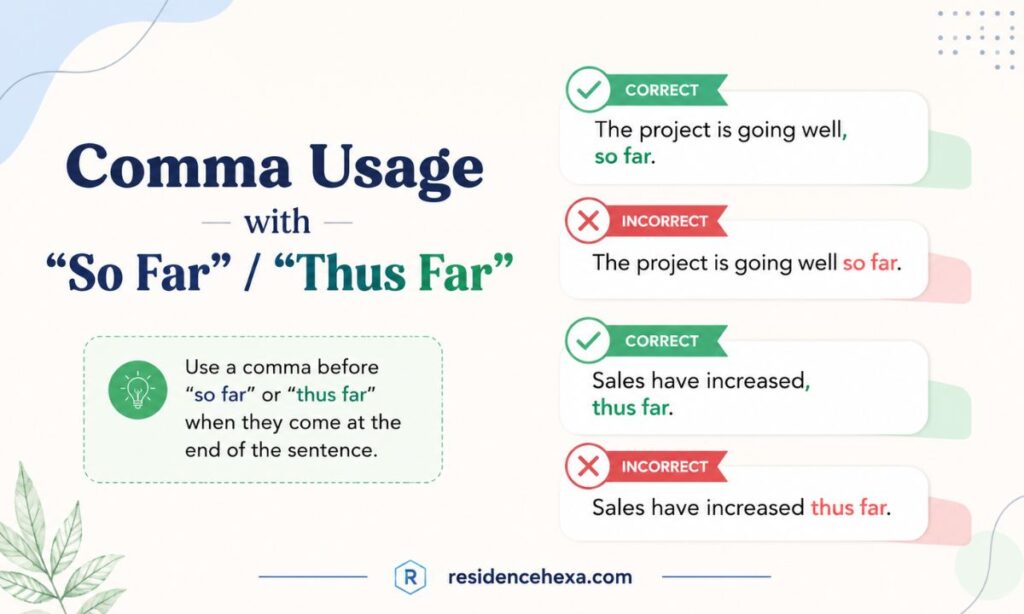
Comma placement with Thus Far vs So Far follows the same logic for both phrases. Here’s a simple breakdown:
At the beginning of a sentence: Use a comma after the phrase.
- Thus far, no complaints have been received.
- So far, we’re ahead of schedule.
In the middle of a sentence: Set off with commas on both sides.
- The team has, so far, delivered on every promise.
- The research has, thus far, supported the hypothesis.
At the end of a sentence: No comma needed.
- We haven’t run into any problems so far.
- The project is on track thus far.
Exception: No comma is required in fixed expressions like “thus far and no further” or “so far and no further.”
Synonyms & Alternatives for Both Phrases
Sometimes you want to vary your language or find a phrase that fits the tone even more precisely. Here are strong alternatives for both sides of the Thus Far vs So Far spectrum. And if you enjoy untangling tricky phrase choices like this one, our guide on “As Evidenced By” vs “As Evident By” covers another formal writing pair that trips up even advanced writers.
Formal Synonyms (Alternatives to “Thus Far”)
| Synonym | Example |
| To date | To date, no solution has been found. |
| As yet | The results are, as yet, inconclusive. |
| Hitherto | Hitherto, all attempts have failed. |
| Heretofore | Heretofore, no such data existed. |
| Up to this point | Up to this point, everything is on track. |
Informal Synonyms (Alternatives to “So Far”)
| Synonym | Example |
| Until now | Until now, there haven’t been any issues. |
| As of now | As of now, we’re doing great. |
| Up to now | Up to now, it’s been smooth sailing. |
| For now | For now, things are looking good. |
| At this point | At this point, I’m happy with the progress. |
⚠️ Quick tip: Using hitherto in a casual text message will sound bizarre. Using so far in a legal brief may seem careless. Always match the synonym to your audience.
Common Mistakes to Avoid
Even experienced writers mix these up. Here are the most frequent errors. (If you find these kinds of mix-ups interesting, check out our breakdown of Inpatient vs Impatient — another pair that looks deceptively similar but means something completely different.)
- ❌ Thus far, I really like your shoes. → Use so far here. It’s too casual a compliment for thus far.
- ❌ So far, the report demonstrates a clear trend. → Use thus far in a formal report.
- ❌ Last week was productive so far. → Never use either phrase for a completed time period.
- ❌ Mixing tones: “Thus far, the experiment is stable, and so far the results look good.” → Stick to one register per piece of writing.
Conclusion
The Thus Far vs So Far debate comes down to one word: tone. Both phrases mean exactly the same thing — up to this point in time — but they live in different worlds. Thus far belongs in formal reports, academic papers, legal briefs, and professional communications where precision and authority matter. So far belongs in everyday conversations, casual emails, blog posts, and anywhere you want to sound natural and accessible.
The golden rule? Match the phrase to the room you’re in. When in doubt, so far is almost always the safer, more versatile choice. But when the moment calls for gravitas, thus far delivers it with elegance. Master the Thus Far vs So Far distinction today, and your writing — formal or casual — will immediately sound sharper, more confident, and more professionally aware.