Have you ever paused mid-sentence, wondering whether “first priority” sounds right — or just a bit redundant? You’re not alone. This phrase pops up in business emails, team meetings, mission statements, and everyday conversations constantly. Yet some grammar purists raise an eyebrow at it, calling it unnecessary or even logically circular.
The short answer: yes, “first priority” is grammatically correct and widely accepted in modern English. But there’s more to the story. Understanding when and why to use it — and when a sharper alternative works better — can make your writing noticeably stronger. This guide breaks it all down clearly, with real examples and practical advice.
Short Answer: Yes, “First Priority” Is Grammatically Correct
“First priority” is a standard English phrase. The adjective first modifies the noun priority, indicating the most important item in a ranked list of tasks or goals. There is no grammatical rule that prevents this combination, and it appears freely in formal writing, corporate communication, government policy, and everyday speech.
Some critics label it redundant, arguing that the word priority already implies something comes first — so adding “first” is like saying “first first.” This concern has logical merit. However, English is full of accepted redundancies: “free gift,” “advance planning,” and “end result” all survive because they serve a communicative purpose. The same logic applies to many common phrase debates — for instance, “as evidenced by” vs “as evident by” is another case where understanding correct usage matters far more than avoiding perceived redundancy. The same is true here.
Bottom line: “First priority” is not a grammatical error. It is widely used, contextually effective, and perfectly appropriate when clarity matters.
Why “First Priority” Works in English

The Etymology of “Priority”
The word priority comes from the Latin prioritas, meaning “the state of being earlier or first.” According to Merriam-Webster’s definition of priority, the term refers to something given or meriting attention before competing alternatives. Historically, it implied a single, most-important thing. Over decades, usage evolved — today we regularly speak of having multiple priorities, which has diluted the word’s original singularity.
Because of this shift, adding first has become a natural way to restore emphasis and signal hierarchy within a list of priorities. When you say “this is my first priority,” you are not just saying something is important — you are saying it ranks above everything else currently competing for attention.
When Redundancy Becomes a Feature
In communication, redundancy is not always a flaw. It can be a deliberate stylistic tool that:
- Adds urgency — “Your safety is our first priority” lands harder than “Your safety is our priority.”
- Signals order — When multiple tasks exist, numbering them (first, second, third priority) creates a clear hierarchy.
- Strengthens authority — In leadership contexts, “first priority” sounds decisive and focused.
- Reflects natural speech — People instinctively use it for emphasis, and forcing formality can reduce clarity.
Corpus research confirms that “first priority” appears extensively in both spoken and written English, from political speeches to project management documents.
Common Alternatives to “First Priority” (And When to Use Them)
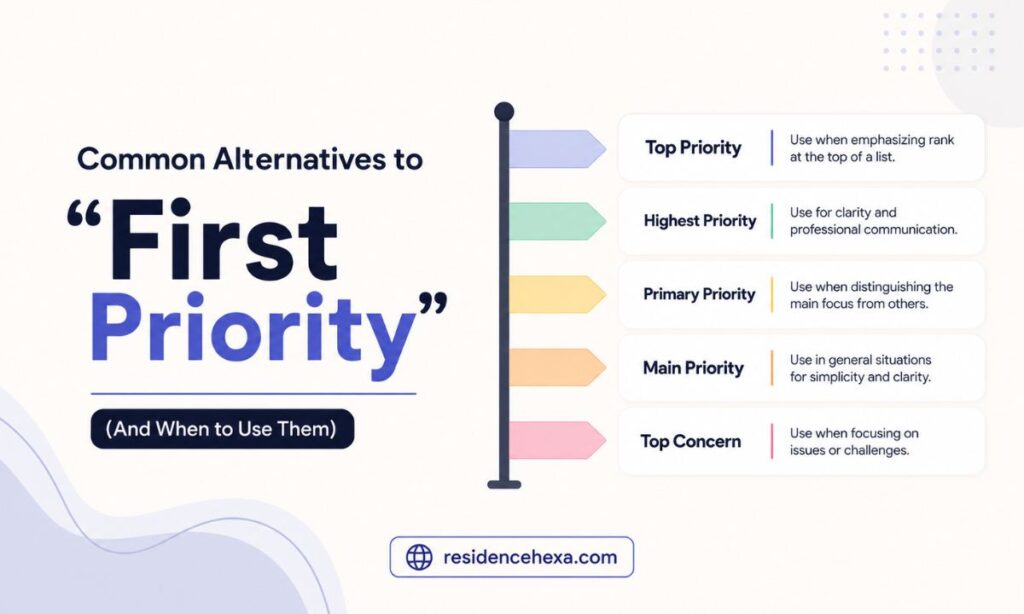
Sometimes a tighter phrase serves your writing better. Here is a quick comparison:
| Phrase | Best Used When | Tone |
| First priority | Listing ranked tasks; emphasizing urgency | Formal, emphatic |
| Top priority | Highlighting the single most critical item | Professional, direct |
| Primary concern | Formal writing, reports, strategic documents | Neutral, authoritative |
| Main focus | Casual conversation, team settings | Conversational |
| Number one goal | Motivational or goal-setting contexts | Energetic, clear |
| Most urgent task | Project management, deadlines | Practical, action-driven |
Key takeaway: All of the above are grammatically correct. The right choice depends on your tone, audience, and context — not on which one is technically more precise.
Examples of “First Priority” Used Correctly in Sentences
Seeing the phrase in real-world contexts helps clarify proper usage. Here are clear, natural examples across different settings:
Professional / Business:
- “Client satisfaction is our first priority this quarter.”
- “Please make the system update your first priority before end of day.”
- “During onboarding, training new staff is always the first priority.”
Personal / Everyday:
- “Getting enough sleep has become my first priority since the doctor’s advice.”
- “She told her kids that homework is their first priority after school.”
Formal / Institutional:
- “Road safety remains the department’s first priority in the upcoming budget cycle.”
- “The committee agreed that environmental compliance is the first priority of the project.”
Listing Multiple Priorities:
- “Our first priority is funding; our second is staffing; our third is marketing.”
In each case, first adds either emphasis or sequence — both valid reasons to use it.
Frequently Asked Questions
Is “first priority” redundant?
Technically, yes — priority already implies importance. But redundancy does not make a phrase incorrect, and “first priority” is widely accepted in standard English usage.
Can I say “top priority” instead?
Absolutely. “Top priority” is a clean, common alternative that works well in most professional and casual contexts.
Is “first priority” formal or informal?
It works in both. You’ll find it in formal business documents as well as everyday conversations.
Is “highest priority” correct?
Yes. “Highest priority” is another valid phrase that emphasizes urgency without redundancy concerns.
Should I avoid “first priority” in academic writing?
In strict academic or technical writing, you may prefer “primary objective” or “principal concern” — but “first priority” is not wrong even there.
What does “first priority” mean exactly?
It means the most important or urgent task or goal in a given set, the one that should receive attention before all others.
Is “number one priority” correct?
Yes, and it carries a similar emphatic weight to “first priority.” Both are accepted expressions.
Conclusion
“First priority” is grammatically correct, contextually useful, and firmly established in modern English. While grammar purists may flag its slight redundancy, real-world communication often values clarity and impact over technical precision. When you need to signal urgency, establish a ranked order of tasks, or simply make your point land with emphasis, “first priority” does exactly that.
That said, good writing means choosing the right phrase for the moment. If a simpler alternative like “top priority” or “main focus” serves your context better, use it. The goal is always to communicate effectively — and sometimes, “first priority” is precisely the phrase that gets the job done. For more guides like this, explore our full collection of English grammar tips and usage guides.