If you’ve ever paused mid-sentence wondering whether to write heard vs herd, or hurd, you’re not alone. These three words are classic homophones — they sound identical when spoken aloud, but carry completely different meanings and spellings. A single mix-up in a professional email or academic paper can change your message entirely, or worse, undermine your credibility. Even experienced writers slip up, and automated spell-checkers don’t always catch the error.
That’s exactly why understanding these commonly confused words matters. Whether you’re a student, a professional, or simply someone who wants to write with more confidence, this guide breaks down the meaning, usage, and key differences between heard vs herd, and hurd — with clear examples and memory tricks so you’ll never mix them up again.
What Does “Heard” Mean?
Heard is the past tense and past participle of the verb “hear.” It describes the act of perceiving sound through the ears, or becoming aware of something through listening.
- Part of speech: Verb (past tense)
- Pronunciation: /hɜːrd/ (rhymes with “word” and “bird”)
- Root verb: Hear
When to Use “Heard”
Use heard any time you’re referring to sound perception, receiving spoken information, or being listened to. Ask yourself: Does this involve listening or sound? If yes, use heard.
Quick examples:
- She heard footsteps on the stairs.
- I heard you for the first time.
- Have you heard the latest news?
- The judge ruled that every victim deserved to be heard.
Memory Trick: Heard contains the word EAR — perfect for remembering it relates to listening. H-EAR-d.
What Does “Herd” Mean?
Herd is most commonly a noun that refers to a large group of animals — especially livestock or wildlife — moving or living together. It can also function as a verb, meaning to gather, drive, or move animals (or people) as a group.
- Part of speech: Noun or Verb
- Pronunciation: /hɜːrd/ (identical to heard)
- Common contexts: Farming, wildlife, animal behavior
Herd as a Noun
| Context | Example |
| Livestock | A herd of cows grazed in the meadow. |
| Wildlife | The herd of elephants crossed the river. |
| Informal (people) | A herd of tourists crowded the entrance. |
Herd as a Verb
- The farmer herded the sheep into the pen.
- Teachers herded students into the auditorium.
- The border collie herded the flock with ease.
Memory Trick: Herd rhymes with heard, but think of it as a word about animals on a ranch. No ears involved — just hooves.
What About “Hurd”?
This is where things get interesting. Hurd is not a standard English word for everyday use, which is why many people assume it’s simply a typo.
However, hurd does have two legitimate uses:
- Agricultural/Technical term: In farming and manufacturing, hurd (also spelled hurds) refers to the woody inner core of flax or hemp stalks left over after the fiber is separated. It is used for animal bedding, insulation, and eco-friendly building materials.
- Proper noun: Hurd is a recognized surname (e.g., Nick Hurd, a British politician) and occasionally a brand name.
Key Takeaway on “Hurd”
| Use Case | Is “Hurd” Correct? |
| Meaning “listened” | ❌ No — use heard |
| Meaning a group of animals | ❌ No — use herd |
| Woody core of hemp/flax | ✅ Yes — technical/agricultural context |
| A surname or brand name | ✅ Yes — proper noun |
Spell-check warning: Because hurd exists as a valid proper noun, spell-checkers may not flag it as an error. Always double-check your context.
Heard vs Herd – Key Differences at a Glance
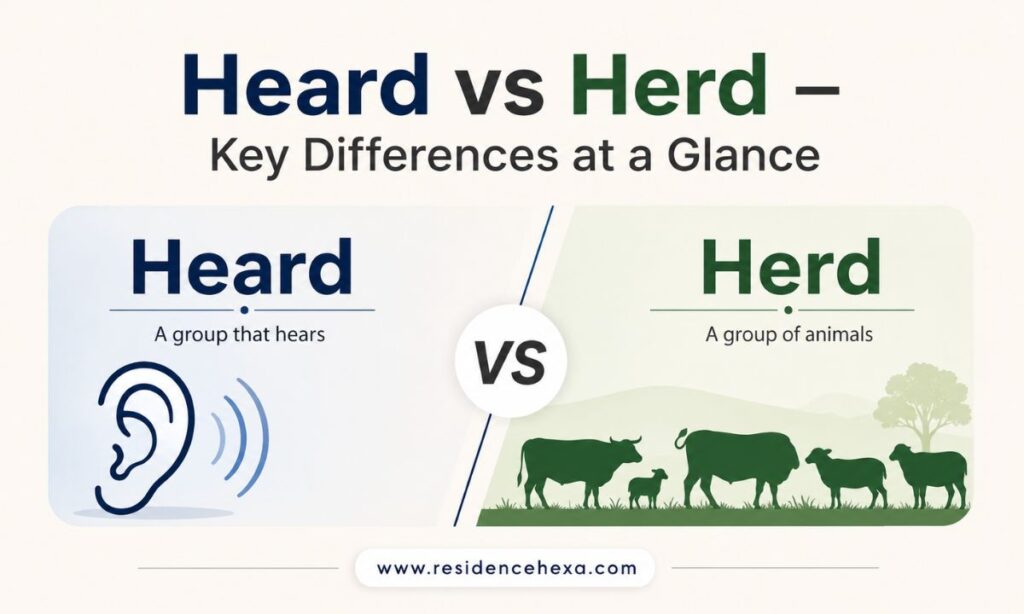
| Feature | Heard | Herd |
| Part of Speech | Verb (past tense) | Noun / Verb |
| Meaning | Perceived sound; past tense of “hear” | A group of animals; to move animals together |
| Context | Listening, communication, sound | Farming, wildlife, group movement |
| Example | I heard the alarm. | A herd of bison roamed the plains. |
| Common Error | Writing “herd” when you mean “heard” | Writing “heard” when referring to animals |
Both words share the exact same pronunciation — /hɜːrd/ — in American and British English. This phonetic similarity is the root cause of so much confusion. Since your ears cannot tell them apart, context and spelling are everything.
Heard vs Herd in Sentences (Examples)
Reading these side-by-side examples is one of the fastest ways to lock in the difference:
Correct Usage — Heard:
- I heard a strange noise coming from the attic.
- She heard about the promotion through a colleague.
- Has anyone heard from the manager today?
- The community finally felt heard after the town hall meeting.
Correct Usage — Herd:
- The rancher managed a herd of 200 cattle.
- We watched a herd of zebras gallop across the plain.
- The tour guide herded the group toward the exit.
- Scientists study herd behavior in migratory animals.
Common Mistakes to Avoid:
| ❌ Incorrect | ✅ Correct |
| She herd about the accident. | She heard about the accident. |
| A heard of deer crossed the road. | A herd of deer crossed the road. |
| I hurd what you said. | I heard what you said. |
| The shepherd hurd the goats. | The shepherd herded the goats. |
Frequently Asked Questions (FAQs)
Are heard and herd pronounced the same?
Yes, both are pronounced /hɜːrd/ — they are homophones that sound identical in speech.
Is “hurd” a real word?
Yes, but only in technical contexts. It refers to the woody core of hemp or flax plants, or it appears as a proper surname.
How do I remember the difference between heard and herd?
Look inside the word heard — it contains EAR, which connects it directly to listening and sound.
Conclusion
The difference between heard, herd, and hurd comes down to one simple question: What are you talking about?
- Heard → Use it when discussing sound, listening, or perception.
- Herd → Use it when referring to a group of animals or the act of moving them.
- Hurd → Reserve it for agricultural/technical contexts or proper names only.
The next time you’re writing and one of these words comes to mind, pause for just a moment. Remember that heard hides the word EAR inside it, and herd belongs on the ranch. With that simple trick, you’ll write with clarity and confidence every time.